
Ten Minutes
By Mike Maddaloni on Wednesday, March 02, 2022 at 07:30 PM with 0 comments

Consistency. Some say it is a sign of complacency, where whatever you do is merely repetition and there’s no change or innovation. I like to think consistency is more of a mindset than whatever it is you are executing upon. To this, I have a now defunct Chinese restaurant to thank.
When I last lived in the Boston area I was in the city of Waltham. It was a city of many faces – its past was industrial manufacturing, among other things the birthplace of the microwave oven, and now the home to universities and high-tech firms along Route 128. That transformation is not complete, as the neighborhood I lived in then was still in transition. I was just off of Moody Street, known as the city’s “restaurant row” as it was zoned for locally owned businesses and the home of some great non-chain restaurants.
Among those restaurants was Hong Kong, a take-out Chinese restaurants just around the corner from home off Moody Street. For myself and my newlywed wife, two working professionals, we frequented ordered from there. As one would expect from a local establishment, we got to know the manager and she always recognized us when we phoned in our ordered and picked it up. Sometimes an order was placed for just one of us, often times both, and we’d also order when entertaining friends. No matter the size of the order, no matter the time, the friendly voice of the manager told us the order would be ready in 10 minutes. Always 10, consistently.
For my wife and I, it was almost comical that any order would take the same amount of time no matter the quantity of food. We were only 10 minutes from a fresh, hot and delicious meal.
New Year, Same Consistency
Soon after moving to the Boston area many years before I learned of the “tradition” of ordering Chinese takeout for New Year’s Eve. The concept was then and likely still is now so popular that you had to place your order days in advance of December 31 to ensure you could get it that night. One New Year’s Eve my wife and I decided to stay in and watch Dick Clark and the ball drop in Times Square, and followed tradition and placed an order days in advance at Hong Kong.
When I went to Hong Kong to pick up our order at the appointed time, I was greeted with the usual warm welcome I was accustomed to from the owner. But the happy expression on her face quickly turned to concern as she told me that she did not have an order ready for me, though she remembers taking the order from me earlier in the week.
Grabbing a piece of paper, she retook my order and proceeded to the kitchen. What followed was a very spirited conversation in Chinese. I didn’t know if she and the cooks were yelling or what, but it was something reminiscent of my Italian heritage, just in another language. After a few minutes she came back to the front counter, smiling, and told me my order would be ready... in 10 minutes! On the busiest night of the year, and at the last minute no less. I took a walk around the block, came back for my order, and went home and told my wife the story as we dove into our delicious dinner.
Deconstructing Consistency
We often see consistency on the surface, however there is likely more as you dig deeper into it. Understanding your product or service, knowing yourself and a commitment to excellence are all part of what delivers consistency. Where the final output may be similar each time, under the hood there is a lot at play that is likely changing and adapting to ensure a consistent end result. Although the Hong Kong restaurant on Moody Street in Waltham, Massachusetts is long gone, its spirit lives on in my own commitment to delivering consistency, and adapting to ensure of it.
This is from The Hot Iron, a journal on business and technology by Mike Maddaloni.
Did you enjoy this? Subscribe to The Hot Iron by RSS/XML feed or Read by Email
Business • Strategize • Thrive • (0) Comments • PermalinkBring Back The Learning Feelin’
By Mike Maddaloni on Monday, January 24, 2022 at 07:33 PM with 0 comments

With no apologies to The Righteous Brothers, I may have lost that learning feelin’, I want to bring it back but I am conflicted as to how I want to bring it back.
Throughout the lockdowns, people around the world were doing new and different things, and one of them was online learning. Some of it was forced, namely when schools closed their doors and moved to virtual. Then there were people like myself, who purposely sought out online learning. Where this was a global movement of sorts, it didn’t start out that way for me, as I would like to share before I go on.
At First, Forced Into It
My first online course was not by choice. I was signed up to take Certified ScrumMaster training in mid-April, 2020 in person. The course was a 2-day program offered at a hotel outside of Milwaukee, and I was planning to stay the night there to get the most out of it.
Without needing to completely restate that painful time, I was later informed the class was going to be offered online instead. Really? How? You couldn’t take any Scrum classes online up to that point, as they were highly engaging with whiteboards and Post-it notes all over the walls. To compound things the company that offered the course wouldn’t allow me to postpone it and said I (ok, my employer) would lose the registration fee if I didn’t show up virtually. As I wrote about shortly after I took the course and passed the exam to be a Certified ScrumMaster I ended up having a great instructor, great classmates and it turned out to be a great overall experience.
So The Graduations Hang On The Wall
After that first class, it felt like everywhere I turned there were online courses being offered – both at work and from learning platforms for free or reduced prices. Some of these platforms offered free weekends, who couldn’t pass that up? As it was alluring I took many courses online, certainly many more than I had in the past.
At the conclusion of most classes, you could download a certificate of completion in PDF format. Where I knew many people who simply ignored them, I collected them like Happy Gilmore did large checks and printed them out, hanging them inside the cabinet doors of my work desk. As the doors only held 6 certs, I would replace older ones with newer ones, keeping the “major” ones up all the time and replacing them all at the end of the year. The picture above is of the certs I just took down that I earned in 2021.
Is The Feelin’ As Intense Now?
Now we are a month into 2022 as I write this, entering year 3 of restrictions that vary depending on where you are in the world. As I worked from home years before it was, um, trendy, my situation is different, coupled with where I live in Northeast Wisconsin. In short, I am out more than shut-in, have more options and with that normalcy I am not seeking out other things to keep me occupied. Towards the end of 2021 I didn’t end up taking many online courses.
When I took down the above-pictured certs, I started thinking more about learning in general, part of which was the catalyst for me writing what you are reading right now. To try to get some of that learning feelin’ back, I recently took a couple of courses offered on LinkedIn Learning. One was on having a more positive workweek, the other on NFTs. As you may guess, I have the certificates from these hanging on the inside of my desk cabinet doors.
Planning To Bring Back The Feelin’
Even with the few nuggets I learned from those 2 most recent courses I tool, they were not really fulfilling to me. Why? I pondered this and realized there was nothing really driving me to take them. I scrolled through the list of courses on LinkedIn Learning and said, hey, this may be interesting. Early on, motivations like maintaining a shrunken amygdala drove me to take courses. Now I need more than them being a simple prop to occupy my time.
So I am working on a plan. The elements of the plan will include what I “need” to learn and what I “want” to learn.
For what I need, it will include video presentations and books on Scrum, as I need to complete education hours in order to maintain my certification. There is also the software and services I will be using in my work to either get ahead on or for just-in-time training.
For what I want, a few are obvious, but I need to put more time into what else I will take. I want to learn more about livestreaming in general, and specifically around the software and hardware needed to take the basics I know to the next level. I also want to learn more about soccer. As a relatively astute swim Dad, I am lacking in soccer, a sport one of my kiddos has switched to and is doing amazingly well at. However I don’t always see where there’s an offsides on the field, and don’t know a lot of the rules and strategy on the sport. Beyond these 2, I am not sure if I want to take on a new hobby or interest, and am open to suggestions from anyone out there in the peanut gallery.
Deconstructing That Learning Feelin’
We should always be learning ... something, whether in formal courses or from real-life experiences. For the former, there’s an investment required, and with any investment it must be done wisely. Even with different motivations and time schedules, I am excited on bringing back that learning feelin’ and want to make sure I approach it with a purpose-driven plan I have the ability to complete. Do you agree?
This is from The Hot Iron, a journal on business and technology by Mike Maddaloni.
Did you enjoy this? Subscribe to The Hot Iron by RSS/XML feed or Read by Email
Business • Strategize • Technology • (0) Comments • PermalinkWhy I Deleted Twitter
By Mike Maddaloni on Wednesday, November 10, 2021 at 08:53 PM with 2 comments
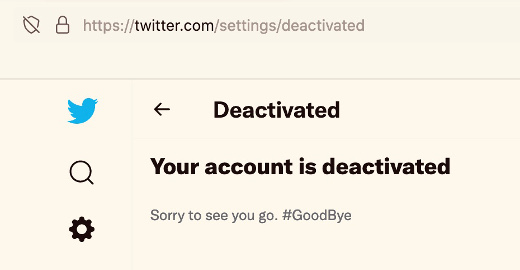
This past weekend I did something I have contemplated for a while but couldn’t get myself to do. I deleted my Twitter account.
Some of you may be surprised, especially those who knew how much I promoted Twitter over the years. Others may not be, especially as I haven’t been actively using my account for well over a year and a half. Though I deleted the app from my mobile phone and stopped checking it several times daily back in March of 2020, I was hesitant to drop it altogether.
But I did, and I am great with that decision. Allow me to indulge why I did, but first how I engaged with social media and its positive and negative impacts on my life.
The Good Ol’ Days... in 2007
Social media in the mid-to-late 2000’s was not completely new, as I had a MySpace page and this blog you are reading was also new to me. As I grew followers and made connections with both platforms, I learned about Twitter, and thanks to my friend and fellow improvisor Christopher, I got an account.
But at first, I didn’t get it. What the heck could I say in 120 characters? And who would want to read it? I slowly started following and connecting with people, and using it as a way to promote my blog. Twitter inspired me to build a Web app that is resting in my project graveyard but even then, I wasn’t using it all that much.
For me, it took seeing Twitter in action – literally – to believe in it, and that didn’t happen for another year when I went to Helsinki, Finland as a participant in Nokia OpenLab. There I met people from around the world who were heavy users of Twitter and other social media channel, and I experienced for the first time a group of people tweeting each other as they sat together. Where that latter fact was not what made me the true believer in Twitter that I became, it was continuing the connections with these people who brought me to the platform and kept me there.Behind the short messages were people, and I got to know people not only around the world but around the corner as well. People who were interested in meeting those whom they only saw an avatar of would host Tweetups – in person meetups of Twitter connections. There are several people from tweetups I still keep in touch with today.
Beyond Shiny to a Utility
As I evolved my use with Twitter, the platform evolved as well. Business, traditional media and more individuals were coming on board, and the “invention” of the hashtag made the platform even more useful. It was becoming my primary source for news, as I could follow networks, stations, newspapers and especially the reporters of those outlets. One example of the power of Twitter was one early evening in Chicago when I saw Blackhawk helicopters flying around the Loop. I immediately took to Twitter, and right away people were chiming in on their own sightings and the media was also on the case. It was a Chicago Tribune reporter who then found an obscure mention on the city’s Web site about a Blackhawk training exercise and shared it. Shortly afterwards it made the paper’s Web site.
Twitter became a customer service channel as well, which truly embraced the collaboration that was a hallmark of social media. Starting with Comcast Cares, an account run by a Comcast employee on his own, customer service evolved on the platform, slashing through obnoxious telephone menu trees to get to the people who could make a difference. This extended beyond business, as my former Alderperson in Chicago was an active user – one day on the way to work I tweeted her a picture of a downed tree in my neighborhood, and on the way home it was gone.
The ability to connect and communicate with people you normally couldn’t or wouldn’t be able to connect with was another uniqueness to Twitter. One time I tweeted to Jack Welch, the infamous former CEO of GE. It happened to be at the time the New England Patriots were in the playoffs, and Welch, who was a Boston-area native, replied to me, “Go Pats!” Though not an intellectual conversation to say the least, it was a pleasant surprise. As I was writing book takeaways here at The Hot Iron, I was able to connect with authors and publishers to share my thoughts, as well as the occasional newsmaker and reporter covering them.
What’s Offline is Online Too
Twitter was not in its own world, as it’s obvious it was made up of those from the “meat space.” Over time I saw Twitter conversations becoming more political and divisive. As this was not just impacting Twitter but other social platforms such as Facebook, driving me to quit that platform years ago. Despite this exodus, I still held hope that Twitter could be different and more tolerable to me.
Over the last 5 years though it was really off the rails for me. I would often joke that, though not a financial advisor, I strongly recommended investing in heels, as people were simply digging their heals in and holding their ground and shouting at others. This was far, far from the Twitter I remembered from almost a decade earlier, and one I was not liking. I went as far as deleting all of my old tweets (after backing them up, for some reason) as who knows what I had said in a short message years ago that I didn’t want to come back to haunt me. Over time I was checking the platform less and less.
The Final Straws
As the lockdowns were taking effect in early 2020 and people were at home, angry, scared, or whatever they were feeling, the tweets were reflective of this. It got to be too much, and I deleted the app from my mobile device. Granted I did not shut down the account, but not having Twitter literally at arm’s length for most of my day was actually refreshing. I would check it maybe once a week from a Web browser, then every couple of weeks, then maybe once a month. As Twitter was also a way for friends to connect with me, I was sharing with them over direct messages, or DMs, my decision and my phone number and email if they didn’t already have it. I didn’t make a big deal publicly of my cutback on its usage though.
In between those checks, I really didn’t miss Twitter. I was still on LinkedIn and starting to experiment with Mastodon, an open source, federated (or shared) protocol of connecting individual social media instances together. I was also blogging more, going back to my “roots” of social media – look at my early posts, and I had many commenters, many more than I do today.
Over the weekend I happened to check Twitter and the only mention I had in the month since I last checked it was a tweet from a complete stranger asking me to DM him about a business opportunity. I paused for a moment, and said to myself this was it. It had been almost 18 months since I retreated, and I really didn’t miss it at all. Sure, the ol’ days were good – heck, even great – but today Twitter has lost its luster. Note that in what I have said so far I haven’t mentioned de-platforming, algorithms controlling what you see and don’t see, and the useless testifying of Twitter’s and other social and tech CEOs in front of Congress. Where these certainly played into my thinking (like not believing Twitter is a public square, rather a private space off of it) I had enough reasons to delete my account, and my proof is with the screenshot at the top of this message.
Will I return? I do have access to other Twitter accounts for organizations that I have helped manage, but personally I don’t see it. But never say never, and who knows what else is right around the corner.
Deconstructing Deleting Twitter
Social media was and continues to be a game-changer for how we communicate in the world, for better or for worse. The opposite of social media is not anti-social, rather I see it as returning to the roots of collaboration that the Internet is. My decision to quit Twitter was personal, but not entirely unique, as I have known others who have quit other social media platforms. Where everyone has their own reasons, there is a common thread of the negativity that is gnawing away at the good that social media enabled. It’s this good that I seek, whether on another platform or with a simple hello to someone, online or in-person.
This is from The Hot Iron, a journal on business and technology by Mike Maddaloni.
Did you enjoy this? Subscribe to The Hot Iron by RSS/XML feed or Read by Email
Announcements • Social Media • Strategize • (2) Comments • PermalinkLower The Minimum Age To Work
By Mike Maddaloni on Monday, October 25, 2021 at 07:49 PM with 0 comments
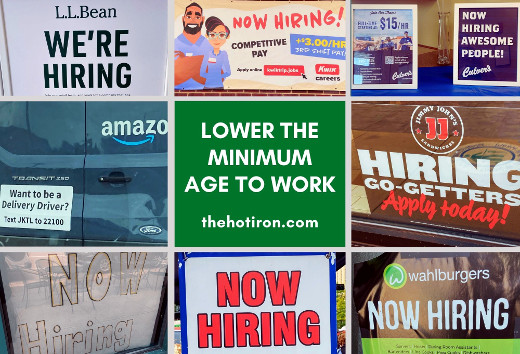
Sign, sign, everywhere a sign... as the refrain from the 1970’s song by the Five Man Electric Band went. Where back in the day the signs related to how people looked, today they relate to how few people are working. When it gets to the point that, when on a family vacation, my kiddos were asking why there were Help Wanted signs in other parts of the country as well as at home, the gravity of the situation is that evident.
There has been no shortage of talk about the shortage of workers, and I don’t mean just after the lockdowns last year – in my little corner of the world in northeast Wisconsin, going back to 2019 and earlier there was low unemployment and many employers then were struggling to hire people. With all that has gone on since, it has been even worse.
With all of the talk, it seems like it is just that – talk. Sure, there are some “standard” approaches to hiring people, such as higher wages, sign-on bonuses and increased benefits. However I haven’t seen much along the line of new, creative thinking to find the right people to augment short-staffed businesses. I have heard of what could be considered desperation, where an employer was hiring people whom they have fired in the past, but that seems like the least optimal situation.
Allow me to put an idea out there that is outside of the standard practices I have seen – lower the minimum age to work.
Where I am sure I am not the first person ever to think of it, and it was not an idea I came up with alone. I have my oldest kiddo to thank for helping me come up with this. Over the summer she was talking about how when she gets old enough she can’t wait to work for her favorite Mexican inspired fast-casual franchise restaurant named after a type of pepper. As an avid consumer of their tasty products, she can picture herself working there in various capacities while earning money and getting employee discounts on said tasty products. But alas, she has to wait, as that business and others have to abide by rules and regulations on minimum age requirements.
That’s when it struck me – could a change in minimum ages to work help alleviate the strain on businesses by making a larger potential pool of available people to work?
Doing My Homework
As I set out to see if my idea was completely off-the-wall or had some merit, the first place I looked was the State of Wisconsin’s Web page on employment of minors. My assumption that every state has information like this, and it may have local overrides – I am not a lawyer, but I’ll get to that in a moment.
At first glance, there are categories where someone under 16 can work and they include everything from agriculture (e.g. bean pickers) to public exhibition (e.g. being Shrek in a play). Searching specifically for “food” and “restaurants” I found only the former, where it is prohibited from being a food slicer as this is considered hazardous. Does this mean my kiddo’s burrito wrapping dreams may have to wait? It’s not completely clear. Recently it was suggested to her by a donut shop owner she met as part of a school program that she could work at the age of 14. Perhaps not making the donuts but selling them?
I further sought to validate my idea, and get the “take” on this from others. To that end I shared this idea with Josh Dukelow, the host of a local radio show Fresh Take on WHBY in Appleton, WI. Not only was he intrigued by it, he included it in a segment of his show where he interviewed a labor attorney about the labor shortage. You can hear the whole segment at the 38 minute mark, and specific mention of my inquiry about lowering the minimum age to work at the 48 minute mark. Of course I would never say an attorney endorsed my idea; she didn’t completely dismiss it but cautioned about the long-term impact of lowering the age.
Labor Still a Hot Topic
As the summer went on and school started, I didn’t think much more about this until last week. That was when I saw the Wisconsin State Senate passed a bill to extend the working hours for 14 and 15 year olds between Memorial Day and Labor Day. This bill is likely to help tourism in the state and take advantage of kids idle time in the summer months. Of course this needs to be passed by the other legislative house and signed by the governor, but I feel this is further validation to the need and a creative idea to solve it.
What do you think – is this a good idea to lower the minimum age to work, or should we just let kiddos be kiddos as they have the rest of their lives to work? I welcome your thoughts in the comments to this post.
Deconstructing Lowering the Minimum Age To Work
Labor laws were put into place and continuously revised to protect workers from poor working conditions. Over time, they also need to take into consideration the realities of the world, including the growth and demand of business and the need for labor to fulfill it. As a kid I delivered the local town newspaper and later worked after school all through high school. Not only was I fulfilling a need of my employer, but I was earning money and gaining a work ethic that has helped make me the man I am. In my desire to explore the change to laws for those under 18, I also wish for them to have the same experience and gains as I to help them through their lives.
This is from The Hot Iron, a journal on business and technology by Mike Maddaloni.
Did you enjoy this? Subscribe to The Hot Iron by RSS/XML feed or Read by Email
Business • Strategize • (0) Comments • PermalinkBe Part Of The Solution If You Can
By Mike Maddaloni on Wednesday, May 12, 2021 at 10:43 PM with 0 comments

For years I’d often say, “I want to be part of the solution and not part of the problem.” This came to be as I’d get into a situation where all I was doing was complaining about it. By removing myself from the chaos in the middle of things to think – perhaps taking a walk along a lake – hopefully I could come back with a way to make a situation better all around. If it takes me to be directly involved and it could to be beneficial to me as well, then I will commit to it.
Over time, however, I have revised that statement to the following, “I want to be part of the solution if I can.”
There’s a few differences from the initial statement above. First, I am removing the declaration there is a problem. Am I in denial here? Not necessarily. In that original statement I (emphasis: me) am saying there is a problem. The fact of the matter is that I (emphasis: me, again) may be the only person who thinks there is a problem!
This has come from experiences where I get involved in something, providing a fresh point-of-view on it and perceive an issue or problem. Note there may well be a problem, but if the consensus of the overall group or community that I have recently joined doesn’t see it that way, or simply thinks things are just fine, then trying to highlight an issue or trying to help solve one may be futile.
Learning the Best Way – The Hard Way
A recent example highlights this. I answered a call to volunteer for an organization I was already a member of to help in live-streaming their meetings. They have already been doing this for a while, but needed more people to help. The idea of this sounded fun and I signed up. The training on live-streaming was in real-time – I and another person observed someone who had set this process up execute on it, all the while following some brief instructions. It was a good thing I brought a notebook as I took several pages of notes above and beyond the instructions. Armed with what was provided and what I wrote, I was ready to take on this task by myself. Or so I thought.
When it came for my first solo live-stream, I followed the instructions to the letter, weaving in my own notes, and thought all was well. When I went to test to see if it was actually streaming (something from my own notes) I found it wasn’t. Panic washed over me as I am sitting here thinking all is working while people are trying to connect to a live-stream that isn’t there! I tried troubleshooting the process, challenging as I didn’t know all I didn’t know, and found that a required field wasn’t filled in, and when I filled it in, the stream started. Twenty minutes into the meeting, but started nonetheless.
Following this screw-up I sent an email to those involved and apologized, then offered to help improve the instructions. I got a response back saying this wasn’t necessary. However I felt it was – as someone who trains people regularly to manage their own Web sites, I felt this enhanced documentation, complete with photos and screenshots, was essential.
Despite the lack of response to my offer, when it was my next opportunity to volunteer, I was ready to further document this process. I started with a new document, bringing in the existing instructions and enhanced them with my notes. I then printed this and brought it with me so I could write in pen the remaining pieces. I also took pictures and captured screenshots along the way.
The only issue was the live-stream didn’t work again. It was a different problem from before, and I troubleshooted it the best I could, but I never got it working. I was furious, but needed to focus. As the video camera was recording the meeting, I knew that would be the Plan B and I would upload the video files later. I double-checked the camera to ensure it was still recording then went outside to get some fresh air, and perhaps to let out a scream or two. When I came back in I checked the camera and it had stopped recording. What? There was plenty of room to record, what could have happened? I resumed the recording, but a key piece of the meeting was never captured. I stewed in boiling water in my mind thru the rest of the meeting, then afterwards I resigned from this volunteer opportunity.
Why did I quit? I saw a need for more documentation, not to mention troubleshooting tips. But nobody else did. Plus I couldn’t put myself through another live-stream failure. Those in charge of this effort, however, felt things were fine. I even heard from the organization’s volunteer coordinator that live-stream issues happen all of the time, yet clearly nobody felt a need for improvement earlier. Where I wanted to be part of the solution, I felt it was a situation I didn’t want to be a part of, and as well I didn’t feel my participation was welcome either.
Unfortunately there have been other situations over the years where I have been in where there was a similar disconnect. I was not trying to impose “my way” rather wanted to make it better for myself, and what I later found out for others too. On the flip side, I have been involved in the past – and currently – in roles where I was able to be part of the solution. And with that I will end this as I need to work on one of those very volunteer roles.
Deconstructing Being Part of the Solution If You Can
Our time is precious, and if time spent contributes to a greater good then it is an overall ideal situation. However we are not mere robots doing a task – we have our ideas and past experiences, and many times we see a way to make a situation better, all the while making a win-win situation. However not everyone is open to that, and in those cases we need to determine if it’s the best use of our precious time, no matter how noble the cause is.
This is from The Hot Iron, a journal on business and technology by Mike Maddaloni.
Did you enjoy this? Subscribe to The Hot Iron by RSS/XML feed or Read by Email
Business • Strategize • Thrive • (0) Comments • PermalinkSubscribe to The Hot Iron



The Hot Iron strives to present unique content and point-of-view on business, technology and other topics by Mike Maddaloni, a technology strategist based in Appleton, Wisconsin.
Photo credit: Logan Connor/Oomphotography
Value for Value
If you like what you are reading on The Hot Iron, buy me a coffee!
About Links
In posts here at The Hot Iron there are often links and banner ads for products and services. For some of these links and banner ads, I receive compensation if you click and/or eventually buy said products or services. Where most links are marked as such, it is safe to assume any link or banner ad is a compensated one.