
Ciao ColdFusion
By Mike Maddaloni on Monday, July 16, 2018 at 05:33 AM with 0 comments

After recently re-reading my post about “retiring” my New England Patriots fan Web site GoPats.com, I realized that with its shutdown, I also took down the last remaining Web site I built using ColdFusion Web technology.
For those of you who are not technical – no fear, as this is not a technical post, rather one about a journey and choices made along the way – good and bad – and where I am today. So you don’t have to tune out just yet!
You Never Forget Your First Web Scripting Language
When I saw the very first graphical Web browser, NCSA Mosaic, shortly after it launched in 1993, I was hooked, and realized this is where I needed my career in technology to go – creating Web sites. Up to that point I was creating reports and screens on mainframe computers and there was nothing exciting about a black screen with white letters. So the playing and experimenting I did with Web sites – including GoPats.com – led to my first Web job a few years later.
For as much as I did to that point, when I started that job I quickly realized I still had a lot to learn. Another colleague at the small consulting firm I was at realized it too, and reminded me of it consistently! Eventually we would become friends and solid co-workers and even did a successful project that pissed off the president of said firm. And it was this colleague who one day early on in my time there asked me if I knew ColdFusion. I said no. He said that I could learn the basics of ColdFusion in an hour, creating a dynamic Web page that queried information from a database and displayed it in the browser. He also said that if I couldn’t do that in an hour that I was stupid! Needless to say I was able to do what he said and within 60 minutes. For me this was a big event, and got me started on more advanced Web site development.
Armed with this new skill, I wanted to use it, but my firm didn’t have any projects that required ColdFusion. So I sought out such projects elsewhere. As I had recently created a Web site for the Boston Jaycees, a non-profit organization I was involved with, I decided to apply ColdFusion code to it, giving the Board the ability to maintain the Web site with ease, and not requiring any HTML or any other coding knowledge. For 1997, this was rather unique. I then applied similar code to GoPats.com and some other personal Web projects, as well as some freelance Web projects I had taken on, work that would expand and eventually lead me to starting my own Web consulting business.
Becoming Web Multilingual
In 1996, as I started working for that small consulting firm, Microsoft didn’t have a Web strategy. By the following year it did, combining its Web browser and scripting language with some of its marketing genius. It was in 1997, when working on a project for a client using Microsoft’s client-server (e.g. PC-based) Visual Basic language, they asked me if I knew anything about the Web. I said yes, and they gave me a Microsoft Web server and its Web applications as part of my responsibility. Only one small thing, I didn’t know anything running a Web server or the language – Active Server Pages (ASP) – the applications were in. This has been a recurring theme throughout my career, but I digress. With the purchase of a few books and some guidance of a summer intern about 10 years my junior, I quickly got up to speed in developing Web pages and Web business applications for the client. Life was good.
All along, however, I was still working with ColdFusion – I had several sites using the technology, plus ColdFusion’s owner, Allaire, was in the Boston area and it had a good user group. There was, however, the beginnings of a change in the landscape. ColdFusion, for all of its ease of use and power, was a commercial product and to run it on one Web server cost somewhere over US$1,000. Microsoft’s Web server and ASP were free. There were other open-source (also free) Web scripting languages I was aware of, like Perl and PHP, though I was not using those at the time. Over time Allaire was acquired by Macromedia who was later acquired by Adobe. Though Web sites written in ColdFusion continued to work just fine even to this day, the Web language fell out of favor for many and they felt it was time to move onto other tools.
For myself, when I started my Web consulting business in 2004, I too was looking at other options, including other programming languages as well as packaged software instead of custom developed applications. This research was done along with the ColdFusion and ASP I was working with for my clients. All of my sites were powered by a content management system (CMS), going all the way back to my first Jaycees site. As time went on I continued to enhance and perfect my own CMS, but at the same time other CMS products came out that allowed me to do what I did best for clients, without the need for developing the CMS itself. Over time I migrated sites to these new platforms, but GoPats.com kept running just fine under ColdFusion.
All Good Things...
As I discussed back when I was doing some major digital spring cleaning and closed down some Web sites, GoPats.com was the last one to go. As updates to the site declined, the cost of Web hosting did not, and is was a cost savings as well. Where I had mixed emotions about this, simplifying the number of languages I was working with and needing to keep up on was also a time savings with all else I have going on in my life now.
So, “ciao, ColdFusion!” It was fun, and we had some great times. Where we may not see each other again anytime soon, we will always have the memories of the pioneering days of the World Wide Web.
Deconstructing Working With ColdFusion
As I said early on, this was not a technical discussion, rather one of choices. We make a lot of them through life and at the time, a good choice may not necessarily be the best one down the road. Though I didn’t choose ColdFusion initially, it worked well for me and I did make decisions about working with it or not over time, until I eventually decided it was not one to continue with. The technology continued to work right up until the end, and I know there is still ColdFusion code working very well today, and you can’t ask for more than that.
This is from The Hot Iron, a journal on business and technology by Mike Maddaloni.
Did you enjoy this? Subscribe to The Hot Iron by RSS/XML feed or Read by Email.


Build • Strategize • Technology • Web Development • (0) Comments • Permalink
Wisconsin Roundabouts To A Native Massachusetts Rotary Driver
By Mike Maddaloni on Monday, July 02, 2018 at 05:33 AM with 0 comments

On a recent trip back to the Boston area I rented a car for the weekend, and as I slipped behind the wheel I also slipped back into Boston driving mode. Or at least as much as I could, as living in the Midwest for the last 15 years has dulled some of my Massachusetts driving edge. As I positioned my hands on the wheel, with my thumb on the horn, I hit the winding roads which were originally blazon by cattle, wagons and marching soldiers. And along the way, I went through a few rotaries.
Rotaries are what they (I?) call out East what I see as a growing occurrence locally here in Northeast Wisconsin, the roundabout. Where they are not anywhere a new invention, and certainly not one solely in the US, roundabouts are being put into place in the area that I now call home, and have been put into place, as the next coming of driving. And they are still going up on roads and intersections.
For someone who has been driving through this type of traffic pattern since I have been driving, I want to share my insights on them from Right to Mid Coast, and how I don’t see what the big deal is.
You Spin Me Right Round, Baby
My definition of a rotary – or roundabout – is a way for traffic to flow through an intersection of 2 or more streets without the need for a traffic light. Cars will approach the rotary, pause for incoming traffic, enter the rotary going around to the right of the center of the rotary, then exit it at the appropriate street. It of course requires everyone to obey these simple rules, and nobody or their cars gets hurt. Simple enough, right?
Growing up in Massachusetts, where most cities and towns predate most of the states in the US, these rotaries have always been there. Sure, some may have been added over time, but the convergence around a circle to get to the street you are heading was nothing new. Fast forward to the times I have been to Wisconsin prior to moving here last year, I have seen roundabouts being created in certainly the dozens over the years, and I hate to say it but to my amusement as well.
My Rotaries Are Not These Roundabouts
The above photo is from a rotary just north of Boston. It a more modern and much smaller sign, as traditional rotary signs were much wider – sometimes 2 or 3 times the width of this one – and much lower to the ground. In other words, when you approached a rotary, you wouldn’t be able to miss it. There also may be a Yield sign as you approach the rotary, but other than that you won’t see any other special road markings or signage that you were entering or going through a rotary in the Bay State. Why? I don’t recall the specific from the road test manual I studied in the early 1980’s.
Moving about 1,500 miles west, you find the rotaries in Wisconsin. Honestly, they are beautiful, and that goes beyond the landscaping. Overhead and side signage greet you as you approach the roundabout. The markings on the signs correspond to the markings on the road, as the road can flare into 2 or 3 lanes, depending on the intersection, on the options you have for going through the roundabout. These lanes continue through the roundabout until you exit it.
As you exit a roundabout, don’t be surprised if there is another one right next to it. Seriously. A whole, completely new roundabout, covering another set of streets including the one you just came in from the last roundabout. Though I don’t have insight into what the roads looked like previously, likely there was another traffic light, and if you are replacing one, then replace them all? Another scenario is you will have a roundabout at each side of a bridge by a highway exit. This “phenomenon” of adjacent roundabouts is something I still can’t get my head around fully, but of course manage to go through just fine.
Since I have moved here I have observed first hand and thru the media as new roundabouts open. One in particular was added at an intersection of 2 streets that had a high accident volume, presuming the roundabout would lessen or eliminate these accidents. However after it opened accidents continued and I personally observed many close calls going through it. Some say it is due to people’s lack of experience with roundabouts and I would agree with that. Though with the signage and lane markings, what to do is almost spoon-fed to you as you enter.
These Roundabouts Are Not My Hometown Rotary
As you may have sensed from the beginning of this, I laugh a bit about the roundabouts here in Northeast Wisconsin. But I have good reason. Many of these roundabouts are at the intersection of 2 or maybe 3 roads. As you approach a roundabout, even with the well-groomed circular island in the middle, you have a clear view of most all of the traffic that is approaching or coming through the roundabout.
It just so happened I grew up in East Longmeadow, Massachusetts, a suburb of Springfield. Where Springfield is the home of the US’s first armory and basketball, East Longmeadow is home to the wicked fast XLERATOR hand dryer and a rotary that ties together 7 streets. Yes, seven. Maple, Shaker, Prospect, Somers, Pleasant, Elm and North Main. You can see it for yourself on Google Maps if you don’t believe me. Seven streets was enough to get it listed in Ripley’s Believe It or Not, and interestingly the submission was by the builder of most of the homes in the town.
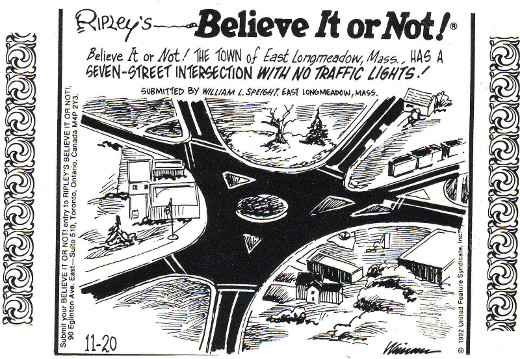
So when you see that car with the Patriots sticker on the back and Wisconsin license plates proceeding through the roundabout with confidence, it didn’t come overnight. When your first driving lesson started on Maple Street and you were headed into the East Longmeadow rotary, you best learn fast.
Deconstructing Roundabouts
The potential for less accidents, faster moving traffic and better fuel economy make roundabouts – and rotaries – a good choice for road improvements. In the short term as roundabout are built there will be both learning and cost curves – the more times you use a roundabout, the better experienced you are with them. But these come at a cost – I saw a new roundabout was well over US$1Million. Hopefully by the time people are used to driving through them the investments by communities in them will have at least broken even.
This is from The Hot Iron, a journal on business and technology by Mike Maddaloni.
Did you enjoy this? Subscribe to The Hot Iron by RSS/XML feed or Read by Email.
Strategize • Technology • (0) Comments • Permalink
Buy Me A Coffee With Ko-fi To Support The Hot Iron
By Mike Maddaloni on Sunday, February 25, 2018 at 11:11 PM with 0 comments

Over the past decade plus that I have been writing here at The Hot Iron, I have mentioned this is a labor of love, writing and sharing my thoughts with you reading it. For most of that same time I have explored options to make a little money from my endeavor, and I present my latest one with Ko-fi.
Buy Me a Coffee, Please
I came across Ko-fi a couple of times in the same day, which prompted me to check into it. It is a free service which allows you to post a button to your Web site or share a link to your personal Ko-fi page, where someone can choose to buy you a coffee, which is in essence giving you money. You can choose to follow others on Ko-fi or have them follow you. You can try all of this yourself by clicking the "Buy Me a Coffee" button on the right column of my blog (or click the photo in this post), or follow this link to my Ko-fi page.
In order for me to receive the money (presumably earmarked for a hot caffeinated beverage) I tie my PayPal account to it, and funds are deposited there. As a result it is a straight cash transaction, and no actual coffee is exchanged in the process, unless I move the money from my PayPal account.
But wait, could there be more?
Where in some regard it is not much different than putting a PayPal donation button or link on my blog, Ko-fi is a unique approach as it is not an ask for cash rather an offer for someone to buy me a beverage. The community around the profile page shows the extent to how folks have supported by coffee consumption, which is usually not far from my keyboard or notebook when I am writing.
Of course when I see something like Ko-fi, the entrepreneurial part of my brain is triggered, and there is great potential for this service. The idea of micropayments are not new, but this is a new, unique way of asking for them. A coffee company - hello, Starbucks or Peet's - could be a sponsor or even an owner of it and tie their current gift cards and mobile apps to Ko-fi, thus making the coffee purchase that much easier to the recipient.
As I mentioned, Ko-fi is in a long line of methods for asking for contributions from my readers. I have had Google AdSense ads on my blog for years, which over time has contributed some but has waned as display ads become almost invisible and blocked by Web browser plug-ins. CentUp was a short-lived service which required you to create an account both to give and receive. Google Contributor offered the ability to block ads from being displayed if you contributed money to a site, but it has been all but eliminated by the search giant. Ko-fi is free, but asks me to buy it coffee, which I have done out of support for it, and to ensure its developers are well-caffeinated when doing their part.
Deconstructing Earning Revenue for Blogging
As the early days of the Web were driven by the free distribution of content, later attempts to earn revenue for content have had a mix of success. Large newspapers and magazines have struggled with earning digital subscribers as their print subscriptions plummet. Attempts at paywalls are met with people finding ways to avoid them and get the content for free. Smaller publishers have also had the same mixed results, most positives coming from extreme niche content. These gaps have driven services like Ko-fi to find a different way to help publishers earn money. Where others have failed, it remains to be seen if a unique payment service could gain traction. If anything, small publishers like myself are certainly cautiously optimistic.
This is from The Hot Iron, a journal on business and technology by Mike Maddaloni.
Did you enjoy this? Subscribe to The Hot Iron by RSS/XML feed or Read by Email.
Blogging • Business • Social Media • Strategize • (0) Comments • Permalink
Penalizing Managers For Giving Bad Reviews As Afterthought
By Mike Maddaloni on Tuesday, February 13, 2018 at 09:48 PM with 0 comments
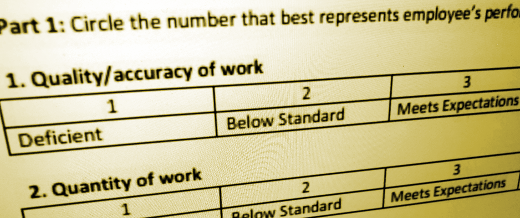
As the new year starts, for many it is also the start of the annual review process with their employer. Where this process varies from company to company, typically it entails creating goals for the coming year, taking into consideration the goals for the team, organization, group etc. and then at the end of the year measuring if you met those goals or not along with feedback that was accumulated throughout the year.
Ask any person who goes through this process and they will likely tell you they would rather spend time standing in line at the DMV! Many people feel it's a waste of time, not only in the fact that they have to spend time working on it but also at the end of the year a couple of things typically happen - one, they don't get a raise or a bonus, and two, for the first time they learn at the end of the year of something that happened months ago or even earlier in the year.
When you get written up on something in December that happened in March, how can you really do anything about it, nine months later, to affect any change? In other words, the performance appraisal process is broken, and I have an idea to fix it -penalize the manager that gives you a poor review or feedback at the end of the year as an afterthought when they had the opportunity to tell you earlier.
Say what?
If you think about it, at the end of the year when someone is giving you a review, their own personal review doesn't necessarily reflect yours. It should, for a manager should be measured on the overall performance of their team, as they should be ensuring their team is excelling at all times. Some manager do believe in this (including, fortunately, the manager I have now), however many managers don't want to be bothered by this throughout the year and as a result giving a poor performance review at the end of the year is really no skin off their teeth and comes naturally to them. Sometimes that poor performance review is based on asking others who have worked with you to provide their input, which is often referred to as a 360° review process. Even when organizations say they have a "immediate feedback mechanism" to let people know when they do well or when they do poorly, it rarely happens this way. Finding out about a problem at the end of the year when there's really nothing that can be done about it serves nobody well.
If the person giving the negative feedback is giving it too late, it is they themselves that should be marked down for it in the end of the year process. This gives the person giving the poor review skin in the game and makes them part of the solution. The whole idea is to inform people at the time something happens that something was unsatisfactory or could've been done better or could've been corrected. When it's given at that point, the person that has the opportunity to make the correction, discuss impacts on their workload that impacts their success, identify the need for education or training or greater organizational issues that need to be addressed that the manager may not even be aware of, et. al. The person and their manager or whomever is giving the negative feedback can then together put a plan in place to lead to success, along with a timeframe and measurement.
Been there, wish it was done
Many times throughout my career I have been on the receiving end of negative feedback too late to do anything about it. When I asked why nothing was brought up sooner, I was never given a definitive answer, namely as the review process did not require it. On the flipside, I have had many managers who gave me continuous feedback, comments, adjustments, etc. as I worked with them, and this was not only greatly appreciated but led to my success and the success of the project I was working on. I also hear this from friends and colleagues that hear of such late-in-the-game feedback they can do nothing about, which simply makes the workplace even less tolerable.
Deconstructing Giving Timely Feedback
Why not strike while the iron is hot, and give feedback while it is fresh, meaningful and can produce a positive outcome? This takes facing issues head-on, something many managers may not be comfortable with or other senior people don't want to be bothered with. By making these mid-game corrections, it allows everyone to succeed, and may also impact the bottom line of the team or organization. This investment in one's team is as important as any training or materials you spend money on them, and can reap even greater rewards.
This is from The Hot Iron, a journal on business and technology by Mike Maddaloni.
Did you enjoy this? Subscribe to The Hot Iron by RSS/XML feed or Read by Email.
Business • Strategize • Thrive • (0) Comments • Permalink
The Secret Life Of Old iPhones
By Mike Maddaloni on Monday, January 29, 2018 at 07:33 PM with 2 comments

When the spotlight was shown on Apple’s “feature” to reduce the power of later model iPhones to compensate for degrading batteries without the owner’s knowledge, the tech giant’s remedy for this, accompanied by an apology, was to reduce the price they charge for a replacement battery from US$79 to US$29. A future upgrade to the iOS operating system will allow owners to disable this “feature” which should close the loop on this issue.
Like any action, there is always a reaction, or maybe 2 or several. In this case, Apple’s reputation has lost a little more of its luster, continuing what many have seen in a decline of their public perception since the death of founder Steve Jobs. No iPhone owner will be surprised if they receive an email or letter in coming months about a class-action lawsuit against Apple. I would add to this an observation I made when I was packaging up and sending in 2 iPhones for new batteries – a new life for otherwise “outdated” devices that may impact their future sales.
Reasons for Upgrade
Whether it’s a car, house, clothing or a smartphone, we all have reasons for upgrading to a newer model when available. On one end of the spectrum are more functional reasons, such as the “need” for new features – in the case of a smartphone, a faster processor or more memory. On the other end are reasons more for “form” or simply the desire to have the latest and greatest of whatever it is. Where I know people in the latter category, I know more that, especially with the rising cost of these devices, are sticking with older models.
Typically, these decisions were merely personal. With the lower battery cost, economics comes into play. By getting a new battery for around $30, you are in essence getting a new, older model smartphone. If you still want to upgrade to a new model, by making a small investment you can conceivably have a more valuable older model device, or one you can pass along to be used by someone else as if it were new.
As the ability to buy a used or new, older model device already exists, the aftermarket for iPhones will now expand with the opportunity for additional devices to be available in it. Or in my case, the demand for buying a new or additional devices has decreased with additional, well-suited devices, available to be reused for a lower cost.
Digital Hand-Me-Downs
Recently I got a new iPhone 8 mainly for the memory, as my iPhone 6’s paltry 16 GB was forcing me to delete apps just to take a few videos of a few minutes in length. And of course, the battery was spent to the point where I had to charge it several times a day, not to mention carrying a spare battery with me all the time. Despite these drawbacks of the 6, it was in great physical condition, and would be well suited for someone else to use.
Such a reuse is going to happen, as the device will be used by a family member who is upgrading from a flip-phone. I have sent it and paid the approximately $30 (I believe there was tax on top of it), once I get the phone back I will set it up for this family member as their more-than-perfect entry into the world of smartphones. Other older models of iPhones are already in use in my family, as my kids use them as WiFi devices and without a SIM card, after I followed what I shared before on how to best setup an iPhone for this purpose.
With the number of iPhones sold over time, there’s a demand for the new batteries. I personally ordered and sent in 2 iPhones, a 6 and a 6S, as I no longer live within walking distance of an Apple Store. Where I sent in the 6 before the 6S, the 6S came back within 3 days. Looking into it, there is a shortage of 6 and 6+ batteries. Apple’s Web site gives me no indication my replacement is pending for this reason though. Once again, a spotlight is being shone on Apple that they have to react to.
Deconstructing a New Life for old iPhones
How will this new life for these iPhones impact the market for new ones from Apple? It’s hard to say exactly. Technology today is made to be disposable, as repair costs will typically cost more than buying a new item. However, with the cost of the new iPhone X at US$999 or even the new iPhone 8 at US$699, paying thirty bucks for a new battery is almost a no-brainer, whether you personally need the device or are looking to sell or hand it off to someone else.
This is from The Hot Iron, a journal on business and technology by Mike Maddaloni.
Did you enjoy this? Subscribe to The Hot Iron by RSS/XML feed or Read by Email.
Mobile Technology • Strategize • Technology • (2) Comments • Permalink
Subscribe to The Hot Iron



The Hot Iron strives to present unique content and point-of-view on business, technology and other topics by Mike Maddaloni, a technology strategist based in Appleton, Wisconsin.
Photo credit: Logan Connor/Oomphotography
Value for Value
If you like what you are reading on The Hot Iron, buy me a coffee!
About Links
In posts here at The Hot Iron there are often links and banner ads for products and services. For some of these links and banner ads, I receive compensation if you click and/or eventually buy said products or services. Where most links are marked as such, it is safe to assume any link or banner ad is a compensated one.