
A Personal Business Dilemma
By Mike Maddaloni on Monday, March 30, 2020 at 10:06 PM with 0 comments

There is a saying that goes, “it’s not personal, it’s business.” Where events occur to the benefit of the business, often times they are done or decisions are made because of the people involved. This following is a true story of a case of the latter.
When I had my Web consulting business, I often partnered with an awesome graphic design firm to develop a Web site. The principal of that firm is someone I met shortly after I started my business. I grew to greatly trust her design and business judgment and enjoyed working with her and her growing firm. Through this we also became friends.
Projects we partnered on usually came as a lead from one of us, and the other would support it. Once such lead was a firm she had worked with for years, providing design services to them and their clients. As she had a very good relationship with this firm, I knew that in partnering with her on this proposal, I surely didn’t want to do anything to jeopardize that relationship. Little did I know I would be put to the test on this.
So far, so good
We had a pre-proposal meeting with the firm and I felt it went well. There were 2 people from the firm, myself and my design partner over the phone. As we started the manager from the firm mentioned he was originally from Boston, as I was as well as my colleague from the design firm, and as a result I brought up the resurgent New England Patriots football team. That personalizing, I felt, went well. Though the other person from the firm in the meeting scowled – perhaps she was a Chicago Bears fan? In any case, it was never my intention to or did I feel I overplayed the connection.
As the meeting progressed we learned more about the current Web site, a portal for their clients, and what they were looking for from the next generation of this technology. During the discussion I asked them for a test user login so that I could go back to my office and go through the site in more detail. When they obliged and gave me one, they also offered for me to have a login for their FTP server; if you don’t know what this means, it’s a rather big deal! They basically have me the keys to their kingdom – FTP stands for File Transfer Protocol and with this login I could access all of the code for their site and even create a local copy of the site to further analyze it. An offer for this level of access rarely happens at this early stage of the proposal process, especially with nothing formal in writing with them.
After the meeting we debriefed and expressed disbelief that we got the FTP server login, then focused on the structure of the proposal and hopeful project. We decided I would take the lead and the proposal would be from my firm. Next we put in the time, created the proposal, reviewed and reviewed it and when we were ready I sent it to the firm by email. And as we did with any such proposal, we would wait. As best said by the late, great Tom Petty, the waiting is the hardest part.
The Unexpected Phone Call
One day the phone rang and it was a friend of mine. I met him through the tech community and we became friends. We never worked on a project together, though we often discussed business, technology and life and were sounding boards to each other. As the call began and we exchanged peasantries I asked him, “what’s up?” There was silence on the other end of the line and I got a sense he was hesitating at what to say. Then he came out and said what I will paraphrase here but this was very close to it. He said, “Mike, I don’t another way to say this, but I just saw a copy of the proposal you sent to that firm.”
Uh, what?
He was prepared for my shock and the crack in my voice, and I could tell he wasn’t happy being the bearer of bad news. However it was something he had to tell me. In short, a friend of his, whom I met previously, showed him a copy of the proposal we had sent to the firm, asking my friend, “hey, don’t you know him (referring to me)?” Apparently the firm had given it to other firms and Web freelancers, asking them to bid on the project based on our detailed proposal.
Uh, what?
Well, that’s not exactly what I said, for my brain felt like it got slammed with a tidal wave. A tidal wave of thoughts, emotions, words, random sounds… I wasn’t prepared for this, but in hindsight it was the best way to hear about it – from a friendly, sympathetic source, when I was in my home office where nobody would see what I could only imagine was also a tidal wave of facial expressions. My friend couldn’t see the tidal wave over the phone but he knew it hit me, as he was just as shocked by this as he created detailed proposals himself, and would have felt the same had our roles been in reverse.
We talked for a bit more, and I am sure he wanted to make sure I wasn’t climbing out on any ledges. After the call I decided to take a long walk as I could use the exercise and mental cleansing that it offered to clear my head before I had to tell my friend the designer what happened.
But before I called her I realized I had a decision to make. How would I react to this? Would I react? Do I just pretend it didn’t happen? Do I confront them? Do I drop it and not contact them? Or do I pursue the project anyway? Or was there some middle ground? The more I thought about it, I decided I would simply drop it. And I could sum it up in one word – relationship.
I was fortunate, as I stated earlier, to have a great working relationship and friendship with her. She had a great relationship with this firm. I clearly had zero relationship with this firm. For myself, there would be truly nothing to gain from this, even if I called them and told them to fuck off! On the other hand, any action I took could have a negative impact on the relationship between her and I, and could have made a bad situation even worse. This of course was my stance, and I was eager to now talk with her as I had come to peace with this unwanted decision.
Another Unwanted But Important Call
When I called her she was actually expecting me to have good news about the proposal, as it had been a while. I don’t recall the exact words I said, but I was pretty much recalled the story as it was told to me. On the other end of the phone was the sound of a similar tidal wave hitting her, with similar shock and disbelief as we both commiserated about this.
Discussing it further, she was leaning towards confronting them about this awkward situation – not in a combative manner, but being matter of fact about it. When I told her about my decision, she was surprised. Not say anything at all? As I explained why jeopardize her established business with this firm as well, it of course resonated with her, but she still felt really bad about what happened. She never thought this firm would act this way as this was never her experience with them. In the end we both agreed to not say anything, and move on.
It’s all good
Eventually we both got over this and went back to work, later collaborating on several great projects. Years later I recalled this event to a friend who is a lawyer who has his own practice and many small business clients. He had a similar reaction as I did to what happened, but concurred with the conclusion. Could I have sued? Sure. Would I have collected enough in damages to make it worth my while? Doubtful. Would the lawyer representing me made any money? Sure, but I digress.
In the end I had a good story and lesson to tell, and a relationship worth keeping, and fortunately no further contact for me with that firm.
Deconstructing Business vs. Personal
Every day we are all confronted with decisions to make – most minor and a few major. Where some don’t require a lot of thought, for those that do, keeping in mind the big picture of where you are and where you are going is paramount. In this case, I stepped back and used that big picture perspective, and I was pleased with the results.
This is from The Hot Iron, a journal on business and technology by Mike Maddaloni.
Did you enjoy this? Subscribe to The Hot Iron by RSS/XML feed or Read by Email
Business • Strategize • (0) Comments • Permalink5 Tips For Those New To Work From Home Due To Coronavirus
By Mike Maddaloni on Sunday, March 15, 2020 at 09:22 AM with 2 comments
 Chances are you are reading this from the comfort of your home. With the declaration of Novel Coronavirus or COVID-19 as a pandemic and declarations of emergencies around the globe, many people are working from home for the near-term. For a lot of them, it is the first time they are working from home for a continuous period of time.
Where working from home isn’t a new concept, not everybody does it. Some companies still don’t have work from home policies. For some industries such as manufacturing, working from home isn’t exactly an option. Even for those people whose employers allow working from home, they may do it once or twice a week, but not every day.
If you are new to this – welcome! I have been working from home continuously for almost the last 3 years and have had a home-based office in the past, so on this topic I have some standing.
Where there is all kinds of advice I can give on working from home for extended periods, I offer these 5 tips to help level-set your experience.
Take a shower – This tip is not as much about your hygiene as it is on your daily routine. Most of us have a routine that leads to us leaving for work, and it is best to continue to do so even while working from home. I do this myself, and it helps prepare me for the day. I then don’t have to scramble if I have to leave the home and go someplace to make myself presentable. Plus, the others in your house will thank you for your cleanliness.
Carve out your space – The ideal work from home scenario would have you in an office with a window and a door that locks that is furnished with the proper desk and chair. In reality, you may be hunkered down on the couch or at best your dining room table. In any case, you need to set space that is yours so that you don’t need to move the kids’ art project in order to create that weekly report. One thing I have done is the past is get some storage bins with snap-locking lids, where I can put my office equipment and supplies and then set them aside at the end of the day, protecting them from other elements around the home.
Don’t obsess over household chores – As you are sitting there, slaving away on your computer on your couch, you may notice more things that need to be cleaned in the house. The carpet could use a shampooing, the furniture is dustier than it should be, and what’s up with all of that laundry? I’m not saying to ignore it completely, but keep it in perspective with the job you still have to do. It’s ok to move laundry from the washer to the dryer during the day and fold some clothes during that status meeting you struggle to keep awake for even when in the office.
Move around – A reality of working from home is that you won’t be moving around as much as you used to. Even if you’re not someone who counts steps and takes the elevator to your office, don’t forget the activity getting to and from the office or within the office will be cut drastically. You don’t need exercise equipment to make up for this, even a walk around the block at lunchtime will help you get some of the body movement you are not getting within the house.
You don’t have to like it – Working from home is not for everyone. Here’s a not-so secret I will share: I am not the ideal work from home person. I am an extrovert, and love working in an office and interacting with team mates to solve the technical problems we face on a daily basis. That being said, all I need for my job is Internet access, my smartphone and a Web browser – not even my own computer – and I can get everything I need to get done during the day. I work from home as we moved hundreds of miles from my office for personal reasons, and where I knew there was an element of sacrifice, I have still been productive and interact virtually with my team throughout the day.
There are a myriad of other work from home tips and life hacks out there, and as I started writing this I saw many myself. I welcome your feedback on these, and if they helped you or anyone else you shared with them to get through this new logistical arrangement.
Deconstructing Working From Home
You too may not be the ideal work from home person, and that’s ok. What’s going on in the world with the reaction to this virus, like anything else going on in the world, is constantly changing. For better or for worse, we as humans have to do the same. Sometimes it’s the small things that need adjustment along with the greater for us to adapt and thrive in changes situations. Good luck.
This is from The Hot Iron, a journal on business and technology by Mike Maddaloni.
Did you enjoy this? Subscribe to The Hot Iron by RSS/XML feed or Read by Email
Business • Strategize • Thrive • (2) Comments • PermalinkDefine The Sandbox For Me To Play In
By Mike Maddaloni on Tuesday, February 04, 2020 at 09:50 PM with 0 comments

“Define the sandbox for me to play in.”
This is a phrase I find myself saying more and more. It is something I have said in the past on occasion, but now it is creeping into my speech with greater frequency.
“The sandbox” I refer to comes from the childhood play thing – a literal box or tray, perhaps a half a foot in depth and a yard square, filled with sand that infants or toddlers would play in. This confined area is designed to keep the sand and the child in a defined space, all the while still allowing them to be creative and have fun.
Later in life the analogy of the sandbox would come into play (pun intended) in my chosen career of software development. Here, a sandbox is an isolated system of servers, network, software and end-user computers and mobile devices where development and experimentation can go on without impacting live software. Though there’s no sand in a technology sandbox, it can easily be as messy.
Thinking Inside and Outside The Box
Many years have passed since my early playing and I have been in all sorts of environments – business, volunteering, social, among others. I have invoked this metaphor of the sandbox as the definition of the overall boundaries or rules of engagement with whatever endeavor I am involved with. In raising this, I am asking for these parameters to be defined, upfront and complete, so I know the limits I am to work within.
In asking for the sandbox definition, I am not looking to limit what I can do. It’s actually the opposite; I want to know the boundaries so I can push them to the limits. When you think about it, there are limits in some way, shape or form in most aspects of life. There’s laws, regulations, policies, traditions, norms, emotions, budgets, physical space, time and design guidelines to name a few. If they exist, let me know them going into whatever I am going to do, so rather than being a hindrance, they are taken into consideration in my planning and actions.
Define your sand-what?
When I speak this phrase – and I find it most effective when spoken – it is often met with puzzlement. What I am asking for is not only something that is not often asked for, but the answer may not even exist, or exist in a form beneficial to myself and others. I am not a perfectionist, and I am not asking for the perfect sandbox either. In some cases, I get various documents or a conversation with someone. When this happens, I try to document what information I have received and as a result am defining the sandbox from these materials. When I do this it is met with some apprehension, especially from those who don’t want to commit or acknowledge the sandbox I have just defined from them.
It’s all play until someone pokes an eye out
Running up against the definition of the sandbox has had both positive and negative results for me in the past.
One time I felt I knew definition of the sandbox, only to find out I didn’t, which had a big impact on my work and emotions. I had to create the technical components of a presentation on a topic, with others creating the other supporting materials. The presentation was short, and I knew I was not going to be able to discuss all aspects of it, so I included external resources for the participants to explore further after the presentation. These resources were Web sites that are known for their leadership on the topic and ones I use myself. However, the day before the presentation, all but one of the links I included was struck from it by the firm’s legal counsel.
Why? They said the sites they had an issue with were run by organizations that also offered consulting services, and by including them it could be implied that the firm were endorsing these vendors. As the firm had strict policies on endorsing vendors, which I found out only as a result of this presentation, these links had to be removed. Period. When I pushed back the lawyers wouldn’t let me finish my sentence.
With the presentation so close, I had no time to find other links to include – I had the best of them, and would have to vet their information thoroughly, as well as ensure they were not offered by someone who was also consulting. So my slide had one link, the one at the bottom of the list, which I had included simply as a reference site. The presentation went on and caused confusion in the mind of some participants, and some told me this. Had I known about this endorsement policy going into it, I would have had plenty of time to rethink my material overall, from what I wrote to what I linked to. But I didn’t, and I couldn’t, and had no fun playing in this tiny sandbox this time.
A more positive example of pushing the limits of a sandbox is when I moved for a more prominent search function on an Intranet portal project I wrote about recently. Even though in this case I didn’t have the full definition of the sandbox in the form of lack of support from my director, I had the confidence that leadership would approve of this change, which they did. Even if it had not been approved, my team and I felt the effort to play to the edge of the sandbox was worth it.
Do you want to play a game?
Even with the sandbox defined for you, it is ultimately up to you if you want to play in it. Though I don’t remember specifically, I bet there were times when I would crawl or jump out of the sandbox as a child. If you do choose to play in it, be aware that on some occasions the sandbox definition may change while you are playing, and this can also trigger a decision point if you want to continue playing or move on.
The decision not to play can be unfortunate for both the person who could have played in it and for the sandbox owner as well. For the owner it can, if they accept it, create a learning moment. Typically a sandbox is there for someone to play with. But what if nobody wants to play in it? The owner – the employer, organization, what have you – has a decision to make. Do they have a sandbox nobody wants to play in?
Deconstructing Defining Sandboxes
I hope the metaphor of a sandbox resonated with your and did not distract from my overall points. In any endeavor there are boundaries. Knowing what they are going into it will make the activity smoother. Changing or just disclosing boundaries late in the process can cause disruption to all involved with the endeavor and can have repercussions to the individuals – the players – and the organization – the sandbox owner.
This is from The Hot Iron, a journal on business and technology by Mike Maddaloni.
Did you enjoy this? Subscribe to The Hot Iron by RSS/XML feed or Read by Email
Business • Strategize • Thrive • (0) Comments • PermalinkMike Maddaloni Featured in Associated Press Article on Amazon Ads
By Mike Maddaloni on Tuesday, November 26, 2019 at 10:04 PM with 0 comments
 They’re everywhere. They’re annoying. But they’re effective.
Where the above 3 sentences could apply to a lot of things, here I’m talking about Internet advertising. From banner ads to text ads to search ads, they are what supposedly finances the Web site you are on, or at least that’s the idea. The earnings from ads here on The Hot Iron this month won’t even buy me an hour of on-street parking in my city. But some ads, especially those found when searching for something, can be very lucrative.
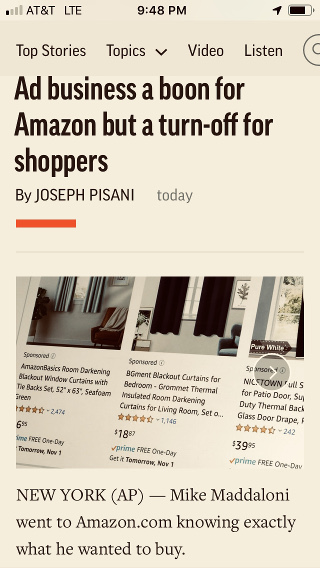
My thoughts on these ads and how they are pervasive on Amazon.com was featured in an article published today by the Associated Press. Titled “Ad business a boon for Amazon but a turn-off for shoppers” by Joseph Pisani, I was one of a few who talked about the ads and their impact on consumers. An example of a recent frustration I had when searching for a product on Amazon opened the article.
I connected with the author through Twitter, seeing a tweet of his asking for people to share their experiences on searching for products on Amazon. The example I stated was real – when I was searching for one product the results showed a different “featured” brand, followed by other brands then 4 or 5 items down the list (differing on various searches) I found the brand and model I was looking for.
Is this type of advertising deceptive? It’s hard to see the small text or icon stating the other items are ads. These days I look for these things, others may just buy the product that paid to be at the top of the list. The ads on Amazon are unique as most all of the items are for sale through the site, and I say that as Amazon even displays paid ads for products on other sites.
The reach of the AP
Articles published by the Associated Press are often carried verbatim or in a modified form on many news outlets. As a result this article can be read on the Web sites for the New York Times, Fox Business, ABC News and even in the Spanish Edition of the San Diego Union-Tribune. Thanks to Jonathan Hoenig for first bringing the article to my attention.
I welcome your thoughts on these types of ads and if they have impacted you, as well as any comments on the article in general.
This is from The Hot Iron, a journal on business and technology by Mike Maddaloni.
Did you enjoy this? Subscribe to The Hot Iron by RSS/XML feed or Read by Email
Business • Strategize • Technology • Web Design • (0) Comments • PermalinkMy Takeaways From The Mueller Report
By Mike Maddaloni on Sunday, September 22, 2019 at 08:01 PM with 0 comments
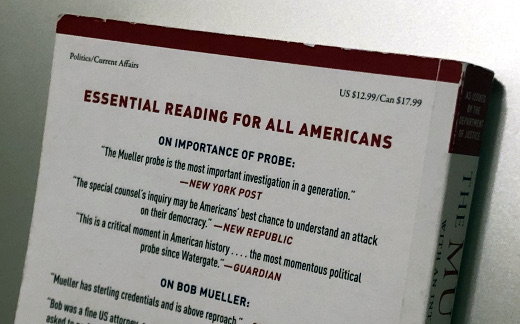
When the long-awaited report on Russian collusion in the 2016 election and obstruction of justice by the Trump administration, better known as The Mueller Report, came out, I was eager to read it. I had enough of the media and political spinning and wanted the information from the source, the Special Counsel’s office lead by former FBI Director Robert Mueller.
When I downloaded the PDF report from the Department of Justice’s Web site moments after its release, I was a little overwhelmed - it was over 400 pages, and I’d have to print it to read, as I certainly wasn’t going to read it on my phone or computer. Staring at the redactions that permeated the pages as I scrolled through it, I thought to myself there had to be a better way to read this.
That lightbulb over my head led me to Amazon, and to my wonderment I saw a couple of versions of said report, which just came out for pre-order. In one click I had added myself to a queue of unknown quantities of people who wanted to read the report the old-fashioned way.
The book, The Mueller Report, The Final Report of the Special Counsel into Donald Trump, Russia and Collusion, arrived a few weeks later, just in time for a work trip. But as I should have anticipated, this was no quick read - written by lawyers, why would it be? Plus I spent as much time reading it on flights as I did talking with people sitting around me, wondering about it as much as I was, so it took even longer.
Eventually I finished the 472 pages of the book, which was longer than the report as it included extra materials, such as the powers of the Special Counsel. The report itself was shorter than the original for instead of showing 33 redacted physical lines, for example, it just mentioned 33 lines were not included. My takeaways were mostly on the content with a little from the report itself.
Details on what was being called hacking – As someone who works in Web technology and social media, it was not enough for me to just hear there was “hacking,” for I wanted all the details of what was being called that. What was in the report satisfied that to a certain extent, listing accounts on Twitter and Facebook and what was posted and by whom. Where I wouldn’t necessarily call it hacking, I do believe there was a deliberate attempt to influence people. However as no analytics were presented with the account activity, it is open as to its effectiveness.
Michael Cohen was Executive Vice President of Trump Organization – In any press mention of Donald Trump’s personal attorney I ever heard, I never heard of his title in Trump’s business. I heard he was a personal lawyer, fixer, handler, bodyman and various other labels that were slang not to compliment him. Granted you can give anyone any title in your own business, but if EVP was his title, why did the media never use it?
The infamous Trump Tower meeting yielded nothing – There was a lot of talk about a June 9, 2016 meeting among Donald Trump Jr., Trump’s son-in-law Jared Kushner, then-campaign staff member (and later campaign chair) Paul Manafort and representatives from Russia. But after reading the testimonies from those in the meeting and what followed it, nothing came from it. Was their intent? That wasn’t even clear as it seemed like if there was to be some collusion, these weren’t the people capable of colluding!
Speaking of which, collusion wasn’t even considered – On pages 167 to 168 of the book it states, and I quote, “… this Office’s focus in resolving the question of joint criminal liability was on conspiracy as described in federal law, not the commonly discussed term ‘collusion.’” So all this time - years - and all of everyone saying collusion, and the label wasn’t applicable? And none of the TV talking heads who are lawyers knew that?
Richard Pinedo was jailed for fake bank accounts as a result of the investigations – There were other charges against others, but I heard very little about it in the mainstream media. One was Richard Pineda, who was sentenced to prison for providing fake identification information to the Russians who were running the “hacking” social media campaigns. Presumably this information was used to eventually make payments to social media sites like Facebook and Twitter for promoted posts. Perhaps information on Pinedo was released to the media, and they chose not to promote it widely?
Trump didn’t “recall” a lot in his responses – The book includes the written responses to questions sent to President Trump in lieu of live testimony by the office of the Special Counsel. Most of them began with “I don’t remember” or “I don’t recall,” all of which did not come as a surprise to me.
I got lost a lot in the second part – The second part of the report was focused on obstruction by President Trump and his staff. Much of this presented a case, then a very long description of the applicable laws and case laws that applied to the case followed by a conclusion. This was a difficult read for me as it consisted of so many legal terms, as well the phrasing of legal descriptions doesn’t exactly follow any rules of prose. As I am not familiar with any of these laws and case laws referenced, there was little meaning to reading the middle of each case, and as much as I tried not to, on occasion I skipped to the end.
If you are interested in hearing something from the horses’ mouth, as the phrase goes, I would recommend reading The Mueller Report yourself. Again it is not a quick read, and not always an easy one, but everything is in there in its source that has been translated by the media for the general consumers.
As I give away every book I read, I will give this one to the first person who makes a comment to this blog post. Don’t post your address, as I will follow-up with you outside of this. Note I have moderation on comments, and they will not appear right away. This offer is open to anyone, anywhere in the world. Make sure to follow the comments to see if you are the lucky winner!
This is from The Hot Iron, a journal on business and technology by Mike Maddaloni.
Did you enjoy this? Subscribe to The Hot Iron by RSS/XML feed or Read by Email
Book Take-Aways •
Strategize •
(0) Comments •
Permalink
Subscribe to The Hot Iron



The Hot Iron strives to present unique content and point-of-view on business, technology and other topics by Mike Maddaloni, a technology strategist based in Appleton, Wisconsin.
Photo credit: Logan Connor/Oomphotography
Value for Value
If you like what you are reading on The Hot Iron, buy me a coffee!
About Links
In posts here at The Hot Iron there are often links and banner ads for products and services. For some of these links and banner ads, I receive compensation if you click and/or eventually buy said products or services. Where most links are marked as such, it is safe to assume any link or banner ad is a compensated one.