
Literally Promoting Search in 1999
By Mike Maddaloni on Tuesday, September 10, 2019 at 09:56 PM with 1 comments
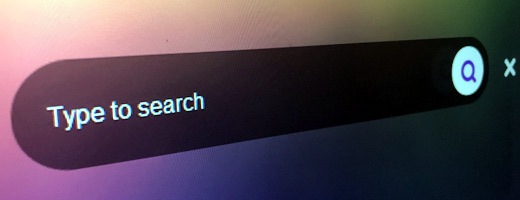
It’s been said if you can’t find anything on the Web by searching for it, it may as well not even exist. Since Google’s launch over 20 years ago that has certainly been the mantra, as their single search box with precise search results trumped all other search engines out there to become the dominant search destination it is today.
Around that same time, I felt the same about search, but on a slightly smaller scale, though with an international reach. I was literally promoting search for the Intranet portal for a global professional services firm in 1999.
Search Hidden and With Good Reason
In 1999 I became the manager of the front-end development team for this portal, which meant I was responsible for leading the team creating and enhancing its Web pages. As part of the role, I had to evaluate the functionality and design we had already, as the portal was being developed by a consulting team that was rolling off the project. When I evaluated the search function, by my best approximation it was poor to non-functional and of no value to anyone using it.
As I quickly came to learn, search was not a priority for the portal. The business sponsors didn’t even want people to simply search for content, rather to use a complex, nested set of 3 drop-down lists to select a category for which content would be presented. If that sounds convoluted, it was. The categories, or taxonomy, mirrored the structure of the firm. The idea was you would navigate to where you “worked” and voila, there would be content waiting for you.
Or so one would think, however this wasn’t always the case. Many times there wasn’t any content there, especially in the early days to months of the portal. But that wasn’t that my concern, as we had an entire other team working on getting content into the portal. The concern for my team and I was to ensure the front-end of the portal worked and was usable.
There was no real urgency to make search function well and have a great user experience as accessing it, as it was literally tucked behind an unlabeled icon of a magnifying glass on the second page of the portal, one you would miss on first glance. There was an option on the first page of the portal prominently labeled search, but it simply led users to a list of public Internet search engines, such as Lycos and Yahoo. Remember, this was 1999.
A Better Way to Content
After the launch of the portal, we decided to tackle search. The task of working on the search engine went to our top developer. He had both a programming and mathematics background, and was eager to get search working. After some time, he was successful, and it was a highly functional and useful feature of the portal, though most people still didn’t know about it. We added a text label to the search icon and others near it where it wasn’t obvious what their functions were. Even then, you had to click the icon which took you to another page where you got a search box, adding steps (aka barriers) to get to the content you want. Over time we found that portal users were using search, and we on the development team used it to validate testing for content. Even with this new label, search was still not a prominent feature on the site, nowhere to the degree I felt it should be.
Making the Case for Search and navigation
With the initial launch of the portal and other changes including the search function behind us, it was on to version 2.0. There was a laundry list of features wanted for the portal, and one was a new user interface. As my team worked through designs and functionality, they proposed putting a search box in a prominent position on the Web site, at the top left corner, literally promoting it from obscurity. Studies of people using Web pages have shown consistently over the years people start at the top, go across the top and down the left side. By placing the search box and button at the top left, there was no extra step needed to get to search results.
I was pleased with the work and designs we put together, and then we started the process of presenting it up the food chain of the leadership for review and approval. We knew we would have tweaks and adjustments to make, but we were hopeful much of the work we did would persist, especially search.
When we presented it to the director of the development team, my direct manager, he liked it. The next step was to present it to his manager, who was the overall director of technology. But he didn’t like it. He felt it went against the goal of navigating to content and wouldn’t be approved by the top leadership of the team. We pointed out the 3 drop-down lists remained, and people could still choose to use them, as well as the work we did to improve the search function. My director was also reinforcing this, from a usability standpoint, so the busy consultants in the field could get to the content they wanted. After hesitation he agreed we could present the search box design to senior leadership but that he would not back us up on it. This was fine by me, as myself and my director would be the ones presenting it.
Shortly after this less than exciting meeting, we had the meeting with the senior leadership and business leaders for the portal to present our proposals for version 2.0. We were in a beautiful and expensive conference room with cutting-edge functionality, very expensive for that time. We had an orchestrated presentation where myself and my peers would be presenting their team’s work on the next version of the portal, with the onus on me to present the new design and the search box.
When it was my turn, I was ready – the design was cleaner and more modern, at least for standards of that time. As I presented it, I talked to the major features in priority order, and search was near the middle of it. When I brought it up, I talked to the search improvements we made, the gain in traffic to the search page and how users could still navigate to it as they have before. As I finished saying this, I saw the director of the technology literally turn away from the table, though I don’t think anyone else noticed it. As I concluded the lead partner who oversaw the entire portal looked down, and I could tell he was thinking it over. He said he liked it. Relief doesn’t begin to describe the feeling I had, and I was excited for the meeting to end to share the great news with the team.
Another Search Goal Fulfilled Years Later
As we worked on version 2.0, we did a lot of talking about the future of the portal and how it could be enhanced. I had the idea of putting a “header” or section on the pages of other portals within the firm. This header would be a thin bar across the top of the page with links back to our portal as well as a search box. It was an idea that was batted around my team, but one I was not there to even take to any design phase, for not long after version 2.0 was released, I left the firm, being lured by a dot-com startup that folded a mere half-year later (and a topic for another time).
About a half-dozen years later, my wife got a job with this same firm, but working with a consulting practice. In between those years the portal itself had gone through significant change, namely not being the focal point for the firm it was previously. One night as she was catching up on some work at home, I looked over her shoulder to see what she was doing. Much to my surprise she was on a page of the firm’s Intranet, where our portal had lived, and across the top of the page she was on was a header bar similar to what I just described. Needless to say it made me smile, and I was patting myself on the back as I walked away.
Deconstructing Promoting Search
Technology and the way we interface with it is always changing. New ideas must be encouraged, embraced and tested to truly see their effectiveness. Search is one of those areas, and its importance is even more important today. In this case the functionality of the search box was not the innovation, rather promoting it to a position of prominence on the Web pages. Where I cannot take credit for the design of the header bar that evolved over time, it in itself was an evolution of what we started with and presented with mixed results now over 20 years ago.
This is from The Hot Iron, a journal on business and technology by Mike Maddaloni.
Did you enjoy this? Subscribe to The Hot Iron by RSS/XML feed or Read by Email
Business •
Strategize •
Technology •
Thrive •
Web Design •
(1) Comments •
Permalink
Get Out
By Mike Maddaloni on Thursday, August 01, 2019 at 09:52 PM with 0 comments
Yesterday was a crappy day. Problems by someone else at work consumed my time to rectify it, which took away from the things I needed to do and am still catching up on. Then on top of it I offered to help a friend after work who had some trees get knocked down by storms a week ago.
Interestingly, it was helping with the trees, something I wouldn’t normally do or think I would enjoy otherwise, that brought back the spark that was snuffed out during the day.
Godzilla vs. The Mighty Oak
If any of you reading know me, you are probably already laughing at the fact of me helping someone with fallen trees. Even my own kid said that I am not known as a nature person. As I responded to my friend this thought came to mind, but I offered as it would certainly be a case of strength in numbers, plus my friend and others helping knew of my, well, affinity to nature as well.
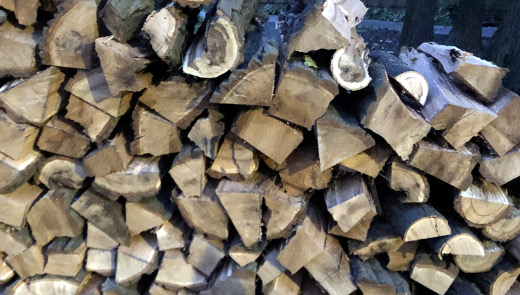
Getting to his house meant passing downed trees for literally a mile. When I pulled into his place, a couple of other friends were helping him split the last of a few logs off the driveway. Though I was a little late, I was just in time, as the next task was to tackle a giant oak – 30 feet if it was not 100 – that was in his backyard. If you are unfamiliar with oak, it’s heavy, and as it was a recently fallen tree, it was still “alive” and full of moisture, which when it dries out will make it a little lighter.
After helping to wheel the log splitter down the slope of the backyard – no small feat in itself – it was time to start splitting the tree. It was cut into segments with chainsaws, and then the arm of the log splitter, named Godzilla, would scoop up the roughly 2-foot segments to be split. Splitting the logs, which were anywhere from 6 inches to almost 2 feet in diameter, required multiple passes through the splitter, which is a hydraulic press that forces the log into a sharp wedge. Splitting a large, heavy segment into 2 made for 2 slightly smaller and slightly less heavy pieces, which needed to be further split, hauled and stacked. All of this for one segment, only to repeat for each one. Lather, rinse, repeat.
I was assigned the task of operating the splitter, as the other guys used chainsaws to cut up the tree, and then were doing the stacking of the cut pieces. Where I never used a splitter before, I certainly didn’t use a chainsaw either. As the splitter was stationary and straightforward to operate, I guided Godzilla in the splitting of this fallen tree for winter firewood.
Where I certainly would have failed a log splitting efficiency test, after several pieces I was getting the hang of it, and frankly found it to be fun! I was nowhere near as agile \ as my friend whose backyard and tree this was, but as he said he was splitting wood since childhood, I wasn’t worried about speed. Plus I wanted to make sure I kept all of my fingers on each hand.
As the last flickers of light from the sun shone on us, we wrapped up the last piece of this mighty oak. What started out as a Herculean task without a solid plan turned into an achievement of firewood and, for me at least a great sense of accomplishment… not only in completing the task, but in completely forgetting about the crappy day I had earlier.
Changes in Latitude
Afterwards talking about task we wrapped up, over beers and brats, I commented on how much fun this was for me. Much of my time is spent within my comfort zone. I don’t necessarily plan or go out of my way to ensure I am in that comfort zone, but it’s where I end up spending my time. Getting out of it, in a heavily wooded area that looked nothing like where I live but a mere few miles slightly north of me, is what the doctor ordered for this day.
Where I may not be adding log splitting to my LinkedIn profile anytime soon, I am certainly up for the task in the future.
Deconstructing Getting Out
In the past I have written about how we all have our place and to play to your strengths and in many cases that approach to things still pertains. The scenario I was in was not in my mind a great risk. Granted if I was goofing around I could have easily chopped off a digit or 2. But going in with a base level expectation, doing something I had never done before and doing it well, adjusted me not just for that day, but a little on what lies in the days ahead. And perhaps it can for you as well.
This is from The Hot Iron, a journal on business and technology by Mike Maddaloni.
Did you enjoy this? Subscribe to The Hot Iron by RSS/XML feed or Read by Email
Diversions •
Strategize •
(0) Comments •
Permalink
JFK Movie Park Bench Moments
By Mike Maddaloni on Wednesday, February 13, 2019 at 02:38 PM with 0 comments

Have you ever been in a situation where you had a hunch about something but weren’t quite sure of it, only for someone to come along and not only reaffirm your hunch but get into details you wish you had not known?
How about this happening to you more than once?
These situations are what I refer to as “JFK Movie park bench moments.” They have happened a couple of times in my career, and I’d like to share these here.
But first, the movie scene
If you have no idea of what I am talking about, let me explain. JFK is a movie starring Kevin Costner and directed by Oliver Stone that came out in 1991. It was about the assassination of US President John F. Kennedy through the eyes of the District Attorney of New Orleans, Louisiana, Jim Garrison.
When Garrison discovers a possible connection to JFK’s murder in New Orleans and his investigation goes public, he travels to Washington, DC to meet someone called “X,” played eerily by Donald Sutherland. They meet around the Washington Mall and sit on a park bench where X proceeds to tell Garrison that not only is he on the right track with his investigation, but provides details about it that are almost too incredible to believe. Of course when Garrison asks X to testify in his trial he says no.
Fast forward a few years
I always remembered that scene from the movie as was so unique – 2 men, sitting alone on a park bench away from – but close to – so many, with one learning the “straight dope” of what led to JFK being shot in Dallas, Texas from the other. This scene came back to me a couple of times in my career after first seeing the movie, when I found out about truths about jobs I had that, in both cases, convinced me to leave before I would have been terminated!
The Numbers and People Lie
After finishing a long-term consulting project with a firm I was working for, I went back to the firm’s office on a weekend to take care of some paperwork. When I printed a few things I grabbed the printouts from the printer only to also get some reports left on the printer by someone else. Among them was a revenue report showing me at the top of the report. Where one’s ego might be stroked to see that, my hourly rate was extremely low for the senior role I had managing the project I just left. Further down on the report were many people who were not bringing in any revenue at all.
Was all I heard about how well the firm was doing a lie? The next week I went to lunch with another consultant at the firm. Armed with the knowledge of this revenue report but not wanting to disclose it, over the meal I asked him how he thought the firm was doing. Thank goodness I have a strong stomach, as I would have tossed it up my lunch after our conversation. The modest cafeteria we were in served as the park bench and grassy for my JFK movie moment as he told me what he knew about the vitality of the firm.
This was eye opening, shocking, yet gave me a great calm in the next steps I took to leave the firm, which I did a few months later. Another six or so months after I left, the firm itself shuttered, leaving some smart people caught in a reaction to my earlier pro-action, scooped up by other lucky companies soon after.
Building the ship while it is sailing is not a good idea
Later in my career I took a leadership role on a high-profile project for an international firm. As one of the first people to join the project team, I not only had the good fortune to be able to build my own team from the ground up, but was involved in much of the interviewing across the project, helping to ensure people who joined would work well in our culture.
Early on I met with one of the senior leaders of the team, who gave an analogy in describing what we were doing that I would never forget, as he said we were “building the ship while it is sailing.” Where initially I saw this as a great opportunity, this feeling waned over time as I felt those sailing and building were far from being in sync.
There were a few managers on the project I got to know – some better than others, and one night as I was departing the office I ran into one of the managers I knew well. We chatted a bit, then felt a local pub would be a better venue to continue our conversations. After a few beverages and some good food we departed for home heading in the same direction. He was staying in a corporate apartment in a place I could never afford.
He invited me to check out said apartment and to continue our conversations. I sat in an oversized leather chair, he poured a couple of glasses of Hennessey, placed the bottle down, and then I sensed another JFK movie park bench moment in the making. He proceeded to reaffirm a lot of the concerns I had on the project, and blew me away with the history and politics of the project, and his projections for where it was going to go. Needless to say that bottle of Hennessey didn’t last long as the tales of international intrigue flew around the room.
But like before, as uncomfortable as it was to hear, it was exactly what I needed to hear. The next morning, as bleary eyed as I was, I started my quest for a new gig which I landed a few months later. Sadly within a year the whole project was shutdown, after a tumultuous ride for the dedicated team that stuck around through it all.
Deconstructing JFK Movie Park Bench Moments
Life has many mysteries. Some of them we find out, but many we go to our grave never knowing the real story of what went on. Whether or not what X was telling Garrison in the movie was completely true or not – and we may never know either way for sure – the drama of the moment stands out and can be a catalyst for action. For Jim Garrison it was to pursue the truth of the JFK murder, for me it was to find new jobs. What could it be for you?
This is from The Hot Iron, a journal on business and technology by Mike Maddaloni.
Did you enjoy this? Subscribe to The Hot Iron by RSS/XML feed or Read by Email.
Business • Strategize • (0) Comments • PermalinkMy Guest Lecture at University of Wisconsin – Oshkosh on Consulting
By Mike Maddaloni on Wednesday, October 17, 2018 at 05:06 PM with 0 comments
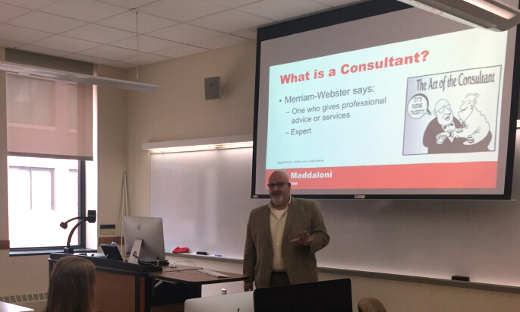
Great interactive classroom instruction coupled with real-world work opportunities provide the best educational experience for students. When you have the chance to help make that happen, it’s extremely rewarding. That happened for me recently as I was a guest lecturer at a university class.
I was honored to be asked once again by Dr. Sara Steffes Hansen, a professor at University of Wisconsin – Oshkosh and chair of the Journalism department. Her class, Application of New & Emerging Media, provides that educational experience working with entities in the community on their social media and beyond. As her students make on-site visits to their clients, I was asked to speak to the class on the topic of consulting.
Last year I spoke to students in the same class, but after their client visit, where this year it was ahead of it. As meeting face-to-face with clients involves many factors – factors many don’t execute on well – I incorporated a role play into the interactive lecture. With a “volunteer” student, I did an improvised sketch where the student was the client and I was the bumbling, unprepared consultant. This segued into my discussion on preparing for and executing on the on-site visit, as well as the follow-up and deliverables from the class assignment.
For me, this guest lecture served many purposes. As I have learned from others, both in the classroom and in the real world, I welcome the opportunity to share my experience and “war stories” with the students. As someone who still thinks and works like a consultant, poor consulting skills from others stick out like a sore thumb soaked in sriracha and lit on fire! If this lecture can help guide students down the path of honing their consulting skills, then the world will be that much better.
This class is part of the UW – Oshkosh’s Interactive Web Management major, which is a combination of curricula from Computer Science, Marketing, Journalism and Information Systems. It is a unique major, mashing up key aspects of each of these areas to offer a comprehensive educational background for how companies today are staffing roles in marketing and tech.
Where you needed to be enrolled in the class to get the full lecture, I am sharing my slides. You can link to the slides from my guest lecture here on SlideShare, or view them embedded below. I am planning on coming back to the class at the end of the semester to watch their client presentations. In the meantime I wish great success to the students of Journalism 61-440!
This is from The Hot Iron, a journal on business and technology by Mike Maddaloni.
Did you enjoy this? Subscribe to The Hot Iron by RSS/XML feed or Read by Email.


Announcements • Business • Strategize • Technology • Thrive • (0) Comments • Permalink
Talking About Fake News in 2004
By Mike Maddaloni on Tuesday, September 11, 2018 at 05:33 AM with 0 comments
It seems everywhere you look today you see something about fake news, from those calling something fake news to those who are defending themselves for not being fake news. However, the idea of fake news is nothing new, and as a matter of fact it was something that I was talking about publicly into 2004.
Yes, I said 2004, 14 years ago from now.
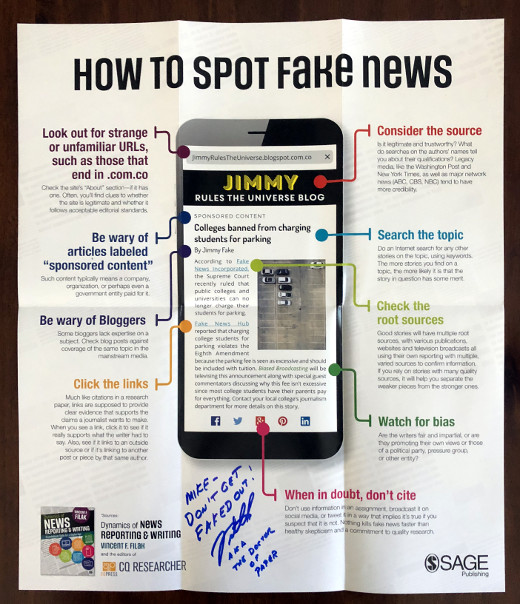
So why would I remember today what happened a decade and a half ago? Interestingly I was triggered to recalling it from a poster by a colleague of mine, Dr. Vincent Filak, professor of journalism at the University Wisconsin – Oshkosh. The poster is about how you can spot fake news and was created as a complement to his recently published collegiate textbook, Dynamics of News Reporting and Writing: Foundational Skills for a Digital Age.
Now let’s take a trip back along memory lane and talk about how even then I realized this was an issue that would be impacting not only news but the Internet and the Web as well.
Back in time
In the spring of 2004 I was asked to speak at the annual conference for winners from Massachusetts of the Hugh O’Brien Youth Leadership Award, best known as HOBY, that was taking place at (then) Babson College in Wellesley, Massachusetts. I had been a recipient of the award back in the 1980s when I was a high school sophomore and recently I had connected with the state HOBY organization in Massachusetts because of something I had written. Shortly after the death of retired New England Patriots player Ron Burton, who after leaving the football gridiron was a champion for charitable causes in the Boston area including the HOBY award, I had written about him on my former Web site GoPats.com – as I have retired that Web site, you can read the original article I wrote on Burton here thanks to the Internet Archives’ Wayback Machine.
After connecting with the HOBY organization about my article, they asked me to speak at their 2004 conference for 2 purposes, one as part of a remembrance of Burton and to participate in a panel about the media. The panel was would consist of Steve Burton, a Boston sportscaster for WBZ-TV and Ron’s son, sportswriter Dan Shaughnessy from the Boston Globe and myself, a technology strategist representing the Internet. I was honored to be asked to speak to the students, and I also realized the challenge of representing the Internet along with two well-known journalists, but I was up to the challenge.
As the conference began, following a video tribute of Ron Burton which included a video from Hugh O’Brian himself, I gave my tribute, talking about the 2 times I met him over the years. Next up was the panel on the media, with myself, Burton and Shaughnessy. Each of us had a few minutes for an introduction to talk about our expertise. Burton spoke first, then Shaughnessy and finally myself. As I listened to their opening statements I felt a little intimidated representing all of what the Internet was and is, but is someone who is been working with it professionally at that point for over a decade, I felt very comfortable and confident in sharing my knowledge to these young people who themselves never knew a time without the Internet.
Following this was a Q&A session where the students asked a lot of great questions. One in particular that I remember was on believing what you read online. First Burton spoke, and what I recall from his comments was him talking to journalistic integrity and how on television you had to make sure to get it right the first time, for even if you have the opportunity to retract it later, many people may not see that retraction as you would in a newspaper. When Shaughnessy spoke, he took more of a cavalier approach; I remember him started out by saying that you really can’t believe anything you read on the Internet. This was not surprising to me because this reflected his writing style, which I consider arrogant, and is why I only occasionally read his columns.
After his comment about not believing anything you read online, and while he was still talking, I reached into my blazer pocked and grabbed my PalmPilot handheld device (remember, this 2004 and PalmPilots were what we used back then!) and I opened up the Web clipping app for the Globe, Boston.com, and brought up an article was written by Shaughnessy about the Boston Red Sox that I had just read that morning. When it was my turn to respond I held it up my PalmPilot and, in a casual way, pointed out I had read Shaughnessy’s latest article online and questioned if I should believe it! He was a little taken aback by my opening line.
I continued my thoughts to the students by simply saying you should know your source. Whether you read it online or watch it on TV or read it in the newspaper, you should have an idea of where the information is coming from, and if the method you are reading it is a reputable one. I reinforced the point by saying if you are unsure, you should ask someone – a parent or teacher – and in any case they should take what they have consumed and form their own opinion. This approach is something I keep front of mind and share with others to this day.
And thus a modern journalism guide triggered me to remember that event from so long ago in context to today. To build on that, I not only try to understand the story but the headline as well – there are many Web sites and sources that deliver what ends up being misleading headlines in the hopes of you clicking on them, reading whatever the story is about, and in the process gaining ad impressions on their Web site. I have found these “fake headlines” linking to stories by legitimate journalists I am familiar with, only to read a story that doesn’t match the headline. Knowing your source is not only more involved but vital today.
Deconstructing Recognizing Fake News
Sadly I believe the idea of fake news has been around even longer than before I did my talk back in 2004. The concept of yellow journalism and opinions by early newspaper publishers have tried to influence readers for years. In a digital world where it takes much less resources to disseminate news – real or otherwise – being able to decipher the true from the fake has a greater importance. Where some look to the media companies and the government to solve this problem, the ultimate responsibility falls on ourselves. Buyer – or reader – beware!
This is from The Hot Iron, a journal on business and technology by Mike Maddaloni.
Did you enjoy this? Subscribe to The Hot Iron by RSS/XML feed or Read by Email.
Business • Strategize • (0) Comments • Permalink
Subscribe to The Hot Iron



The Hot Iron strives to present unique content and point-of-view on business, technology and other topics by Mike Maddaloni, a technology strategist based in Appleton, Wisconsin.
Photo credit: Logan Connor/Oomphotography
Value for Value
If you like what you are reading on The Hot Iron, buy me a coffee!
About Links
In posts here at The Hot Iron there are often links and banner ads for products and services. For some of these links and banner ads, I receive compensation if you click and/or eventually buy said products or services. Where most links are marked as such, it is safe to assume any link or banner ad is a compensated one.