
Talent
By Mike Maddaloni on Friday, December 12, 2025 at 08:42 AM with 0 comments

People can be funny about titles. Funny good, and funny bad.
When I was in college, there was a guy I knew who worked in the school’s public relations office, and when it came time to order new business cards, he knew he was leaving his position soon so he decided to be funny – funny good – and had his title listed as “human being.“ Though that was bold for a stuffy, small New England college, I liked it. Years later I would borrow his title line for my own personal card.
When I started my second job after college, my title was Associate Consultant. After a year I was promoted to Staff Consultant. But I had to switch jobs a few years later in order for my title to be Senior Consultant. In my mid-20’s I was funny – funny bad – about my job title and wanting a “bigger” one, when the reality was that I did the same work despite what I was called.
A colleague recently lamented they hadn’t had the title of Vice President yet in their career. I laughed and said to do what I did: take the easy way out and start your own company, then you can name yourself whatever you want. When I did that, I wasn’t just the president – I was “founder and president.” This was the mid 2000s and being a founder was starting to be a big deal again after the dot-com bust. Even though my company was just one person – me – I was a founder, dammit!
On the flipside, a very good friend is president of her company yet she never uses that title. Instead, she uses Principal Consultant or something to that effect. Why? She’s more interested in a title commensurate to the work she loves, not that she runs a business. Her title also resonates more with her clients. It wasn’t until I saw her name and title on a contract once, then I made an extra effort to annunciate it, much of her dismay.
These days my title is “Senior Program Manager and Agile Delivery.” Why “and Agile Delivery?” A while back my organization was going through an Agile transformation and we thought it was a good idea to add that to titles. Then we stopped going through the Agile transformation, but my title remained the same. I’ve dropped the “and Agile Delivery” from my email signature and my LinkedIn profile, but I still see it internally.
Today masses of humanity are calling themselves AI Experts. Before that they were calling themselves Social Media Experts. Before that they were calling themselves Web Experts. Before that they were calling themselves Business Re-engineering experts. Before that… well, you get my drift.
So why all the talk about titles? I recently rediscovered a business card I got back in the 90’s that triggered this. I was at a fundraiser and sports broadcaster Mike Tirico, who at the time was working for ESPN, was in line right behind me at the entrance of the event. Someone came up to him and asked him for his business card, and as he was taking one out of his wallet, I asked him for one as well, to which he obliged. When I took a look at it, it showed his title as simply “talent.”
“Talent: is a title that is often given to people in media and entertainment. You will never see a prefix of “senior” or anything else with it. Perhaps this should carry over to the business world? In one word it simply says all that it needs to.
Deconstructing Job Titles
It doesn’t take long after accepting a title when you realize it’s merely an external moniker and what really matters is what you do and how you are compensated for it. For whatever the title, however, it is what we uniquely contribute to the job that matters, and that is our talent.
This is from The Hot Iron, a journal on business and technology by Mike Maddaloni.
Did you enjoy this? Subscribe to The Hot Iron by RSS/XML feed or Read by Email
Business • Thrive • (0) Comments • PermalinkMy Takeaways From Slow Productivity
By Mike Maddaloni on Wednesday, November 05, 2025 at 11:06 AM with 0 comments

When was the last time someone said to you, “slow down, take the time needed and finish the task to a quality completion?” Whether it’s at work, home, school or anywhere else in life, typically an urgency is raised by someone else and imposed on you; whether a last-minute task or a poorly-developed plan, it’s now on you to complete it. I have referred to this before as a “culture of ASAP”, however most would just say it’s pretty much standard operating procedure these days.
When the suggestion from a work-related book club was made to read Slow Productivity: The Lost Art of Accomplishment Without Burnout by Cal Newport, I had mixed emotions about it. By simply reading the title I knew I was generally in agreement with premise, however I was already lamenting finishing the book and not being able to integrate any of it. I knew the usage of the word “slow” comes from the expression “slow food,” which is a movement where people take the time to prepare meals using real ingredients and not rushing to eat. Rather than judging this book by its cover, I bought a copy and decided to see how I felt after reading it.
Any biases aside, I was hoping to gain some key takeaways from Slow Productivity, which did happen.
Humans derive great satisfaction from being good at what they do and producing useful things – This line I took from the book verbatim, and I can’t agree with it more. Having satisfaction and pride is not egotistical, as I see it essential to us getting up every morning and facing the day. Granted, there’s many times when someone does something for the money, but this I see as a goal for the journey in what someone spends most of their time doing. This line reminded me of how I got started working with computers and my first consulting gig using them in high school.
The importance of work intake – Whether something is assigned to us or we take it upon ourselves, we often don’t consider the full 360-degree picture of it. We often say we will “make it work,” but don’t think that balancing the new task or activity among all the others we have in process will impact the quality or completion of any or all of them. The concept of “task-switching” instead of multi-tasking comes to mind here, as we are not doing multiple things at once, rather we are switching between multiple things, not giving any of them the focus and attention they deserve. Even if we believe it’s the right thing to do, not doing it well – whatever it is – is a consequence.
Rituals in how we work – Where I know some people who can just sit down and do the task before them, I am not one of them. I often use rituals in my own work. For example, as I write this, I am at a coffee shop and not at home nor at my co-working space, as I find I can sometimes be more focused and creative with beans grinding and various conversations in the background, not to mention other venues where I have gone to in order to simply think. My notes for this post indicated I read this book while sitting in parking lots when taking my kids to various sports practices.
Slow Productivity was a quick read, and in the end worthwhile to me, namely as it reaffirmed many of my beliefs and gave me some additional context in approaching many of the tasks I take on. This is a good book for anyone who feels a little stuck in their working ways, or for a leader who doesn’t feel their team is working as well as they could be, as it may enlighten them on their approach to them.
As for what I am doing with this book, I am going to hold onto this and bring it with me the next time I am in Chicago and drop it off in a high-profile place in the Loop; perhaps some leader will see it and it will help their thinking about those who work for them and that there’s a better way to be more productive.
This is from The Hot Iron, a journal on business and technology by Mike Maddaloni.
Did you enjoy this? Subscribe to The Hot Iron by RSS/XML feed or Read by Email
Book Take-Aways • (0) Comments • PermalinkMike Maddaloni Interviewed On High School Booster Club
By Mike Maddaloni on Friday, October 31, 2025 at 10:25 AM with 0 comments

Previously I have talked about my “other” job, leading my kids’ high school booster club. It is truly a labor of love – there’s a lot of hard work to it, but the rewards are readily visible. That’s not to say it is all smooth sailing; in any organization there are challenges, and a booster club is not immune from them either.
One of our greatest challenges, as I also talked about before, is getting volunteers to staff the concession stands at sporting events. In addition to providing sustenance and tasty treats to fans, they are a significant fundraiser for us. Not only is this a challenge, but also is something newsworthy as well, so I recently learned.
Ahead of the TV broadcast of an Appleton North High School Football game on local TV station NBC26 in Northeast Wisconsin, I and one of my colleagues on the booster club’s board of directors were interviewed by reporter Noah Cornelius on the effort and needs for concessions. You can read and watch the interview here on the NBC26 Web site and watch the video of the interview here and it is embedded below.
Noah conducted a great interview as we showed him all of the logistics and planning that goes into a concessions stand, and I thank him for the opportunity to share our story and his great presentation of it. He told our story well, especially the need for volunteers.
For the popcorn doesn’t pop itself!
This is from The Hot Iron, a journal on business and technology by Mike Maddaloni.
Did you enjoy this? Subscribe to The Hot Iron by RSS/XML feed or Read by Email
Announcements • Strategize • Thrive • (0) Comments • PermalinkReading But Not Writing Book Takeaways
By Mike Maddaloni on Thursday, October 09, 2025 at 08:51 PM with 2 comments
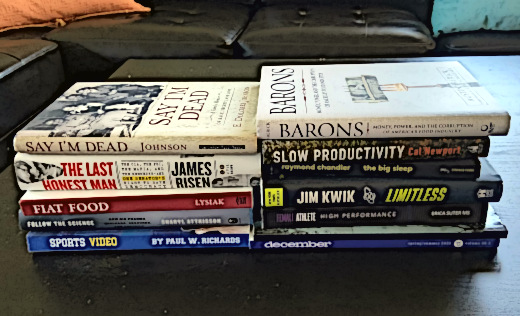
You've probably seen elsewhere online something similar to the picture atop this post: a stack of books, and it is usually accompanied with some text along with it saying that this is someone's reading list for the summer, fall, holiday break, vacation, hospital stay, etc., et. al., yada yada.
In my case, the picture above is not of books I have yet to read, rather it is of books I have already read. What's odd about that is that I pretty much always give away books after I read them and write takeaways from them that I share at this humble blog, but as you can extrapolate, I am a little behind on my writing... by almost a year.
Anytime I can sit down and read is a gift, especially when it's a paper book and not a screen. I have been good over the years with this cycle of reading and sharing, but part of the queue is a little backed up right now.
So I am sharing the spines of these worthy reads, in the hopes that I can use it as a motivation to write more. Feel free to add a comment of encouragement to this post.
Deconstructing Reading and Writing
“There is creative reading as well as creative writing.” — Ralph Waldo Emerson
This is from The Hot Iron, a journal on business and technology by Mike Maddaloni.
Did you enjoy this? Subscribe to The Hot Iron by RSS/XML feed or Read by Email
Announcements • Book Take-Aways • (2) Comments • PermalinkMy Takeaways From Lead Like A Dog
By Mike Maddaloni on Thursday, October 02, 2025 at 08:26 AM with 0 comments
Where did you learn to be a leader?
Over the course of my career, I have found few if any people who took leadership training, then became a leader. Often is the case someone rises from the ranks of an organization and is bestowed a title of leadership, such as manager. Does leadership training follow? I’ll just say that it didn’t for me, and most everyone else I know.
So then, how does one learn leadership? For myself, it was from the numerous examples of leaders I had over the years – some good, some not so good – and from them I developed my own leadership style. Other sources included indirect leaders and stories from others about their leaders.
Could one of those sources for leadership learning be a dog?
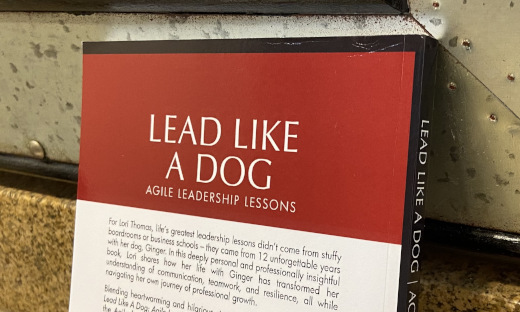
This is the theme of Lead Like a Dog by Lori Thomas. A leader that I have had the pleasure to work with first-hand, she wrote this book as a leadership resource, tying human leadership principles to examples reinforced by her dog, Ginger. Could someone already in a leadership role like me, though not a dog owner, take away something from this book? Certainly.
Agile principles apply to everyone – Lori is a Certified Scrum Product Owner, and much of the book talks to Scrum and Agile principles. However it is also very relatable to leaders – or anyone – who do not work with Agile. The idea of working in short sprints, and making adjustments, applies to dogs as much as it does to people and projects.
Leading a team is all about individuals – Where one would think “one-size-fits-all” applies to all people on a team, it does not (especially not for hats and people with big heads like me, but I digress). Understanding who people are, what motivates them and bringing out their best should be the job of every leader. This is something I know Lori does well, and in the book she talks to her experience with it.
You CAN teach old dogs new tricks – Whether a leader or not, anybody is capable of learning and continuously growing. This was more of a reaffirmation for me than something new, as I am doing it myself as are other “old dogs” I know and work with do on a daily basis. Where these days companies are looking for a 1,000% match in skills, perhaps instead they should be hiring for the capacity to learn those skills?
Lead Like a Dog is a great, uplifting read that I recommend not just for any seasoned leader but as well someone newly thrust into the role, whether they are a dog and/or pet owner or not. The wisdom that Thomas shares here, from her own experience, is evergreen and relevant today, especially in the current climate of staff reductions and negative opinions of Agile and Scrum.
Where I typically give away the copies of books I read, occasionally I hold onto a few and this is one of them. As the author is a colleague and friend, I will keep it until I next see her and have her autograph it.
This is from The Hot Iron, a journal on business and technology by Mike Maddaloni.
Did you enjoy this? Subscribe to The Hot Iron by RSS/XML feed or Read by Email
Book Take-Aways • (0) Comments • PermalinkSubscribe to The Hot Iron



The Hot Iron strives to present unique content and point-of-view on business, technology and other topics by Mike Maddaloni, a technology strategist based in Appleton, Wisconsin.
Photo credit: Logan Connor/Oomphotography
Value for Value
If you like what you are reading on The Hot Iron, buy me a coffee!
About Links
In posts here at The Hot Iron there are often links and banner ads for products and services. For some of these links and banner ads, I receive compensation if you click and/or eventually buy said products or services. Where most links are marked as such, it is safe to assume any link or banner ad is a compensated one.