
Retail Returns Happen - Always Have, Always Will
By Mike Maddaloni on Saturday, June 08, 2024 at 09:04 AM with 0 comments
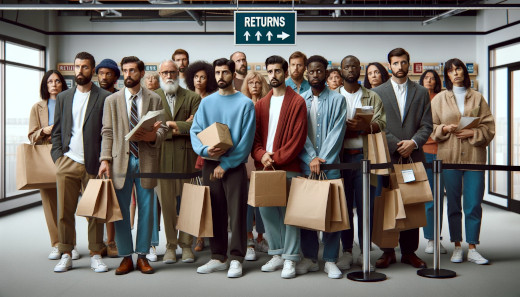
AI-generated image of a mass of people returning merchandise at a store by DALL-E
Over the Christmas holiday last year, I started reading news stories regarding the increasing volume of returns to both online and brick-and-mortar retailers. In them they discussed the business and logistics of returns to how returns are mounting despite efforts by retailers to curtail them.
On the surface, it sounds like this is a relatively new phenomenon. Most people reading this post have likely returned something to Amazon or some other retailer recently or even this week. The volume of returns has been growing over the years, combining among other reasons the move to buying more items online that – though you can see pictures of it – you are not actually touching the item until you receive it, to simply more competition in the retail space, where you may find a lower price the next day.
However returning merchandise is nothing new. Where I am not a retail industry expert by any stretch, I’d like to share my unique point of view on retail returns as I had some education on this from my Aunt who years ago who worked for a local department store. She was a long-time employee of Steiger’s, a family-owned chain of stores in western Massachusetts and northern Connecticut. They had about a dozen stores in total before they closed down in the early 90s and sold off their stores to Filene’s, eventually to be engulfed by Macy’s.
What’s Old Is...
My aunt’s job at Steiger’s was processing returned merchandise at the company headquarters. Returns would come into her office from all of the stores. Some items were truly damaged or had some defect. Others were still new and just not wanted, and some were likely worn once and then returned as no longer needed. In some cases items were returned to the manufacturer, but often the maker did not want them back and would simply refund the store. Those items were kept and she facilitated a quarterly sale for employees where they could buy the items for pennies on the dollar of their original retail price. Needless to say, we had a lot of items around our house and clothes in our closet from those sales.
When I was old enough to understand about money and how much things cost, my Aunt explained to me about the business of returns and how that fit into the overall cost and pricing of merchandise. She told me, for example, if an item on the rack at the store had a sticker price of $100, the actual cost to Steiger’s for the item may have been as low as $10, of course depending on the brand. That allowed profit to be made with discounts that you see stores offering for 10% to 30% off right-away on new merchandise. It also allowed for profit to be made when the sticker price is reduced over time; even at 50% off a profit can be made. The items on a deep-discount rack were also helping the bottom-line of the store.
After my Aunt came over to our house with things she got from the employee sale – not going to lie, she would set aside things for her sister and niece and nephew – even then there was some profit made by the store. When manufacturers and wholesalers gave credit back to the store it was to offset the fact that they didn’t want the items back or it cost more to ship and process them than their actual value. Rather than throw them away, the 4 times a year sale became an employee perk.
... Not Necessarily New
Now fast-forward to present day. The 800 lb. gorilla in the room, Amazon, has been facing a growing number of returns as, well, people have been buying more from them. They have built an evolving infrastructure to manage them, from returns to Amazon lockers, Kohl’s department stores and UPS Stores to crediting your account now or doing a cash refund days later, to asking more and more questions as to why you are returning an item. Other online retailers are using third-party services for similar drop-off returns, as I have gone to random stores to bring back something from a random online site my kids bought from facilitated by some random service.
As mentioned in the above-linked articles, online and retail stores are also taking steps to try to curtail returns, from shrinking return windows, offering only credit for returns and using third-party services to track frequent returners. But long before Amazon was on the scene, I knew people who would often buy multiple items, say clothing, then try on at home and return the ones they didn’t want. This, of course, being something that required a physical trip to a store, not to mention a lot of time.
Today you can buy something from your mobile device in the time you are stopped at a red light (no, I have never done that, of course not!). The convenience and impulsive nature of doing so drives increased sales, and with that naturally comes the possibility for increased returns. Just this week I returned a lamp I got from my daughter that barely illuminated a small spot on her desk, something we couldn’t have known from the pictures or random reviews on the Web site. Other returns in my household have been for items that just didn’t fit right – how else would you be able to try it on without buying it first?
As I write this, it is a point in time. I am sure I, and everyone else in the world, will continue buying more and returning more. Also as I write this, I am awaiting my return home to a pair of sneakers I bought online... this is the second pair from them, as the one I bought last week were not the right side – I bought the size based on other models from the brand that always fit – and I hope these fit. If not, I am going to return them, likely paying shipping back as the exchange had no added shipping cost (for me) and shop a local store where I can actually try them on.
Do you think about retail returns as much as I have here? That or any other thoughts are welcome in the comments of this post.
Deconstructing Retail Returns
There will always be retail returns. No matter the reason, people want what they want and if they don’t want it they will return it. Efforts to curtail returns could have consequences, and likely will be eased in or built into alternative ways of doing business with a retailer. In a world where every store in the world is literally in the palm of your hand, a long standing part of commerce shouldn’t not be expected.
This is from The Hot Iron, a journal on business and technology by Mike Maddaloni.
Did you enjoy this? Subscribe to The Hot Iron by RSS/XML feed or Read by Email
Business • Strategize • Technology • (0) Comments • PermalinkMy Takeaways From Strategic by Rich Horwath
By Mike Maddaloni on Wednesday, May 29, 2024 at 04:44 PM with 2 comments
All too often we get swept up in the minutiae of the work day and the next thing we know we are at home, plunked on the couch and say to ourselves, "Self, what the hell happened today?" When we then try to answer the question, we will find what we did was tactical and likely necessary, but was it the best solution or the best we can come up with, not to mention even remotely strategic?
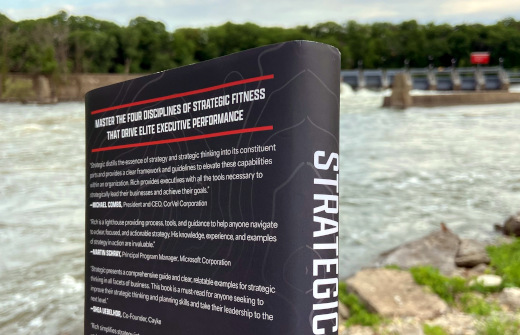
One day being overcome with this feeling I was not being/acting strategic led me on a quest – where I may not be able to affect things surrounding me, I can try my damnedest to affect those in my three-foot world. So I did what anyone these days does when in a conundrum – I did a simple Internet search on the word “strategic.” Near the top of the results page was a link to the new book Strategic: The Skill to Set Direction, Create Advantage, and Achieve Executive Excellence by Rich Horwath. A Chicago-area consultant, he runs the Strategic Thinking Institute and is a speaker and consultant on strategy. From that description alone I felt like I struck gold, so I ordered a copy of the book right away.
When Strategic arrived I put aside the two other books I was simultaneously reading and dug into this, which I felt was a smart and – dare I say – strategic decision on my part. So it comes as no surprise I had a slew of takeaways from the book, and I will summarize some of the top ones here.
What strategic is and isn’t – The book opens with his definition of what strategic is: possessing insight that leads to advantage. Later he goes into details on what it is not: the ABC’s, aspiration, best practices and cautious. As the book flows, the topics discussed are built on these.
Strategy Quotient Assessment – Throughout the book there’s a plethora of models and tools to help you in analysis and decision-making that will lead to insight. One of them is the Strategic Quotient Assessment which is an online survey of 50 statements offered by the Strategic Thinking Institute to determine your strategic quotient, or SQ. As of this writing I have not yet taken it myself, but this assessment that comes with a cost is something I plan to do.
Note to Self: Read The Art of War – Several times in recent weeks I have seen references to this book that is over 2 millennia old and attributed to Chinese military strategist Sun Tzu. One of those was in this book. What’s interesting about these references is that in all cases they were related to business, not war. Needless to say it’s on my summer reading list.
Kill failing projects quickly – A quote in an article from Harvard Business Review on why execution of business strategy unravels in the book stated, and I am paraphrasing, if you decide to kill a failing project, do it right away and quickly.
When I read this I thought of the quote the great triad of Canadian philosophers, “if you choose not to decide you still have made a choice.” This phrase, now over 2 score old, reinforces something I have experienced over my career when leaders cannot decide to stop doing something soon enough, even when armed with the evidence needed to do so.
Don’t skip manager/staff meetings – To say we are overbooked with meetings is an understatement, and when looking to squeeze room into a packed calendar, often standing meetings with staff are canceled. Horwath stresses this should not be the case for a number of reasons that I, as someone who has been on the receiving end of this too often over the decades, completely concurs with. Remember, such one-on-one meetings should not be solely for the benefit of the staff person.
Strategic is a great read and packed with a number of decision-making models, advice and real-world experience from Horwath’s own consulting and coaching career and many well-known companies. Throughout it there are references to articles which are listed in the endnotes, which in itself is a great reading list that can provide you with a wealth of information in itself – I got a lot from the one I mentioned above and several others I read. The only critique I have of Strategic is that it uses business examples from well-known organizations like Amazon, but no names of small or mid-sized businesses, which may be relatable to the average reader. That being said, the points he used to reinforced with said company names were certainly not lost.
To say I recommend Strategic to anyone is a no-brainer. Whether you feel you are already strategic or tactical, a leader or staff worker, this book is for you. Where I typically give away books, this is one I am holding onto. It will be a reference and inspirational guide for myself to reread in part or whole to remind myself of what I need to be doing to not feel like I originally did when I sought out the book. This is also not Horwath’s only book as he has written several other books on strategy, including a strategy graphic novel. After going back in time and reading The Art of War, I may come back to present-day Earth and read some of these others.
Have you read Strategic? Have I inspired you to read it? I welcome your thoughts in the comments of this post.
This is from The Hot Iron, a journal on business and technology by Mike Maddaloni.
Did you enjoy this? Subscribe to The Hot Iron by RSS/XML feed or Read by Email
Book Take-Aways • Strategize • (2) Comments • PermalinkLast In First Out For My Email
By Mike Maddaloni on Wednesday, May 15, 2024 at 09:42 AM with 0 comments
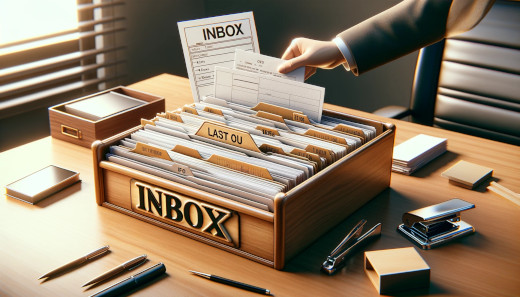
AI-generated image by DALL-E of a wood and paper inbox on a desk
There's nothing like coming back in the morning from a vacation where you worked really, really hard to not check work email for the entire time, only to be faced with a burgeoning inbox of unread messages. As you take a sip of your preferred work-safe beverage and put hands to the keyboard, you are likely thinking, where the hell do I start? Do I sort through those marked urgent (wait, most of them are) or sort by sender and start at the top of the food chain (but that requires recall of the org structure). What do you do?
For me, it's simple - I start with the last email in, at the top, and work my way down. So the last message in is the first out. Last-in, first-out, or as the accountants call it, LIFO.
The Reason for Whom to be Pleasing
I didn't always use this approach. Some of the approaches I mentioned are ones I have used over the years. When you get down to it, it's almost a no-win situation - someone's message won't get read as quickly as they want it to be read. With LIFO, someone is getting responded to quickly, and starting at the top of the list is also easier to manage. My ultimate goal for using LIFO is to get to inbox zero, something I always strive for.
With any process you choose for any task, it's always nice to have some validation for it. Initially I didn't tell anyone about my approach as I didn't want them to be slighted if their messages came in earlier during my out of office period. I got some reassurance of my choice from John C. Dvorak, the veteran technology journalist and co-host of the No Agenda podcast. During one episode he was talking about email and stated he uses LIFO for pretty much the same reasons I do. As he emails with pioneers in technology, I couldn't have a better endorsement.
How do you manage your inbox? Do you LIFO, first-in, first-out or FIFO? Or something else? I welcome your thoughts in the comments to this post. Of course now that my approach is out in the open, I expect more emails to be sent to me just as I return to work.
Deconstructing Last In First Out
Perfection can be the enemy of the good. When it comes to a digital stack of messages before you, choosing a method to process them that you are comfortable with is paramount. My choice of LIFO as a method has worked for me, and it still allows me to sort through my inbox to find, say, messages from my boss if needed.
This is from The Hot Iron, a journal on business and technology by Mike Maddaloni.
Did you enjoy this? Subscribe to The Hot Iron by RSS/XML feed or Read by Email
Strategize • Technology • (0) Comments • PermalinkLet It Snow THEN Decide If To Close
By Mike Maddaloni on Tuesday, January 09, 2024 at 11:19 PM with 0 comments

“Oh the weather outside might be frightful,
But the idea of a snow day is so delightful,
And since we don’t know the way the forecast will go,
Let it snow, then decide if to close!”
With no apologies to the late Sammy Cahn, I share with you what has transpired over the last day. Yes, this is part rant and part constructive criticism as well.
Yesterday around 4 pm, I got an alert for my kids’ school system stating that classes would be canceled today due to a looming snow storm. Where I didn’t feel like looking at the forecast myself, some people told me we would be getting a few inches to a foot of snow during what was being called Winter Storm Avree. As the snow was supposed to start overnight and dramatically impact rush hour traffic, school was proactively canceled in the name of safety the day before it was to happen. Canceled not just in my fair town but in a majority of the State of Wisconsin in the US upper Midwest, an area that is not unfamiliar with snow in January.
When I awoke this morning, there were signs that school was certainly canceled. A plethora of dishes and implements from the late-night baking my kids did as they didn’t have to get up early filled the kitchen. However when looking out the window, there was a mere dusting of the white stuff in the street and there were bare spots on the driveway and sidewalk at my home. Way to go Avree.
So much for the snow, and the concerns of safety that compelled government officials to cancel education for a day. As I write this it is over 24 hours from when the cancellation notice was sent, but nothing even close to white-out conditions that would make it unsafe to travel in the morning. Even as it snowed later in the day into the evening, it was certainly navigable out.
Golden Snow Days
The events of the last day are a far cry from what life was for me when I was growing up in the 1970’s and 1980’s. School cancellations would happen in the morning of the school day. Us kids would get up earlier in the morning to huddle by the radio to hear if our school system was cancelled. What was told to me years later by the assistant superintendent was the decision was made early in the morning, considering the forecast and what was happening outside their window, and then phoned into the radio and TV stations along with the secret password so some wiseass wouldn’t just call in a bogus cancellation.
This approach followed me from public schools to even college, as they were slow to never cancelling classes. Where it was always nice to have a day off, the reality was that I was in New England, snow happened in the winter, and we had to deal with it. This was the assumption I had when I moved to Wisconsin, as I previously alluded to.
Today is not Yesterday
So what has changed? Is it the litigious society we live in? Is it a by-product of the recent lockdowns? Is there an assumption that more parent are home (albeit working) so if closing classes are canceled the kids can stay domicile with the parents or families who will already be there? Are we simply not as tough as we used to be? I am sure if I pose this question directly to a school bureaucrat I will be returned with a scripted response laced with safety as the paramount concern, but not acknowledging my reservations for the kids staying home, especially as report after report continues to come forth on the negative impact of school closings over the past few years on kids performance in school.
Somewhere in the middle is a happy medium. But who wants to meet in the middle these days? Fortunately we got enough snow to make a decent snowman as secondary compensation. The primary compensation will be classes in session tomorrow.
Deconstructing Weather Related School Closings
Safety is always a concern in all we do. But the process that goes into determining what is safe or not has to be reviewed to ensure it makes sense, and take into consideration possible collateral damage as a result of any decisions made. The best place for kids to be for learning is in person and all reasonable actions should be made to ensure this happens as much as possible.
This is from The Hot Iron, a journal on business and technology by Mike Maddaloni.
Did you enjoy this? Subscribe to The Hot Iron by RSS/XML feed or Read by Email
Diversions • Strategize • (0) Comments • PermalinkHeading to the Microsoft Azure And AI Conference December 5 – 7
By Mike Maddaloni on Tuesday, November 28, 2023 at 09:42 PM with 0 comments

Next week, Tuesday through Thursday, December 5 through 7, 2023, I will be attending the Microsoft Azure and AI Conference in Orlando. Will you be there too?
The conference includes a wide array of presenters from Microsoft and partner firms on leveraging the latest capabilities of Microsoft’s cloud hosting platform Azure as well as artificial intelligence, or AI – the hottest topic out there in the tech world and beyond.
I will be attending with colleagues from work who all work with Azure in different capacities. This collaboration among peers will heighten my learning for certain over the 3-day conference. I am hoping to take away from this tangible ideas and potential projects to meet our team and organizational goals.
If you are attending feel free to connect with me here and comment on this blog post or you can connect with me on LinkedIn and please no spammy sales pitches.
This is from The Hot Iron, a journal on business and technology by Mike Maddaloni.
Did you enjoy this? Subscribe to The Hot Iron by RSS/XML feed or Read by Email
Announcements • Strategize • Technology • (0) Comments • PermalinkSubscribe to The Hot Iron



The Hot Iron strives to present unique content and point-of-view on business, technology and other topics by Mike Maddaloni, a technology strategist based in Appleton, Wisconsin.
Photo credit: Logan Connor/Oomphotography
Value for Value
If you like what you are reading on The Hot Iron, buy me a coffee!
About Links
In posts here at The Hot Iron there are often links and banner ads for products and services. For some of these links and banner ads, I receive compensation if you click and/or eventually buy said products or services. Where most links are marked as such, it is safe to assume any link or banner ad is a compensated one.