
Talent
By Mike Maddaloni on Friday, December 12, 2025 at 08:42 AM with 0 comments

People can be funny about titles. Funny good, and funny bad.
When I was in college, there was a guy I knew who worked in the school’s public relations office, and when it came time to order new business cards, he knew he was leaving his position soon so he decided to be funny – funny good – and had his title listed as “human being.“ Though that was bold for a stuffy, small New England college, I liked it. Years later I would borrow his title line for my own personal card.
When I started my second job after college, my title was Associate Consultant. After a year I was promoted to Staff Consultant. But I had to switch jobs a few years later in order for my title to be Senior Consultant. In my mid-20’s I was funny – funny bad – about my job title and wanting a “bigger” one, when the reality was that I did the same work despite what I was called.
A colleague recently lamented they hadn’t had the title of Vice President yet in their career. I laughed and said to do what I did: take the easy way out and start your own company, then you can name yourself whatever you want. When I did that, I wasn’t just the president – I was “founder and president.” This was the mid 2000s and being a founder was starting to be a big deal again after the dot-com bust. Even though my company was just one person – me – I was a founder, dammit!
On the flipside, a very good friend is president of her company yet she never uses that title. Instead, she uses Principal Consultant or something to that effect. Why? She’s more interested in a title commensurate to the work she loves, not that she runs a business. Her title also resonates more with her clients. It wasn’t until I saw her name and title on a contract once, then I made an extra effort to annunciate it, much of her dismay.
These days my title is “Senior Program Manager and Agile Delivery.” Why “and Agile Delivery?” A while back my organization was going through an Agile transformation and we thought it was a good idea to add that to titles. Then we stopped going through the Agile transformation, but my title remained the same. I’ve dropped the “and Agile Delivery” from my email signature and my LinkedIn profile, but I still see it internally.
Today masses of humanity are calling themselves AI Experts. Before that they were calling themselves Social Media Experts. Before that they were calling themselves Web Experts. Before that they were calling themselves Business Re-engineering experts. Before that… well, you get my drift.
So why all the talk about titles? I recently rediscovered a business card I got back in the 90’s that triggered this. I was at a fundraiser and sports broadcaster Mike Tirico, who at the time was working for ESPN, was in line right behind me at the entrance of the event. Someone came up to him and asked him for his business card, and as he was taking one out of his wallet, I asked him for one as well, to which he obliged. When I took a look at it, it showed his title as simply “talent.”
“Talent: is a title that is often given to people in media and entertainment. You will never see a prefix of “senior” or anything else with it. Perhaps this should carry over to the business world? In one word it simply says all that it needs to.
Deconstructing Job Titles
It doesn’t take long after accepting a title when you realize it’s merely an external moniker and what really matters is what you do and how you are compensated for it. For whatever the title, however, it is what we uniquely contribute to the job that matters, and that is our talent.
This is from The Hot Iron, a journal on business and technology by Mike Maddaloni.
Did you enjoy this? Subscribe to The Hot Iron by RSS/XML feed or Read by Email
Business • Thrive • (0) Comments • PermalinkMike Maddaloni Interviewed On High School Booster Club
By Mike Maddaloni on Friday, October 31, 2025 at 10:25 AM with 0 comments

Previously I have talked about my “other” job, leading my kids’ high school booster club. It is truly a labor of love – there’s a lot of hard work to it, but the rewards are readily visible. That’s not to say it is all smooth sailing; in any organization there are challenges, and a booster club is not immune from them either.
One of our greatest challenges, as I also talked about before, is getting volunteers to staff the concession stands at sporting events. In addition to providing sustenance and tasty treats to fans, they are a significant fundraiser for us. Not only is this a challenge, but also is something newsworthy as well, so I recently learned.
Ahead of the TV broadcast of an Appleton North High School Football game on local TV station NBC26 in Northeast Wisconsin, I and one of my colleagues on the booster club’s board of directors were interviewed by reporter Noah Cornelius on the effort and needs for concessions. You can read and watch the interview here on the NBC26 Web site and watch the video of the interview here and it is embedded below.
Noah conducted a great interview as we showed him all of the logistics and planning that goes into a concessions stand, and I thank him for the opportunity to share our story and his great presentation of it. He told our story well, especially the need for volunteers.
For the popcorn doesn’t pop itself!
This is from The Hot Iron, a journal on business and technology by Mike Maddaloni.
Did you enjoy this? Subscribe to The Hot Iron by RSS/XML feed or Read by Email
Announcements • Strategize • Thrive • (0) Comments • PermalinkItalian Treats at Christmastime
By Mike Maddaloni on Saturday, January 11, 2025 at 10:11 PM with 0 comments

Christmastime is when I get to unplug from work by using up all the vacation time that I didn’t use throughout the year and spending time with family and friends, all the while celebrating the true meaning of the holiday. Add to it my Italian-American heritage, and it’s also a time to indulge in traditional treats I grew up with.
It likely comes as no surprise that food is an important part of any Italian-American celebrations. Even funerals. Especially funerals. Since I was a kid I could never figure out how, within a couple days of someone dying, the women of the family (and yes, it was usually only the women) were able to produce so much food. To top that, literal moments after they were dressed in black grieving at a funeral home, they are back at the house forcing food down my throat. But I digress, back to Christmas.
The Italian foods my family had around the holidays were on the sweeter side. Interestingly, my family never did the feast of the seven fishes that other Italians did. Why? Mainly because my Mom didn’t like half of the fishes, especially eel and baccala, the latter being salted cod. That was alright by me because and we made up for it on the other end of the taste spectrum. Here are a few of my favorite things for the end of the year. As I tell their tale, I will share how my family pronounced them with their Abruzzese dialect.
Pizzelles
If you’ve been a committed reader of The Hot Iron (and that term fits in so many ways), you know I have mentioned pizzelles (pronounced pit-ZELLS) before. Pizzelles are an Italian cookie made from simple ingredients; flour, sugar, eggs, butter and flavored and anise. There are other varieties of pizzelles, but for me anise flavored is the one only way to go. Although you can now buy them in some supermarkets, homemade using my Mom’s recipe is the tradition I am carrying on.
In recent years I have also adapted a grain-free, dairy-free version of Mom’s recipe, to which I am sure she would have approved. Using paleo/nut flour and maple syrup instead of sugar among other changes yield a quality cookie that allows me and the family to indulge in more (ok, maybe a little too much this year). This year I upped the game with a new pizzelle iron. Rather than using the non-stick one made in China I got on Amazon, I bought a pizzelle iron from an Italian-American founded company, made in Pennsylvania of cast aluminum, complete with my last initial engraved into the iron. This new addition to the family added an extra touch to the holidays.
Torrone

Torrone (pronounced tuh-RONE) is an Italian nougat and nut treat. As kids we would get the La Florentine torrone which came in small pieces wrapped in foil and in little boxes, with unique designs (and faces) for vanilla, orange and lemon. Of course you can’t just have one, and next thing you know the assortment box of 18 is all gone. That problem from my youth sadly still exists today, though the pieces are even smaller now. Torrone comes in other varieties, and this Christmas I tried a few other brands, however I went back to my old favorite (which my kids prefer as well). As some of the ingredients in torrone are on my quarantine list, I may explore making my own next year.
Baci

Baci (pronounced BAH-chee) are Italian candies made with dark chocolate and hazelnuts that recently turned 100. Baci is the Italian word for kiss, and each foil-wrapped treat contains a note – traditionally they were always about love, but these days they are famous quotes for some reason. Like torrone, Bacis are smaller and there’s fewer in a box, which for me is just fine as this treat that can be found at stores year-round is one I reserve for this time of year.
Panettone

Panettone (pronounced pan-e-TONE) is a sweet Italian bread that is made in a round loaf shape with dried fruits and wrapped in paper resembling a large cupcake liner. You slice the panettone (pie shaped or simple slices) and can eat it as is or toasted, the latter is what we always did. Again as most grains are something I deflect from these days I have found mini panettones at Trader Joe’s of all places, made in Italy and branded as Trader Giotto’s so I was still able to have a taste. I have even seen mini ones in Walgreen’s, however those are made in Brazil. By chance when buying local eggs at a Breadsmith artisan bakery I discovered they make panettones around the holidays, and theirs are made with a sourdough starter as well as slivered almonds. Despite my dietary preferences, this was a nice change to have a fresh-tasting panettone, as the store-bought ones have always been very, very dry.
Sfogliatelle

Sfogliatelle (pronounced sfo-ya-DELLS, plural) are toasted, flaky, Italian dessert filled with custard and candied fruit. Growing up we never ate cannolis and even when I had the opportunity to I would decline, much to the dismay of every non-Italian I know who assumes that’s all my people eat. Where I live in Wisconsin the closest Italian stores or bakeries are over 90 minutes away in Milwaukee, which is a good thing not to have these indulgences so close to home.
Growing up sfogliatelle were not exclusively a holiday treat, but by what could be called a Christmas miracle they are now. Several years ago we took a family vacation to Florida the week of Christmas, as we wanted to try a warmer climate for the holidays. As it so happened, we were at Universal Studios on Christmas Day. After getting through the mob at the front gate, I spotted a Today Show café (Universal is owned by Comcast that owns NBC) and a brief coffee break sounded good before taking on the park. As I placed our beverage order, in the display case in front of me was several varieties of pastries… and one sfogliatella! Needless to say, I ordered it and, believe what you want, but to me that was a certain sign my Mom, Aunts and Uncles were looking down on us and wishing us a Merry Christmas.
Deconstructing Christmas Treats
The holidays a conjure up a lot of meanings and thoughts at the end of the year, and a big one for me is nostalgia. I think back to growing up in an Italian-American household, complete with a lot of love and a lot of food, and the sweet treats at Christmastime were just as important as Santa and, of course, church. Even though the ingredients of these items are these days not among my favorite things, I am finding creative ways, coupled with moderation, to still carry on and pass along these cultural traditions, along with how my family pronounced them.
This is from The Hot Iron, a journal on business and technology by Mike Maddaloni.
Did you enjoy this? Subscribe to The Hot Iron by RSS/XML feed or Read by Email
Announcements • Thrive • (0) Comments • PermalinkThe Personal Impact Of Volunteer Leadership
By Mike Maddaloni on Thursday, November 21, 2024 at 07:35 PM with 0 comments
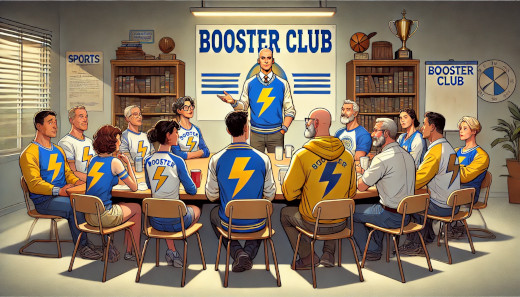
AI-generated image of a booster club meeting by DALL-E
Prior to my last post, it had been almost 2 months since I shared my thoughts here on this humble blog, and the response from you my dear readers was overwhelming. Overwhelmingly non-existent, but I digress. With the volume of email we all get, not to forget RSS feeds for some as well, I am sure my musings may have taken a backseat to everything else going on in the world.
What was the reason for this? I’ve recently gotten a little busier than the typical busy that my life is. So what am I doing? I was recently elected the president of my kids high school sports Booster Club.
The Booster Club is a 501(c)3 non-profit organization that is independent of the school yet tied to it by its charter. I’ve been involved for the last two years, helping with the Web site and starting an email newsletter. As I realized these could be handled by more creative and marketing focused-people plus an opening for this leadership position, I decided to jump in, of course with my wife’s blessing.
When I told people what I was doing this I got a variety of reactions, everything from, “congratudolences” to why on earth would I want to do that. To that end I am able to sum up my reasons in one word: impact.
In this election year here in the US, I’ve repeatedly heard a phrase familiar to me over the years attributed to the late historian James Bryce regarding someone taking on a top leadership position: the presidency is open to anyone who has the audacity to believe they can do it. Even for a position like the president of a Booster Club I think you have to believe similarly. Yes, I can take on this leadership role and yes, I can fulfill it to the best of my abilities. For me that was a big part of it, but equally important is it’s helping me fulfill something in missing in my life, in having a leadership position that I don’t quite have elsewhere.
Similar Yet Different
When I put my hat in the ring I knew a little of what I was getting into as I’ve had leadership roles in non-profit organizations in the past. Most notably in the early 2000s I was president of the Boston Jaycees, a member-run leadership organization that was affiliated with a larger US-based and international society. The Boston chapter had just under 100 members and all the challenges you think you’d have with an organization of young people trying to make a difference in their community. Our greatest one was recruiting new members. People would have to commit not only a membership dues but also to being involved as we were volunteer-run; we needed people to be active and run projects, ideally creating a base that would be the future leadership of the chapter. I recall from that time period someone telling me that your job as a leader to find your successor, something that is in the back of my mind as I commence this new role.
Impact to me is two-fold. First there’s the organization’s impact on the community. In this case the Booster Club serves the high school athletic programs with equipment and funds from the money we raise from donations and concession sales. Then there’s the personal impact. This is satisfaction from the good I and all the others involved do in growing our Booster Club and in the support we provide. It’s that personal pride from a job well done and overcoming challenges.
That part about growing the Booster Club is something that’s not entirely new to me, and probably even greater than it was the last time I encountered it. Back in the late 90s and early 2000 with the Jaycees, we were competing for the time of young adults against them staying home, watching cable TV and playing video games. If they actually did something, many would want minimal commitment. The Booster Club audience is grown adults who have very active children participating in sports, academics and other activities and sometimes the last thing those parents want to do is work in a concession stand slinging burgers and hot dogs, let alone take a leadership or other role in the club.
Back to the personal impact, back when I was the Jaycees president I would occasionally hear snarky comments that I was in it to stroke my own ego. Sure, to say that you’re the “president” of something can boost one a bit, but it is a healthy reminder as well that in order to fulfill the position you have to rise up. You have to be a better person than you are and sometimes you got a bear the brunt of things that you may not think you should in order to ensure progress, whether it’s lending a hand in different areas, having tough conversations with people and putting new, bold initiatives out there.
As I reflect on just the past few months I’ve been at the helm of the Booster Club it’s so far so good, but there’s much to do. Hopefully it’s won’t continue to curtail my blogging or other activities that I enjoy.
Deconstructing Stepping Up to Volunteer Leadership
I’ve often said there’s never a best time for anything and this is true whether it’s volunteering leadership or making a difference in an organization. For myself, even though I’ve been through this before, I’ve always enjoyed it and I’m looking forward to this new role with new people and opportunities before me and the opportunity to make an impact in the community and myself.
This is from The Hot Iron, a journal on business and technology by Mike Maddaloni.
Did you enjoy this? Subscribe to The Hot Iron by RSS/XML feed or Read by Email
Announcements • Build • Thrive • (0) Comments • PermalinkTake Fives
By Mike Maddaloni on Sunday, August 11, 2024 at 09:43 AM with 1 comments

So I have more five dollar bills in my wallet these days.
Why? The genesis for this was not having smaller bills on me and as a result costing me more than I hoped when tipping on a recent trip to Chicago. I was staying at a nicer hotel and at almost every turn there was someone to tip. As most ATMs today just give $20 dollar bills, that was all I had. Needless to say it made me look like a really generous guy.
Inflation Hits Gratuity
With the prices of everything going up over the last several years, restaurants have not been immune from this. It is evident in not only the menu prices being higher, but the suggestions for what to tip the wait staff are right up there too. You know those “tipping tables” you see at the bottom of your bill, the ones that list percentages and the dollar amounts to make it “easier” for you to tip? In the past they would likely offer 15% and 20%, and maybe sometimes 25%. These days I am seeing them starting at 18% and sometimes going as high as 30%! That, and more restaurants are automatically adding a tip on parties larger than 4 plus that tipping table too. Clearly restaurant staff are being hit by inflation like the rest of this, and with the overall check being higher, many diners are likely not tipping as they used to.
Thus I started carrying fives on me. Doing so was made easier by my new bank’s ATMs offering $5 bills along with $20 and even $1 bills – it also offers $100 bills as well and, though a popular thing to carry on you in Wisconsin I pass on those, but I digress. It allows me to tip appropriately, as well as not look too cheap by handing someone simply a one-dollar bill.
Making It Real
Carrying more cash on me has been something I have actually been doing for a while. From every expense you make being tracked to ginormous bank statements listing those very transactions to having had a few attempts of hacking of my bank accounts in recent years, by using cash more reduces all of this. Not to mention some merchants are passing along to their customers their credit card fees. Several local gas stations are offering cash prices up to 5 cents off a gallon. With filling up 2 cars every week, this adds up quickly, and I’ll take the reduced cost of anything anywhere I can. Even though the stands at the farmers market take cards and accept payments from mobile apps like Venmo, they are always appreciative to take old-fashioned fiat currency.
Deconstructing Carrying Fives
When it comes to inflation we often feel powerless to merely succumbing to it. By carrying five dollar bills on me it is attempt to counter this wave. Seeing cash actually leaving your wallet makes you think about what you are doing with that money, more than a piece of plastic or QR code ever will. By placing a bill in a tip jar or someone’s hand makes the acknowledgement of gratuity more real. One $5 is easier than fishing a couple of ones from your wallet and makes a little more generous statement without going over the top.
This is from The Hot Iron, a journal on business and technology by Mike Maddaloni.
Did you enjoy this? Subscribe to The Hot Iron by RSS/XML feed or Read by Email
QR Codes • Strategize • Thrive • (1) Comments • PermalinkSubscribe to The Hot Iron



The Hot Iron strives to present unique content and point-of-view on business, technology and other topics by Mike Maddaloni, a technology strategist based in Appleton, Wisconsin.
Photo credit: Logan Connor/Oomphotography
Value for Value
If you like what you are reading on The Hot Iron, buy me a coffee!
About Links
In posts here at The Hot Iron there are often links and banner ads for products and services. For some of these links and banner ads, I receive compensation if you click and/or eventually buy said products or services. Where most links are marked as such, it is safe to assume any link or banner ad is a compensated one.