
New Approach To Managing My Email Inbox To Zero
By Mike Maddaloni on Tuesday, July 07, 2015 at 11:42 PM with 0 comments
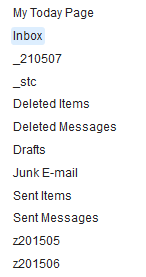 Over 6 years ago I wrote about a process I had then been following for almost a decade – managing my email inbox to zero. The idea was straightforward – your email inbox is not a to-do list or anything else. You take mail from it, and do something with it, just like the postal mailbox at your home. Doing this is something I continue to do – dare I say obsess over – now for over 15 years.
Like any process, a better way to do something comes along, including how I was managing my email. Where the basics of keeping the inbox to zero still applied, the one part that wasn’t working for me was the filing of emails. It became clear that while email is not a good task list, it is also not a good archive, especially how I was managing it. So I came up a new process I’d like to share with what I did with the emails I wanted to file.
A Better Way To File
While archives of email folders are searchable, have date/time stamps and so forth, pouring through email messages and threads was becoming more and more inefficient for me. To start, I had my email stored offline in an email client software, Mozilla Thunderbird, on my PC. If I needed something while away from it, I couldn’t. Even with all of the emails I had in the archive within Thunderbird, I rarely would have to go back far in time for something. Needless to say, I was continuing to save email message after email message, and it was cluttering my hard drive more and more.
The change to my filing was in 2 steps – the first was to eliminate Thunderbird from the picture and only use Web-based mail. The second was to create folders for email messages I was saving for a particular month, and only keep the current month and 2 past months in Web mail. Once a new month rolled over, I would create a new folder for it, then go through the oldest folder and either delete or save to my PC archive the individual email message as a PDF file. The accompanying photo to this post shows how my mail folders look – the “_201507” is the current folder, and those prefixed with “X” (namely so they will appear at the bottom of the list) are for the last 2 months prior.
I started this process back in March, and now we are at July. I have since cleared out 2 months of old emails, and probably only saving half of them. I have at ready-access email messages I need through Web mail and on my mobile device, and I have a more robust archive of my “stuff” on my personal hard drive.
In short – so far, so good.
Now I will get back to the 17 messages in my inbox. In the meantime, I’d welcome your thoughts on my revised approach, and feel free to leave them in the comments of this post.
This is from The Hot Iron, a journal on business and technology by Mike Maddaloni.
Did you enjoy this? Subscribe to The Hot Iron by RSS/XML feed or Read by Email.


Strategize • Technology • Thrive • (0) Comments • Permalink
Revisiting My Web Site Redesign Checklist
By Mike Maddaloni on Friday, May 01, 2015 at 02:22 PM with 0 comments
There comes a time when we reevaluate something we are doing. This thing may be an ongoing activity or something is simply still “around” that requires little to no attention, but is something we are aware of. The thought process involved in determining to continue or suspend something can be interesting in itself, and can lead to a go or no-go or a change to what it is we are doing.
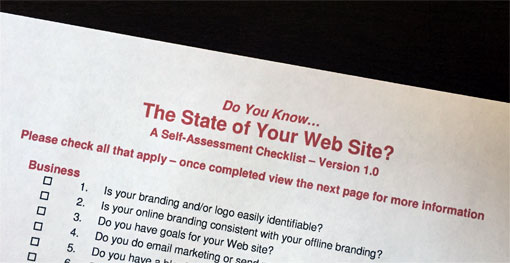
Among my seemingly too many projects and activities is something I am still proud of, but wondered if I should keep it out there. About 5 years ago I launched The State of Your Web Site within my former Web consulting firm. It is a checklist of 34 items which I felt are important to the vitality of a Web site. As I later wrote in a post about the process of creating it and naming it, a lot of work went into it. That being said, should I still keep it out there in the Internet eye?
The evaluation process boiled down to 2 points – 1 for and 1 against it. The con is the amount of time that Is needed to keep something like this current, as tools and technology and trends are always evolving and changing. As it is almost 5 years old now, there are some parts of it that are in need of updating. The pro, however, is that people still seek my advice on their Web site, despite that I no longer offer that as a service any longer (if they need someone, I simply refer them to Visible Logic). For that reason alone, I felt it was worthwhile to keep The State out there, and to spend some time to update it and keep it fresh.
Once I made this decision, another “pro” came to mind – this is a good way to keep my own Web skills sharp. As I am still in the profession of building great Web sites and Web applications, to have a “home” for my research and thoughts would be an ideal use for the checklist.
The first step of this process is to do just that – establish a new location to host and offer The State of Your Web Site. This will be the place where, when I review the checklist items and update it, I will post and announce the updates. What better place than right here, at The Hot Iron? Going forward, you will be able to find the latest post on The State at thestateofyourwebsite.com. Right now that link points to the very post you are reading. If a new post had more current information, the link will redirect to it. By clicking on the image at the top or this link you can view the original version of The State – as I said, it came out in 2010, and the list does need some updating, but as you review it you will find some “timeless” items to consider for your Web site.
As I work on updates to The State I of course welcome your thoughts and comments on it – on the list overall to specific elements within it. You can leave them as comments to this post or contact me directly. Your feedback will be vital to the validation of changes to The State of Your Web Site, and I thank you in advance for your time.
This is from The Hot Iron, a journal on business and technology by Mike Maddaloni.
Did you enjoy this? Subscribe to The Hot Iron by RSS/XML feed or Read by Email
Announcements • Build • Business • Strategize • Technology • The State of Your Web Site • Thrive • Web Design • Web Development • (0) Comments • PermalinkMy Takeaways From The Book How We Survived in UHF Television A Broadcasting Memoir 1953-1984
By Mike Maddaloni on Friday, April 17, 2015 at 05:49 PM with 1 comments
Where the Anchorman movies were a good laugh, weaved in between the puns was a story of both the “golden age” of local broadcast television and the genesis of cable television, which had a transformative effect on local television.
As I grew up in western Massachusetts, the local TV station to watch was WWLP channel 22 in Springfield, MA. It was an NBC affiliate who consistently was the ratings leader for news and local programming. Part of that local programming included editorials by the station’s president, Bill Putnam, which were highly informative, opinionated and entertaining. When I heard that Putnam and his then business partner (and now wife) Kitty Broman Putnam wrote a memoir about the formation and the behind-the-scenes of the operations of WWLP, I had to get a copy of it. That memoir, How We Survived in UHF Television A Broadcasting Memoir 1953-1984, includes insider information and photos about not only the founding of the TV station, but the UHF television band and entities like the Federal Communications Commission (FCC).
Though there are many tales which are local to western Massachusetts, from places to politicians, it is a book for anyone who is interested in broadcast communications and its history. For someone like myself who is interested in that and local history in general, it is an interesting tale, spanning over 30 years, of the creation, evolution and positioning of a local television station during a time when broadcast television was evolving and positioning as well. It was of course interesting to learn the why’s and what-else’s about the TV station that I probably spent too much time watching during my own evolution and positioning.
Learning the “inside baseball” of WWLP (whose call letters come from Putnam’s full name, William Lowell Putnam) was of course a great takeaway for me from this book, but there were others that make this an interesting read for others, including:
- Entrepreneurial ventures come different forms - When you think of a business labeled with the word “entrepreneur” one often thinks of a small space with a shoestring budget in a remote office. This was the case with WWLP, whose studios were atop a mountain and was built by Putnam and other staff. Where what you saw on TV looked polished and expensive, it was far from that, and the station also had a stable of investors who help funded the lean operation. Plus in those days, long before high-definition television, studio sets could have been made of cardboard colored by markers and you wouldn’t know the difference.
- The tools are always getting better - This is a term I use quite a bit, especially when describing the evolution of my former Web consulting business, where changes in technology often drove changes in the business model. The same can be said for television, whether it was in broadcast transmitters or from black and white to color pictures. Being aware of these changes and having the capital – both money and time – to address and adapt to them is important in the survival and thriving of any business.
- You’ve got to know when to fold ‘em - Putnam, Broman and company sold WWLP in the mid-1980’s and got out of broadcasting altogether. This was in the early days of the large expansion of cable TV across the US. Though local broadcast stations would get their signal carried on the cable, the revenue model for those same local stations was not defined, nor was it understood what the real impact of cable would be on broadcast. With this on the horizon, Putnam got out of the business early, at a time when he was able to sell for a good profit.
Though How We Survived… hasn’t made many national top-seller lists, it is an entertaining read. It starts technical where Putnam goes into the definitions of what the story of people and places is about. It then ends with recipes by Kitty Broman, who in addition to her leadership role hosted a daily TV show. One thing the book doesn’t do is get into too much detail about all of the various on-air personalities, and only mentions a few of them. One is Bill Rasmussen, who was the sports director at WWLP prior to founding ESPN.
As I do with all of the books I read, I like to give them to others. I am giving this to my friend Tom, as he grew up watching WWLP like myself, and lived near the access road to the mountain-top studios.
Have I convinced you to read this book? Have you read it? I welcome your thoughts in the comments to this post.
This is from The Hot Iron, a journal on business and technology by Mike Maddaloni.
Did you enjoy this? Subscribe to The Hot Iron by RSS/XML feed or Read by Email.
Book Take-Aways • Business • Strategize • Technology • Thrive • (1) Comments • Permalink
My Blogging Guest Lecture At University of Wisconsin-Oshkosh #uwonewmedia
By Mike Maddaloni on Friday, February 13, 2015 at 05:54 PM with 0 comments
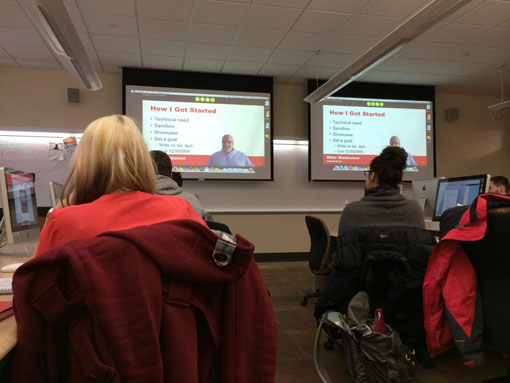
Photo credit: Wilke (?@Wilke_411) via Twitter
Yesterday I had a distinct honor to guest lecture to college students on the topic of blogging.
I was invited to speak to 2 classes at the University of Wisconsin-Oshkosh by journalism professor Dr. Sara Steffes Hansen. As part of her classes where she is teaching the students all aspects of blogging, each student is building a real, public blog. What better way to learn blogging than with real-life experience?
As someone who has his own blogs and has built blogs for clients, I have learned on the job about blogging as well as keeping up with trends and changes to blogging over the years. One challenge was focusing on key elements to share with the students and keep it to a brief presentation with time for their questions. Another challenge was that I would not be able to be physically in the lecture hall on the Oshkosh campus, yet deliver my messaging in an interesting and engaging way.
As with my own writing style, I decided to tell the story of how I got into blogging myself and then focus on areas that I felt were important to the students, including the art and science of writing and writing on a regular basis, plus some key pointers about blogging such a sharing and social media integration.
For the presentation itself, I created PowerPoint slides and used technology from Personify to literally insert myself into the PowerPoint presentation so that when the students were looking at the screen they saw both the slide material as well as myself, as you can see from the picture above. As the Personify technology is extremely unique in itself, I'm already writing another post on using Personify and how I was successful in conveying myself, my style and my message to the students remotely – watch for it soon.
I have posted the slides from the presentation to SlideShare and you can link to it here or view embedded below. I kept the slides at a high-level and spoke to the details so that the students did not have to read slides, and by using the unique Personify technology I was able to make that happen very well. If you look at the slides and are wondering about the references to Ernest and Edgar, those are to 2 “other” famous Chicago-area writers, Ernest Hemingway and Edgar Rice Burroughs, as I used them as examples of different approaches to writing.
Thanks again to Dr. Hansen, the team at Personify and the students who asked great questions and shared the presentation on social media. It was great getting back into the classroom and I am looking forward to my next opportunity.
This is from The Hot Iron, a journal on business and technology by Mike Maddaloni.
Did you enjoy this? Subscribe to The Hot Iron by RSS/XML feed or Read by Email.
Announcements • Blogging • Build • Social Media • Strategize • Technology • Thrive • Web Design • (0) Comments • Permalink
My Takeaways From The Book One Word That Will Change Your Life
By Mike Maddaloni on Friday, February 06, 2015 at 05:52 PM with 0 comments
Goals by nature are complex. At least that’s how I see them. As they segue to an action plan to achieve them, they must be clear and not too wordy, yet not vague or they will lose their meaning. Often times goals are “boiled-down” to a phrase or even one word for marketing and promotional purposes as a simple rally cry to those who are a stakeholder to these goals.
In the book One Word That Will Change Your Life by Jon Gordon, Dan Britton and Jimmy Page (not the guitarist), they propose you simply have 1 word as an overall goal for yourself for a year. They present a rather simplistic yet thoughtful process by looking inward, opening yourself up to discovering the word, then applying it to your year.
As I read this several takeaways came to me, including:
- You need to find a process that works for you – The steps in this book may work for you, and also they may not. Sometimes it takes a book like this to help you though such a process.
- Divine intervention is not for everyone – The book is based on faith in God in order to open one’s self to ”receive” their word for the year. This may be a turn-off for some, perhaps those who do not believe in a supreme deity. That being said, if you are a spiritual person, you can still follow this process without acknowledging a god to open up and find your word.
- Maybe simple is all you need? – If you are typically someone who does not set goals, or are someone who belabors the process to do so, following a simple process in this short book may be exactly what you need.
As simple as the concept is for One Word, the book is as short. It was written to be read in less than an hour, and tells a good story on how the concept was formed, how it works and how it has been used by others. One Word was another book I owned and found when I moved – note there are more to come! I don’t recall the inspiration for getting it, but my guess it was its process meaning around goal-setting.
So I set a phrase and not a word
As I started 2015, I thought about this book that I had read a while back and decided to open up and see if I could come to a word to guide me through the year. As I reflected on where I was and what I was doing, what came to me was not 1 word but 3, and after trying to come up with a good 1 word for the 3, I decided to stick with the 3 – mix it up. As I am creeping up to my sixth decade on this planet, I often find myself getting a little stodgy and repetitive. I could be going to the same stores or reading the same blogs and sites or simply doing the same thing. Why not mix it up, expose myself to new things, foods, places, people, even if the change is slight. This way, I am making small, incremental changes in my life, which won’t seem as obvious while in the process.
For myself, I will use the hashtag #mixitup to mark things new and different for me.
As always, I welcome your thoughts on the concept of One Word and the book itself. Have your goals so far this year been a challenge and you’re looking for something new? Or have you followed One Word and chose your own? Please share in the comments to this post.
This is from The Hot Iron, a journal on business and technology by Mike Maddaloni.
Did you enjoy this? Subscribe to The Hot Iron by RSS/XML feed or Read by Email.
Blogging • Book Take-Aways • Business • Strategize • Thrive • (0) Comments • Permalink
Subscribe to The Hot Iron



The Hot Iron strives to present unique content and point-of-view on business, technology and other topics by Mike Maddaloni, a technology strategist based in Appleton, Wisconsin.
Photo credit: Logan Connor/Oomphotography
Value for Value
If you like what you are reading on The Hot Iron, buy me a coffee!
About Links
In posts here at The Hot Iron there are often links and banner ads for products and services. For some of these links and banner ads, I receive compensation if you click and/or eventually buy said products or services. Where most links are marked as such, it is safe to assume any link or banner ad is a compensated one.