
My Takeaways From The Book Unleashing The Ideavirus By Seth Godin
By Mike Maddaloni on Monday, April 12, 2010 at 06:00 AM with 2 comments
Are all ideas timeless? This question came to mind recently as I started reading Unleashing the Ideavirus by Seth Godin, a book which was released about a decade ago. I was aware of the book and I have read others of Godin’s books like Purple Cow and Meatball Sundae and found those books interesting and energetic, but what about a business and marketing book written just as all the dot-coms were failing?
As I thought about this, I kept my thoughts focused to what I do here at The Hot Iron, writing my takeaways from the book rather than an in-depth review of it. Keeping true to my theme, here are my takeaways from Ideavirus.
My greatest takeaway is on the way things have been done before – you most certainly can try to do it as before, and it may work or it may not. Display billboards may work in Oshkosh, Wisconsin, but not necessarily in Chicago. But in Chicago there is the desire by the new owners of the Cubs to have a Toyota billboard in the outfield of Wrigley Field. Is this the best way to spend money by Toyota? From the Cubs perspective it is, as it is new money, and they only have to look to Fenway Park of an example of this. Billboards won’t be going away anytime soon, but they may start to fade more where they are not as effective.
Another takeaway is on the use of hyperlinks within the book, and if you lose anything in the telling of the story when the links are no longer valid. Throughout the book there’s mention to companies who are no longer in business. There’s also links to those companies, as well as other URL links, which are no longer valid. With a move more and more to eBooks and the pervasiveness of the URL, how should this handled in telling a story? Does the story lose something when a link is broken? Or should there be a hybrid, where the link is present, but also in the story/book is a detailed mention of the Web site or page linked to and more written within its pages about the company or entity? In my opinion noting is lost with the broken links, but nothing gained from them either.
Unleashing the Ideavirus is a quick and energetic read, and you can read it for free in many formats. A PDF is still available here on Seth Godin’s Web site, as it was originally released for free. You can also read it in pieces from DailyLit, as I did. It is also available for sale, and clicking on this affiliate link to Amazon.com will allow you to buy Unleashing the Ideavirus. And even though almost 10 years own, I feel Ideavirus is relevant today, probably moreso with the proliferation of social media, which did not exist then as it does today.
Did you enjoy reading this? You are welcome to subscribe to The Hot Iron by RSS feed or by email.
Super WiFi Value from Super 8 Motels
By Mike Maddaloni on Saturday, April 10, 2010 at 04:22 PM with 0 comments
On a recent trip my family stayed at a Super 8 motel. It was everything we wanted – close to where we were visiting, clean, comfortable and at a great price. But above all, for me it had one of the best WiFi signals I have gotten in any hotel anywhere in the world, as you can see in the screengrab below.

The debate about the price vs. value for low and high-priced hotels will go on forever. Most all higher-end hotels charge for WiFi, and will even go as far as charge you for each computer you want to access it. And don’t get me wrong, I’ll take a Westin over a Super 8 any day, but at the end of that day, if I just need to briefly get online (as was the case when I was at this Super 8) I am not looking to go through a process and incur a US$15 charge to do so.
Where value is in the eye of the beholder, the last I checked WiFi doesn’t have eyes.
Did you enjoy reading this? You are welcome to subscribe to The Hot Iron by RSS feed or by email.
Next likemind Chicago on Friday April 16
By Mike Maddaloni on Wednesday, April 07, 2010 at 11:35 AM with 0 comments
 The next likemind will be Friday, April 16, 2010 in dozens of cities around the world.
In Chicago, it will be at Argo Tea, 140 S Dearborn St. at the corner of Adams and Dearborn Streets in the Loop from 8:00 am to 10:00 am.
I call likemind a gathering of creative-minded people, from various disciplines including Internet, advertising, art, social media, et. al. For more information on likemind, you can read this great article on likemind from the New York Times.
No RSVP is required. You are also welcome to join the likemind Chicago Facebook group.
Did you enjoy reading this? You are welcome to subscribe to The Hot Iron by RSS feed or by email.
April Fools Day Blogging Thoughts
By Mike Maddaloni on Friday, April 02, 2010 at 03:53 PM with 0 comments
 If you read The Hot Iron yesterday, you may have noticed my post for Thursday, April 1, 2010 was an outright April Fools joke. The idea that Google can predict what you want to search on is surely one of debate, but the connection between your brain and the browser is not quite there yet, at least at a consumer level.
After gauging the response to the post, as well as general commentary I saw around social media about April Fools Day and blogging, the question presents itself, “should you blog a joke on April 1?”
Analysis Paralysis
There is no shortage of opinion out there, and that can also relate to your blog as a whole as well as its individual post. When thinking about reactions to such a post of your own, there’s many angles to look at from. Some say you should ignore anything posted on April 1 in general, as it is a waste of time to sort through the jokes to find what is real. Others say your attempt at humor may not get through to an existing reader or a new reader, which could turn them off and away from your blog. Then others say that in a world where things are too serious, why not have some comic relief?
So summing it up, blogging on April 1 may be a no-win situation. But thinking about it more, isn’t that true for the other 364 days of the year as well?
Be True To Your Blog
My recommendation is to be true to the mission of your blog. By consistently writing relevant content and engaging with your community you should be in good shape. Over the long term, you should have increased readership – both in page hits and subscribers. Watching hits and activities on a day-to-day basis may not be relevant for you, as for whatever reason you may get people unsubscribing or a decrease in the number of hits. But like the stock market, you may have bumps along the road but over the long term you should gain.
Keeping true to The Hot Iron, I never try to take myself too seriously, so every once in a while snarky comments may come out, and yesterday that was in the form of an entire post. I will continue to strive to educate and engage in conversation, and hopefully you the reader will enjoy it as much as I do.
Did you enjoy reading this? You are welcome to subscribe to The Hot Iron by RSS feed or by email.
Google Eliminates Search Box From Their Home Page
By Mike Maddaloni on Thursday, April 01, 2010 at 06:00 AM with 4 comments
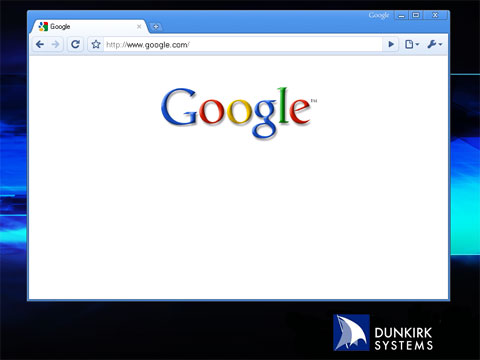
This morning when I opened my browser to perform a Web search I saw something different on Google’s home page – nothing but their logo. There was no search box or buttons, as shown below.
However, when I went to move the mouse on the page to make the other text appear on the page, I was returned a search results page for what I was going to search on!
So what happened – was I imagining this, or did I not have enough coffee? It turns out it was none of these. Rather, it appears Google has changed how searches are executed, as I found in this article on their search blog about the elimination of the search box.
“Google has adapted its predictive technology used for delivering relevant ads to how searches are performed. We can anticipate your search request without you manually typing in search keywords or phrases. This allows Google to provide a much richer, not to mention expedient, search experience, as well as optimizing our search indicies based on the collective thought of the world’s computer users, which we have been tracking for over the last decade.”
The article went on to mention this is not a beta feature and is live for all users.
Proof In Usage
So how well does it work? The search I was going to manually type in this morning was of “patriots” and I was returned a search results page with the first link listed being what I was looking for. When I paused after reading the Web page I got to from the search, another search results page was presented in the browser, this time for the search term “breakfast” which was what I was thinking about at that moment.
After thinking of several things and getting highly-relevant search results for each, I contacted a few friends and colleagues over Twitter to ask of their experience with this. One friend I was able to get a hold of on the phone in the Boston area said to me, “all I keep getting is search results pages in Google on the search term of 'porn'… wait a minute, that’s what I was, hey, I gotta go” and the call quickly ended.
Impact On Web Community
Though this was just released today, it will be interesting to see the reaction of the Web community to this. People who work in SEO, or search engine optimization, will probably all be out of jobs as what people want for content will be known ahead of time. Usability experts will probably be baffled as there is really nothing to be used on Google search anymore. Anyone developing for the Apple iPad will probably not notice anything different, as it is rumored there is an undocumented “feature” where the iPad blocks Google altogether.
What do you think about the new way to search on Google? How accurate are the search results for what you were thinking? Feel free to share your results in the comments, but you may not want to share everything you thought of.
Editor's Note: On 4/3/2021, changed the article link as the previous one was broken.
This is from The Hot Iron, a journal on business and technology by Mike Maddaloni.
Did you enjoy this? Subscribe to The Hot Iron by RSS/XML feed or Read by Email
Technology • Web Design • (4) Comments • Permalink
Page 105 of 220 pages ‹ First < 103 104 105 106 107 > Last ›
Subscribe to The Hot Iron



The Hot Iron strives to present unique content and point-of-view on business, technology and other topics by Mike Maddaloni, a technology strategist based in Appleton, Wisconsin.
Photo credit: Logan Connor/Oomphotography
Value for Value
If you like what you are reading on The Hot Iron, buy me a coffee!
About Links
In posts here at The Hot Iron there are often links and banner ads for products and services. For some of these links and banner ads, I receive compensation if you click and/or eventually buy said products or services. Where most links are marked as such, it is safe to assume any link or banner ad is a compensated one.