
What I Learned This Week For June 12 2020
By Mike Maddaloni on Saturday, June 13, 2020 at 10:03 AM with 0 comments
It was sunny. It was rainy. It was warm. It was cool. It was this past week.
- A healthy, fine-tuned database server will go far in the performance of a Web site or Web application. Never assume your database server is in that positive state.
- I went to Door County, Wisconsin for the first time last weekend. Door County is a peninsula that is about a couple of hours north of me in the northeast part of the state – I often say if Wisconsin is the right hand, Door County is the thumb. As we traveled though, it reminded me a lot of Cape Cod in Massachusetts, and ironically there is a motel named Cape Cod off the main road! We had a simple day trip to do some biking in a state park, but we will definitely be back to this beautiful area.
- This past week my favorite news and information radio show, Fresh Take with Josh Dukelow, went on a furlough schedule, going down to 3 days a week from 5. Alas it is another victim of the pandemic as advertising revenue is likely down. Where it’s unfortunate to all, from Josh to us listeners, hopefully the station will bounce back stronger after the reduced episodes are planned to resume a normal schedule in July.
- On recent episodes of Fresh Take I learned about TheDispatch.com, a news Web site that launched last year. Though the staff largely came from the former conservative publication The Weekly Standard, I have found their coverage to be very objective. It’s primarily a paid service but has no annoying ads for the free content they offer.
- I posted an item on eBay for the first time in a while, and found some additionally robust features, yet still as familiar as used to be. In case you’re looking for a lift rocking chair, the auction is open through this Sunday night.
- When going thru some old links while in my recently-reopened co-working space World HeadQuarters this past week, I found this article about my past co-working space in Chicago, OfficePort. I had clearly saved the article as a picture of me is in it.
- I got an email to say I passed the ExO Foundations certification exam I took last week. Fueled by my friend Eric’s passion behind exponential organizations and the start of his consulting firm BostonExO, I decided to take this free base-level exam. It was comprised of watching videos, taking a multiple-choice exam and writing short essays. Where I got a score for the exam right away, it took a few days before they reviewed my essays.
- Continuing in the vein of learning, I completed the first course as part of the Microsoft Cloud Skills Challenge for the month of June. The training is on their Azure cloud hosting service, and is relevant as at work we are planning to move our programs to this platform. These courses are free, and by taking them you can earn a free Azure certification exam.
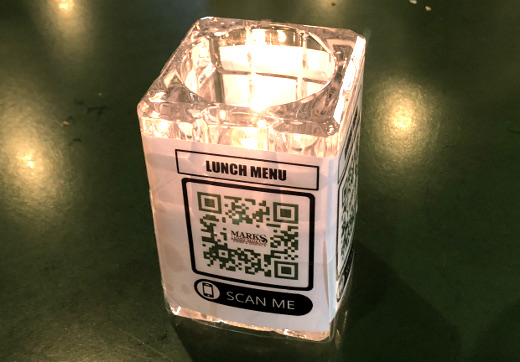
- As I have been venturing back out to restaurants, I have found many are adopting contactless, online menus that people can access by scanning a QR code with their smartphone. The fact that Apple now has QR code scanning built-in to its iOS operating system has allowed this to be a viable option. Had QR code scanning been built-in years ago, who knows how pervasive QR codes would be today?
Peace, Duane.
This is from The Hot Iron, a journal on business and technology by Mike Maddaloni.
Did you enjoy this? Subscribe to The Hot Iron by RSS/XML feed or Read by Email
What I Learned • (0) Comments • PermalinkWhat I Learned This Week For June 5 2020
By Mike Maddaloni on Sunday, June 07, 2020 at 07:54 PM with 0 comments

Better late than never. However there may be a reason why that is.
- Twice this past week I heard the term “COVID slump” and I can relate to it. In each case it was described similarly: we all started this sheltering-at-home period with a lot of energy and positivity that we would get through this. And for most of us it has gone okay, but over time that overexertion of energy has drained us. Where in the beginning we were all about Zooming, now whenever we see another invite to one we cringe and crave for in-person meetings! It has taken me a couple of starts to simply write-out these learnings from the week, where in past weeks they flowed much better. Even my last post – another “lost” one I wrote back in 2017 – took more time than I had hoped to finally type up, edit and post.
- Over the last week there has been an increasing amount of releases from companies and organizations about the senseless murder of George Floyd. Where most of them I take at face-value, one in particular I took with much deeper meaning. YouthBuild Boston is an organization that provides underserved kids building trade skills, along with education and support to thrive. I have been following them for close to 2 decades, and am proud to have supported them with their Web site and technology over the years. They sent out a message to “Our Students and All Who Care About Them” and you can read it here. Though the message did not have a link to donate to YouthBuild Boston, click here and know your donation will go to an amazing organization.
- If you ever Google yourself – something I do all the time and recommend you do as well – you may see your name appear on Web sites that look like they are simply aggregating personal information on you. This from on the LibertyID blog tells of how you can remove yourself from some of those “services.”. This blog is also a good source of information about identify theft.
- I had never heard about Progressive Web Apps until I read about them in the morning in this article by Matt Wilber. Shortly after that a colleague asked me about them – talk about timing.
- Where we hear about COVID-19 from doctors and medical scientists with a lot of numbers, I hadn’t heard anything directly from people who work exclusively with numbers. That is until I heard this podcast interview with Maurice de Hond, a Dutch data scientist, by Adam Curry. It’s a great interview and tied together for me some disporate information I have been hearing.
- You know those backdrop banners you see at awards shows or events that have company and brand logos repeating? The concept is called “Step and Repeat,” and thanks to Mark Boeder for educating me on this.
- This past week my kids got to swim with one of their friends from the swim team. Open lap swim started a week ago, but it has just my kids swimming. Yes, they all kept in their lanes, which were close to six feet apart, but it was nice for them to have some semblance of swim team practice which they haven’t had in months.
Yo Vinnie!
This is from The Hot Iron, a journal on business and technology by Mike Maddaloni.
Did you enjoy this? Subscribe to The Hot Iron by RSS/XML feed or Read by Email
What I Learned • (0) Comments • PermalinkLearning To Code In the Early 1980s
By Mike Maddaloni on Thursday, June 04, 2020 at 11:47 PM with 0 comments
With all of the focus and attention these days on teaching kids about STEM (science, technology, engineering and math), it has triggered me in a positive way to recall when I myself learned how to write computer code back in the early 1980’s.
Now before you rush to judgement and say there is no comparison of the world today in 2020 to nearly 40 years ago, I’ll somewhat agree. The technology itself today is vastly different now than from then, however there are similarities in how I got started with computers and how my interest progressed.
Where It Began
This flashback is truly a journey, back in time and over many miles from where I am now. My junior high school in Massachusetts was the scene. One day in my math class, instead of getting to use basic-function calculators that were locked in a wooden case, 3 carts were wheeled in to the classroom with a Commodore PET computer on each of them. Little did I know how this would be the catalyst of my passion for technology.
Be aware the mobile smartphone you may be reading this post on has orders of magnitudes more power, memory and storage that all 3 of those PET computers combined. Let alone the fact the screens were monochrome (aka black and white) as compared to the rich colors in the palm of your hand. That being said, those computers with their cassette tape drives (we had no floppy disk drives then) had much more power than the calculators we usually got to use and we didn’t even realize the powerful tool that was put in front of us.
Tool, or should I say toy? All we usually did in math class with the computers was play games. Sure, the intent of these computers in the classroom was to expose us to the early-stages of the concept of personal computers, from typing commands to loading software from the cassette tape drive and running said software. Despite these “skills” we were learning, it wasn’t enough for me. I didn’t want to just play games as my classmates were content with, I wanted to write games!
Geek Quest
If I only had a picture of the face my teacher made when I asked her how to write software to program the PET computer. After her initial shock, she admitted she didn’t know, but there was another math teacher, Mr. Palmer, who she thought could help me. I didn’t have him for a teacher before and didn’t know him at all, and back then it was unusual to get such guidance or training from another teacher. But I wanted to learn how to write code, so I was connected with him by my teacher.
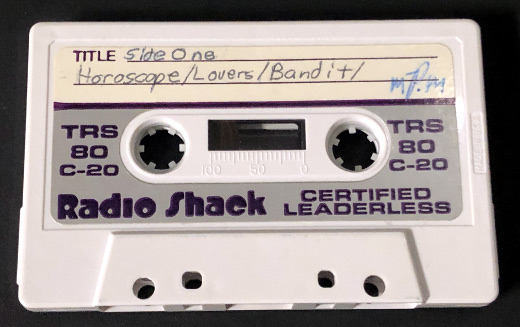
This unassuming introduction was a pivotal point in my life. And in middle school no less! Mr. Palmer proceeded to tell me the games and programs I was using on the PET were written in the BASIC programming language. He lent me a book on learning BASIC that he had, gave me some pointers and suggested I start reading this, and he would help me with any questions I had. He also said there were other books on BASIC and that other computers ran programs written in BASIC too, so I could look into those as well. Armed with this knowledge and direction, I was off and was writing my first BASIC programs by literally writing them with a pencil and paper. I did this at home or in study halls, and then when I got time in front of the computer, I would type them into the computer and save them to a cassette. The photo above in this post is of one of the cassettes I recently rediscovered from those days.
This geek quest was a solo one, however, as I was the only kid in class who wanted to write code. When it came time to use the computers in math class, of the 3 computers I would always get one to myself. Some kids complained, but overall they didn’t seem to care as long as they got a chance to play games in class.
What’s Your Sign?
My first programs were short ones that didn’t do a whole lot – clear the screen, scroll text, basic math – and I wanted to do more. The idea came from somewhere (sorry, I don’t recall all of the details of this time!) to write a program that would tell your horoscope. So I came up with a simple premise, you type in your astrological sign, spelling it exactly (even Sagittarius), and a preset silly horoscope for you would be displayed on the screen. If you know anything about programming languages, it was a giant If-Then-Else statement. But it was my If-Then-Else statement.
After some toil and testing, the program was done. I showed it to Mr. Palmer and he liked it, so I then let my math classmates give it a try. For as simple as it was, some of them were actually impressed that I was able to create such a program. And with this, I wrote the first of many, many computer programs I would over the next decades.
To Infinite Loop And Beyond
From this humble beginning, I learned more “advanced” features of the BASIC language. As I moved into high school I had access to the school’s mainframe, a Digital PDP-11, as well as eventually my own computer at home, a TRS-80 Model III. With these 2 platforms my learning took off, exploring more complex aspects of programming, the hardware of the computers and my first foray into going “online” with dial-up computer bulletin boards. Along the way I also had my first computer consulting gig in high school. Next came college and a degree in Computer Information Systems, and the career I have talked about much here in this blog.
Deconstructing Learning to Code
In the beginning of working with computers I had a mentor who guided and encouraged me – thank you Mr. Palmer, wherever you are! Over the years and many miles from the junior high school, it’s nice to reminisce about those exciting early days of computing and the enthusiasm I have had for technology. This guidance was important for me then, just as it is critical for young people today to also be inspired in a career in high technology.
This is from The Hot Iron, a journal on business and technology by Mike Maddaloni.
Did you enjoy this? Subscribe to The Hot Iron by RSS/XML feed or Read by Email
Build • Strategize • Technology • (0) Comments • PermalinkWhat I Learned This Week For May 29 2020
By Mike Maddaloni on Thursday, May 28, 2020 at 11:06 PM with 2 comments
It was a short and somewhat quiet week, at least on the work front.
- Among all the bills passed and rules changed in Washington DC regarding the pandemic, a change to Flexible Spending Account (FSA) allocations was made. If you’re unfamiliar, an FSA allows you to pay for medical and related expenses with pre-tax deductions from your paycheck. You can reduce the amount you originally signed up for, and if you haven’t heard from your employer’s HR department then you should contact them. That, or spend your larger-than-expected balance at the end of the year on Band-Aids.
- Two of the greatest summer swim meets are now canceled. With the City of Appleton, Wisconsin FINALLY (emphasis intentional) announcing if it’s going to open or close its 2 great municipal pools – yep, they will be closed – the 8th Annual Summer Classic in June and the 22nd Annual Bird Bath Invitational in July, a meet which attracts over 1,000 athletes from around the state and region are now canceled. Where the fact that they wouldn’t happened was inevitable, the reasons why decisions were prolonged baffle me. And others.
- Not to dwell on agitation on what is preoccupying most of the world right now, but this post on the Brand New blog has the tone of something I have written in my head many times in the last few months.
- I get daily Google Alerts on my last name, which likely everyone reading this does too, right? A hit on this unique product on Amazon came up and made me wonder if it’s an automated product customization feature of the retail giant?
- You need to be 18 to buy Super Glue in Wisconsin, and not a malfunction with the self-checkout register that was prompting a store clerk to come over to approve the purchase. I didn’t inquire further why the rule or law was in place, but now I have something to look into if I am really bored.
- This article brought the inner-child geek in me – it is about how you can access the software and data on an old computer cassette using a vintage computer emulator on a modern computer. Apologies if I lost anyone there, but as I have several old tapes from decades ago – if they haven’t demagnetized, they’ll be fun to explore!
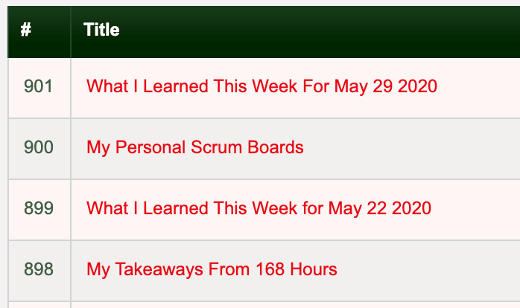
- This is my 900th post here on The Hot Iron. It shows as post 901 as the first post I made to this blog 13+ years ago was likely a test and deleted. It’s a nice milestone, and now I can’t wait to get into quadruple digits.
Happy Anniversary Sweetheart!
This is from The Hot Iron, a journal on business and technology by Mike Maddaloni.
Did you enjoy this? Subscribe to The Hot Iron by RSS/XML feed or Read by Email
What I Learned • (2) Comments • PermalinkMy Personal Scrum Boards
By Mike Maddaloni on Wednesday, May 27, 2020 at 10:14 PM with 4 comments
Shortly after completing my Scrum training and becoming a Certified ScrumMaster, it was clear to me that in order to be successful at the Agile framework, I have to be an active practitioner. Where I am planning that in my job with my director who is a Scrum Master himself, I sought other ways to use it.
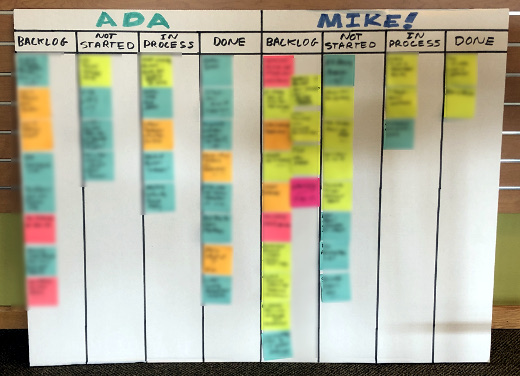
Where I am applying Scrum right away is in my own work and in my personal life. The latter was reinforced when I read Scrum: The Art of Doing Twice the Work in Half the Time by Jeff Sutherland as he talks about how to use Scrum well beyond software development. This led me to creating personal Scrum Boards for both. The picture accompanying this post is of my Scrum Boards, with my work one to the left and my personal one to the right.
Elements of a Scrum Board
A Scrum Board is a tool for tracking progress and providing visibility on a project. There is single definition of how one is structured or organized, as it should ideally fit your needs, whether individually or for your Scrum Team. The basic components of it should include the following, and I also indicate how I have adapted these components for my needs.
Backlog – A Backlog is the work to be done. Larger, higher-level items are called Epics, and smaller, shorter, more specific items are called User Stories.
In both of my Scrum Boards the Backlog is the first column – yes, I purposely blurred out the tasks in it, both for confidentiality and to not bore you, my dear reader, of the mundane minutiae of my life. Most all of these are User Stories. Each is written on a Post-It note so they can be easily moved around.
Not Started – This is actually an optional component, and is also referred to as a Sprint Backlog. All work done in Scrum is done in Sprints, a defined period of time such as 2 or 4 weeks. The items in these columns are what I plan to work on during the week. As it is not required, I simply could have all of my Backlog prioritized in one column.
For myself, I have 1-week Sprints. At the start of the week, I review – or Refine – the Backlog and select the work to be done in the Sprint. Refinement also includes readdressing the priorities of Epics and User Stories, which can vary from week to week, or in this case Sprint to Sprint. Once this process is completed, I move the Post-Its to the appropriate column.
In Process – When I start an Epic or User Story, I move it to this column from Not Started, indicating what I am actively working on.
It’s not uncommon for me to have multiple items in process as I am often awaiting something else to be completed to proceed. It is not my intent to have more things in process than I can manage. The goal here is to use this to get more work done by breaking tasks into smaller components.
Done – Once a User Story or Epic has been completed, it gets moved to this column, and a small celebration takes place in my mind.
The accompanying photo was taken towards the end of last week, when I had several items done, and since then I completed more. At the end of the week I clear all Done items, and hold a review, or Retrospective, to go over the week, realities in my schedule, setting up the next Sprint the following week.
More To It Beyond Myself
In using Sprint Boards for personal work, I am adapting it from a standard Scrum flow. I am performing the roles of a Scrum Team myself – the Scrum Master, Product Owner and Development Team. I also am not doing a Sprint Review per se, a process of demonstrating the work of a sprint for approval, for as I move an item to Done I am reviewing it at that time. Additionally, my Retrospective and Refinement processes are not as involved.
A Scrum Board is typically displayed prominently in an office or managed using an online tool that all have access to. Mine is on a project board that kids use at school for presentations, as its tri-fold format allows me to easily transport it through my house or even to my co-working space. During the workday it is open and visible and at night it’s folded away.
There are other components that can be added to a Scrum Board. This article from Scrum Inc. on Scrum Boards expands more on them, and how other elements of Scrum interface with them.
You Can Do It
Have I convinced you to have your own Scrum Board? I welcome your thoughts and how you manage your own in the comments to this post.
Deconstructing Scrum Boards
A single, visible place for all elements of your project are what Scrum Boards are for and are a key component to the Scrum framework. Though my own Scrum Boards are modified in some form to use for myself, even in this form it is good practice to follow as my overall work is transformed towards Agile.
This is from The Hot Iron, a journal on business and technology by Mike Maddaloni.
Did you enjoy this? Subscribe to The Hot Iron by RSS/XML feed or Read by Email
Business • Agile / Scrum • Thrive • (4) Comments • PermalinkSubscribe to The Hot Iron



The Hot Iron strives to present unique content and point-of-view on business, technology and other topics by Mike Maddaloni, a technology strategist based in Appleton, Wisconsin.
Photo credit: Logan Connor/Oomphotography
Value for Value
If you like what you are reading on The Hot Iron, buy me a coffee!
About Links
In posts here at The Hot Iron there are often links and banner ads for products and services. For some of these links and banner ads, I receive compensation if you click and/or eventually buy said products or services. Where most links are marked as such, it is safe to assume any link or banner ad is a compensated one.