
7 Vital Web Site Updates For The Pandemic
By Mike Maddaloni on Tuesday, August 11, 2020 at 09:49 PM with 2 comments
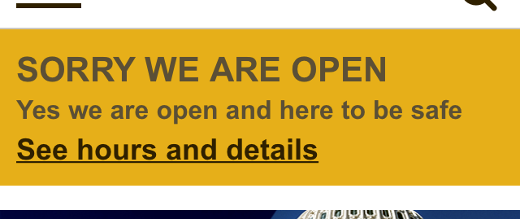
As businesses and individuals return to work, of equal importance to safety and protection is communications – we need to know as much as possible to make informed decisions. One area I have found lacking is with the Web sites of businesses and professionals. Many sites I see in the course of trying to return to normal suffer from a dearth of vital information needed for people to determine if they are still operating or not, and if so how.
Here I offer seven recommendations for your Web site to indicate the status of your business and how to help return to normal as possible these days.
Add alert functionality upfront – If there’s something important you want people to know, put it right up front. How? You can have a brightly colored alert banner anchored to the top of your home or all Web pages to inform people. A browser pop-up can also achieve this. As you may not have this functionality already, you might have to check with your Web site consultant or look into the services of your Web site platform to see how you can gain this. It may be easier than you think, and even if it comes with a cost, it will be well worth it.
Are you open? – This may be obvious to you the business owner, but not all Web sites I visit make it clear. The messaging may be nested into the design of the site but not easily found. Using the alert functionality mentioned above is one way to achieve this. Another is to look at all of the content of your site and make whatever adjustments needed to indicate so.
Update location, hours and contacts – Due to changes in your business, have you relocated? Did you change your hours? Do you have different contact information? Is this new information reflected on your Web site? If not, it should be.
Changes to your business practices – If the experience your customers will have with you has changed as a result of COVID-19, indicate this on your Web site. Will someone have to wear a mask? Do you have shielding in place? Is distancing required? This is important for people to understand if they can still do business with you and will give them the peace of mind they may need that it's safe to do business with you.
Add social media feeds to your site – Many businesses and individuals are updating their social media accounts more than their Web site. Why not kill two birds with one stone and put the feeds from your social media accounts onto your home page? How to do this varies depending on your site and you should follow the previous tips on checking your Web site provider or consultant.
Start an email list – Many businesses found out the hard way when they had to shut down that the only contact with their customers was when they came through their door. As my good friend John Wall says on his Marketing Over Coffee podcast, you've got to have a house list. Every business, every professional should have an email list with the sign up on the Web. There are many different services where you can set up a mailing list, some are even free. For example, if you are reading this by email, I use MailChimp in order to create and send the emails from my RSS feed. You can customize templates and the content to send to your customers and contacts.
Add e-commerce – There's no time like the present to take online payments or sell products and services online. Just last week, Chipotle just started doing this by selling clothing and other items online. Now the company that was all about selling burritos and bowls is now into merchandising. If you don't have a specific new product idea, simply having the ability to take credit cards is important. It can be as simple as setting up a PayPal account and pay by the transaction by transaction, then upgrade to a credit card service when you get more volume.
Deconstructing vital Web site updates
As social media and other services have evolved, much business content and functionality, even e-commerce, uses them. Your Web site may have been neglected or completely out of sync with other messaging you have out there. As Coronavirus remains out there, I recommend these vital Web site updates to ensure it remains an integral part of your business.
This is from The Hot Iron, a journal on business and technology by Mike Maddaloni.
Did you enjoy this? Subscribe to The Hot Iron by RSS/XML feed or Read by Email
Business • Strategize • Web Design • (2) Comments • PermalinkWhat I Learned This Week For August 7 2020
By Mike Maddaloni on Thursday, August 06, 2020 at 11:34 PM with 0 comments

While many I know on the US East coast were clearing fallen trees from Hurricane Isaias this week, I tried not to be too guilty of the unseasonably cool weather we had in the Midwest, which perhaps made me more open to things around me.
- My friend Jimmy’s brother Bobby was recently diagnosed with a form of cancer, and now his family is facing a financial uncertainty along this unplanned medical journey. A GoFundMe page was setup for him, and if you are so inclined, please help this family in need.
- After watching the SpaceX Falcon capsule successfully splash down this past weekend, I was reminded of an article I read a while back and re-read this week about how Elon Musk and SpaceX use agile.
- I did some brainstorming on how I may do a guest lecture I have been invited back to give to an Interactive Web Management class at the University of Wisconsin – Oshkosh. In the process I recalled a past lecture I gave remotely in 2015 using Personify software. So I looked into Personify again, and learned that literally just a few weeks ago they released a version of their previously PC-only software for the Mac. I am going to evaluate both of their remote presentation apps for options on how I can best present a typically interactive, in-person learning session I have been fortunate to give over the last few years.
- Without getting into any awkward details, the Native deodorant brand is my new favorite.
- My co-working space, World HeadQuarters, announced they are moving to 2 new spaces at the end of the month. I have mentioned this space over time but hadn’t written anything in detail on it, and will do so once they move. The current space, a former ski shop, is very unique but not as functional as what the new spaces will offer.
- My favorite domain name registrar Name.com wrote on their blog about the opt-in security features they offer. As a long-time customer I leverage some of these, and am fortunate I have the choice to do so, unlike other registrars who invoke them without warning, no matter what they say. And yes, the link to Name.com will earn you – and me – a $5 credit if you move your domain names to them like I did over a decade ago.
- Healthcare software firm athenahealth recently rebranded one of its products as athenaIDX. This was nostalgic for me and hundreds others who worked for IDX Systems Corporation back in its heyday. IDX was acquired and went thru corporate selloffs and mergers before athenahealth got the product. The rebranding was extra nostalgic for me as I was involved in the last rebranding of its products that IDX did, as I managed the domain names for the firm, I was one of a few people in the whole organization who knew what the new brands would be before they were announced. I wrote about this a few years back as it was part of the project I didn’t “politically” work on.
- I would have thought the phone system hold music at SiriusXM would have been much better, but alas no. And if you truly want to get the best price from them, you have to commit to canceling, then they will offer it to you.
- I watched the documentary Juice: How Electricity Explains the World this week. It was a well-done presentation about electricity consumption and generation around the world. Even better was that, in my humble opinion, it was relatively objective and had no strong political leanings. And entertaining and educational as well.
- For my last post on book takeaways from The Fight for Four Freedoms I used Temi, the voice to text service I found a few weeks ago. I actually wrote it in a notebook, read it into my iPhone, then uploaded the audio file to Temi. As they don’t charge for your first submission, I saved about $1.50 for the six-minute audio file. Not to forget the likely half-hour I would have spent to initially type it. It still required editing, but the time savings for the initial transcription was well worth it.
- There was a bridge to nowhere, and now there’s stairs to nowhere. Gabriel Lofts are new apartments in a 100+ year old former lodge and furniture store building in Appleton, Wisconsin. The builder said they were going to retain many of the building’s unique features, and one is the above-pictured staircase, though it now leads to nowhere. At the bottom of the stairs at street level is a glass door, so I am curious to how they plan on using this space.
Happy Half-Century Mr. Northwoods!
This is from The Hot Iron, a journal on business and technology by Mike Maddaloni.
Did you enjoy this? Subscribe to The Hot Iron by RSS/XML feed or Read by Email
What I Learned • (0) Comments • PermalinkMy Takeaways From The Fight For The Four Freedoms
By Mike Maddaloni on Tuesday, August 04, 2020 at 08:41 PM with 0 comments
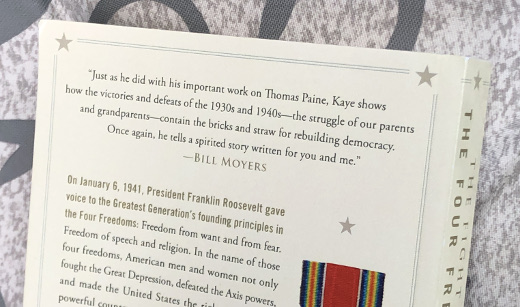
For myself growing up in New England, I was always interested and intrigued about the history of the United States. As a child, I was engrossed with the celebration of the Bicentennial of our country. Being in the area where early events in America happened, it was almost like I was absorbing history rather than studying it.
For a lot of the rest of the history of my homeland, however, I don't know it to the same level of depth. Much of it to me is top-line to the timeline, but without a lot of the minutiae. This is why I was interested in reading The Fight for the Four Freedoms by Dr. Harvey Kaye. I learned about the book after I heard Kaye on local radio interviews. I borrowed a copy of the book from a friend to learn the author's take on this time in history.
My takeaways from the book were a mix of thoughts on myself and history.
I had no recollection of ever learning about the Four Freedoms – As I read through the book, I often ask myself, why didn't I already know about this? Thinking back on what I learned in public schools, that one history class in college, stories from family members who lived through that era as well as my own personal reading, I knew a lot of the basics – the Great Depression, President Franklin Delano Roosevelt (aka FDR), the New Deal, Social Security and of course the U.S.’s entry and time in World War II. All things considered, I can’t recall the Four Freedoms at all.
In short, the Four Freedoms were goals or quests FDR had for America: freedom of speech, freedom of worship, freedom from want and freedom from fear. He first presented these when he addressed Congress in January, 1941. I know the first 2 are in the U.S. Constitution. The last two, in my own assessment, are “covered” with the phrase “life, liberty and the pursuit of happiness” in the U.S. Declaration of Independence.
There were a lot of government “acronym” agencies during this time, and now – Thinking back on my own history lessons, I knew about the Work Progress Administration (WPA) and the Tennessee Valley Authority (TVA), but that was about it. The book lists programs after program, agency, after agency, and all were referred to the acronym for their much longer names. We of course have this today, with new ones created just this year. If I were to look back my guess is there were more in between and even before this time. Each acronym comes with its own overhead needs to exist: budget, staff, etc., and one always hopes the results are worth the effort to create it.
History plus opinion of this period of time – I knew going into the book, from listening to him on radio interviews, the author has strong liberal / progressive political views. As I read the book, this was evident in the very positive tone given to FDR and all that government did, in contrast to the negative tone towards business and free enterprise. Granted from my own knowledge I know all wasn’t good from business, and many had the same feelings towards the government. I was able to read beyond this, however, and still got the essence of the Four Freedoms. Not bad for a self-described centrist and supporter of business and entrepreneurship.
I recommend The Fight for the Four Freedoms for anyone who is interested depth on this topic and period of time. It painted a good picture of the beliefs of FDR, those who followed him and the meaning behind his goals. As I borrowed this book, I returned it to its rightful owner and did not pass this one onto someone else.
This is from The Hot Iron, a journal on business and technology by Mike Maddaloni.
Did you enjoy this? Subscribe to The Hot Iron by RSS/XML feed or Read by Email
Book Take-Aways • (0) Comments • PermalinkWhat I Learned This Week For July 31 2020
By Mike Maddaloni on Friday, July 31, 2020 at 02:12 PM with 0 comments
The idea of these “What I Learned” posts is certainly not something original, just the content is. I certainly didn’t create this category, and I have seen more and more of these types of posts and emails out there. So before I get into this week’s, I ask – do you find these useful? Feel free to add a comment to this post or contact me. In the meantime, here’s what’s cross my personal dashboard, in some cases literally.
- If IKEA is the crown jewel of the flat-pack, build-yourself furniture market, then I just found the court jester in Monarch Specialties. I finished putting together a new desk for my daughter which, in the end, looked as nice as the pictures of it online, but was an unbearable experience to build. To begin with, the instructions were extremely tiny, even with a magnifying glass combined with my reading glasses. The instructions also took major “leaps” on each page – rather than step-by-step, several steps, some which required an extra person or fancy maneuvering, were combined together. I could go on, and I just may with a not-so-flattering product review.
- The Nielsen/Norman Group is a consultancy on online usability and user experience and is well-known in the Web space. Their recent article on Privacy Policy and Terns of Use pages on Web sites can be summed up in 3 words – they all suck. Note those are my own words, and you can read the article for yourself if you are so inclined. With the increased number of international privacy laws, coupled with people trying to bypass them, those pages likely won’t get any better.
- Though it was a Merriam-Webster word of the day a while back, for some reason flibbertigibbet didn’t resonate with me then, as I read them daily. But it has stuck with me now as it was the title of a recent episode of the news analysis podcast No Agenda.
- Posts of the picture of Dignity,, a large, unique monument in South Dakota stated appearing recently on LinkedIn. However, Dignity was installed several years ago. I wish I had known about it before and on my family’s road trip that way last year we would have taken a different route to see it.
- My friend Nick Rhodes’ photo booth service OutSnapped now offers a virtual component. And not surprisingly to me, it has a great user experience and creates some great pictures – check it out for yourself and try it for free. If you are hosting a virtual event and want something other than the usual Zoom / Brady Bunch grid, check out OutSnapped.
- I recently ventured over to High Cliff State Park here in Wisconsin. The entry booth is no longer staffed and even the automated pay stations are disabled, thus leaving buying a pass online as the only option. But it has to be an annual pass, not a daily pass. But the extra funds go to a good cause, right?
- A local small business that I have used extensively since we moved here, Donaldson's Cleaners, went delivery-only as a result of the virus and closed its 2 retail stores. As I never visited the stores and as an indicator to send me monthly statements with inserts like this announcement in their customer system was not checked, I didn’t find out until I saw the story on a local newspaper’s Web site. That being said, it has had no impact on me, in the quality cleaning of clothes or their service level.
- If you buy a hitch cover for a trailer hitch on your vehicle, don't forget to buy a hitch lock pin, which is most always sold separately.
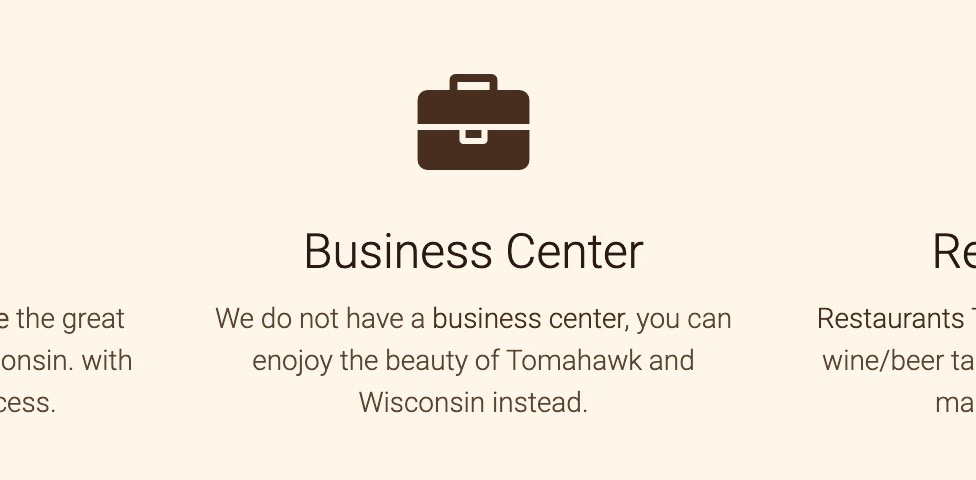
- When looking for a place to stay for some form of a real vacation this year, I found the Web site for a hotel that had the interesting description above for its non-existent business center.
As I was editing these I was listening to DJ Liquid Todd on SiriusXM’s BPM channel. I had a déjà vu moment as I recall listening to him on WFNX in Boston back when I was in Boston and there was still a WFNX.
This is from The Hot Iron, a journal on business and technology by Mike Maddaloni.
Did you enjoy this? Subscribe to The Hot Iron by RSS/XML feed or Read by Email
What I Learned • (0) Comments • Permalink5 Ways I Wish Business Was More Like Sports
By Mike Maddaloni on Thursday, July 30, 2020 at 07:17 PM with 2 comments
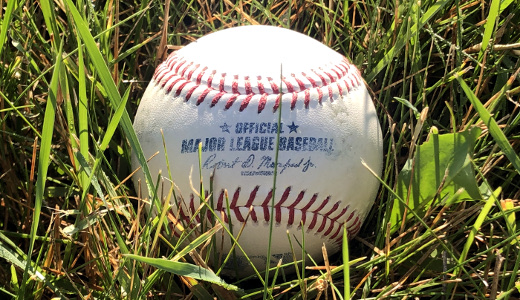
With professional baseball finally – well, at least as of this writing – starting to come back this year, I have been thinking more about it and other sports, especially how teams and the league are structured. In keeping with the mission here at The Hot Iron, my mind has been pondering how the business world could benefit from being more like professional sports.
Now before you the fair reader says, “hey, pro sports ARE businesses” let me elaborate. First, I concur, as you can’t have teams worth multi-billions and players making multi-millions and not be a business. Where I think they can be more alike, it’s certain aspects unique to sports that would be welcome and refreshing complements to the business world.
And now, ladies and gentlemen, here’s the starting line-up for my 5 ways I wish business was more like sports.
Minor leagues – When you get a job with a company, you are working right away. Some firms may have a training program, and many have a probationary period, but those are in place to get you up to speed and to fire you if need be, respectively. If you are new entering the workforce, say from school or perhaps not, or if you are switching careers, having a minor league system would be a great way to develop your skills and abilities, all the while actually producing.
By being in a minor league system in business, it’d be known that it is still the minors, and expectations would be somewhat different. Such differences could be in your pay and the cost of your services. When you are ready to perform at the top level, you would join the majors. If you never achieved that level, you could stay in the minors or maybe switch careers. In either case the minor leagues of business can be a place to develop the best and brightest people.
Free agency – Talk about the ultimate transparency, as everybody knows what an athlete makes and what the terms of their contracts are. What if that was the same in business, where it is completely the opposite and as non-transparent as one can imagine.
What you are worth to the marketplace would be well-known, and if your current employer couldn’t offer it to you, you could easily go elsewhere, being a free agent. Sure, being a contractor in today’s business environment is a close approximation, but the knowledge of who’s out there and available in any profession or discipline would not be as much of a mystery as it is now.
Working 162 days a year – That’s the number of games in a traditional Major League Baseball season, and other sports have fewer. When you are only working those days, it doesn’t mean you are idle the remainder of the year. When not in a game you are training, relaxing, recovering, getting physical therapy or even meditating.
What if the business work schedule allowed for you to have designated working days and designated training days, days in the middle of the week, and not just at night or the weekends? This way you can prepare better for your work time, ideally correlating to you being more productive and efficient.
No stigma to getting fired – When you get fired in business, it is a bad situation. How many people go around saying, “hey, I got fired?!” There are many reasons why people are fired, including lack of management oversight, new leaders or a change in direction in a company or group. Many times, it is simply personality conflicts. Or simply they could have made mistakes worthy of their termination. Getting fired doesn’t mean you don’t have the skills to do your job. That being said, you are not going to go out looking for a new job saying you were fired from your last one.
In sports, it’s the opposite. Players are getting cut all the time, and many times their unemployment is short as another team signs them. Coaches are getting fired all of the time, only to emerge wearing another team jacket the next season. In all cases it was well-known that the coaches or players were fired, yet nobody is shouting at them during a game because of what they did for their last team. Both players and coaches can perform poorly one season and thrive and win the very next one for a variety of reasons, such as the organization they go to has a much different culture or “system” which works better for them.
Spring Training – In business, an annual kickoff for the new year could be a weekend away for some senior leaders, but for the majority it is a meeting or, these days, a Webinar. What if business had a true spring training, as baseball does, where you get out of the normal office, get some training and bond with your co-workers, and plan and prepare for the upcoming calendar or fiscal year?
Deconstructing Business Being More Like Sports
The way sports have traditionally operated lends to the structure and elements as I have outlined here. As sports have evolved, players and coaches are “working” year round, just as a standard business does. I present here how I have imagined how business can leverage some of these elements from sports, and feel it could transform how businesses function and perform. Isn’t it worth a try to change business as usual?
This is from The Hot Iron, a journal on business and technology by Mike Maddaloni.
Did you enjoy this? Subscribe to The Hot Iron by RSS/XML feed or Read by Email
Business • Strategize • (2) Comments • PermalinkSubscribe to The Hot Iron



The Hot Iron strives to present unique content and point-of-view on business, technology and other topics by Mike Maddaloni, a technology strategist based in Appleton, Wisconsin.
Photo credit: Logan Connor/Oomphotography
Value for Value
If you like what you are reading on The Hot Iron, buy me a coffee!
About Links
In posts here at The Hot Iron there are often links and banner ads for products and services. For some of these links and banner ads, I receive compensation if you click and/or eventually buy said products or services. Where most links are marked as such, it is safe to assume any link or banner ad is a compensated one.