
Blog Post Titles Matter
By Mike Maddaloni on Saturday, November 14, 2009 at 10:49 AM with 0 comments
 You set up your blog, you write frequently, you have a great subscriber base, so you’re done, right? Hardly. A blog is only as good as its most recent posts, and in order to keep people thinking you’re good they must be reading, and with every post you must compel them to do so, and it starts with the title.
What’s Old Is New Again
The title of your blog post is like the headline of a news story in the newspaper. It must be true to the topic, yet have an element of sales to get someone to read it. Especially today, where people do not go out of their way to buy a newspaper and rather have a lot to choose from online, the title of the blog post has to resonate with them and be the entre to your writing.
It’s Not Just You
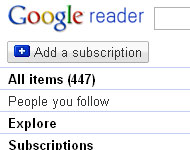
As the choices of what to read are almost limitless, coupled with the lack of attention span and overall time of the reader, people need to understand in seconds what your post is about and make a decision to read it or not. And in many cases, it has nothing to do with you personally, but moreso with your competition. Many people read blog posts with a blog feed aggregator such as Google Reader. If they go a few days – or even hours – without reading, the number of unread posts can quickly accumulate, as shown with the accompanying screen shot from my own Google Reader account. When faced with this, people will just scan headlines to get beyond the sheer number of posts and back to a manageable number for a later time. Your wonderful, thoughtful writing can be a victim of someone’s lack of time if it doesn’t catch their attention.
Where many times the headline comes first then the text of the post itself, before you go live with it, review the headline to see if it matches what you just wrote. If not, take a few seconds to adjust it, and this time invested may mean all the difference for someone else to take a few seconds to read what you wrote.
Did you enjoy reading this? You are welcome to subscribe to The Hot Iron by RSS feed or by email.
5 Years of Dunkirk Systems, LLC
By Mike Maddaloni on Friday, November 13, 2009 at 03:30 PM with 3 comments
 Today “technically” marks the 5 year anniversary of my consulting business, Dunkirk Systems, LLC. I say technically as it is the date of the filing of my incorporation of the business.
Where the true origins of my consultancy go back many, many years, the point where I decided to go on my own is in 2004, and it has been a wild ride from there for sure. On an almost daily basis I learn more about what it means to be in business – everything from operations to money to customer service. I have had the good fortune to work with some great people, from partners and contractors to clients.
So happy birthday Dunkirk, and it’s time to get back to work, as there is much more that lies ahead if we want to make it another 5 years!
Did you enjoy reading this? You are welcome to subscribe to The Hot Iron by RSS feed or by email.
Next likemind Chicago on Friday December 4
By Mike Maddaloni on Thursday, November 12, 2009 at 10:14 AM with 0 comments
 The next likemind will be Friday, December 4, 2009 in dozens of cities around the world.
In Chicago, it will be at Argo Tea, 140 S Dearborn St. at the corner of Adams and Dearborn Streets in the Loop from 8:00 am to 10:00 am.
For November and December, likeminds are combined into one with the global holiday schedule.
I call likemind a gathering of creative-minded people, from various disciplines including Internet, advertising, art, social media, et. al. For more information on likemind, you can read this great article on likemind from the New York Times.
No RSVP is required. You are also welcome to join the likemind Chicago Facebook group.
Did you enjoy reading this? You are welcome to subscribe to The Hot Iron by RSS feed or by email.
Get Your Name On Twitter
By Mike Maddaloni on Wednesday, November 11, 2009 at 05:00 AM with 4 comments
Whether or not you plan on using Twitter any time soon, get your name on it now. Register for the microblogging service and create a basic profile with a URL link to your Web site.
Why? The main reason is more and more people are using Twitter and these people have a great expectation for other people and companies to be there as well. People will try looking up a person or entity by simply trying their name after twitter.com, as shown below.
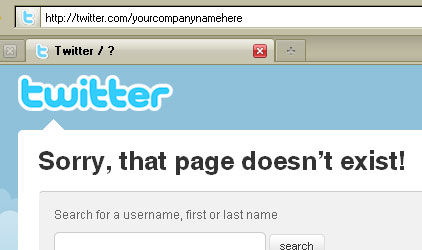
If they can’t find you, they will try to search for you. If they still can’t find you, they will probably post a tweet stating they couldn’t find you.
Another reason to at least set up the account is someone else may do it before you. Squatting on personal, company and brand names is becoming common it Twitter, just as it is still common with domain names. The simple, inexpensive way is to get the name now and avoid the hassle later if someone else gets it before you do, just as it is with domain names.
Once you have your Twitter account, make a plan to start using it. Spend some time exploring Twitter, read any number of blogs and articles on it, and see who else is using it, especially in your market and industry. Look for more on Twitter and social media from Dunkirk in the future.
Consider Twitter as you would any other tool for your business, as others will have that expectation of you. And when you do start using it, follow me.
Did you enjoy reading this? You are welcome to subscribe to The Hot Iron by RSS feed or by email.
Analogy Of Buying A Car And Web Site Scope
By Mike Maddaloni on Tuesday, November 10, 2009 at 12:44 AM with 1 comments
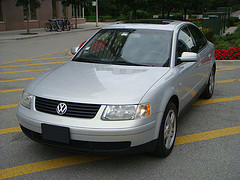 When it comes to explaining the process and elements of Web design and development, I find myself using analogies to the real world. Though they sometimes feel cliché to me, they do help many clients and prospects to understand what they are about to get into.
One common one is comparing the scope of a Web site project with buying a car. Imagine going into an auto superstore or an extensive used car store and a salesperson asks, “can I help you?” This scenario is similar to when someone comes to me and states, “I want a Web site but I don’t know where to start.”
Many of the same considerations come into play, and here’s a few of them matched up.
Car – How many people do you need to transport?
Web – How large is your firm/organization?
Car – What accessories do you want?
Web – What features do you want for the Web site, such as eCommerce, blog, etc.?
Car – Are you the only driver or are there others?
Web – Will others be maintaining the information on the Web site?
Car – Do you have a trade-in?
Web – Do you currently have a Web site?
Car – What is your budget?
Web – What is your budget?
There are many others I have used, but these examples help both the Web site owner and the consultant to determine the scope of the Web site, including features, functionality and content. I also have other analogy categories I will share another time.
Do you find analogies of this sort helpful?
Did you enjoy reading this? You are welcome to subscribe to The Hot Iron by RSS feed or by email.
Page 112 of 220 pages ‹ First < 110 111 112 113 114 > Last ›
Subscribe to The Hot Iron



The Hot Iron strives to present unique content and point-of-view on business, technology and other topics by Mike Maddaloni, a technology strategist based in Appleton, Wisconsin.
Photo credit: Logan Connor/Oomphotography
Value for Value
If you like what you are reading on The Hot Iron, buy me a coffee!
About Links
In posts here at The Hot Iron there are often links and banner ads for products and services. For some of these links and banner ads, I receive compensation if you click and/or eventually buy said products or services. Where most links are marked as such, it is safe to assume any link or banner ad is a compensated one.