
A Next Frontier In Mobile Is Behind The Corporate Firewall
By Mike Maddaloni on Tuesday, February 15, 2011 at 05:00 AM with 0 comments
While I say I cannot predict the future, sometimes things are so glaring to some and not others, by pointing out you are opening eyes for some people. One of them for me is “a” next frontier in the use of mobile technology – to get beyond the corporate firewall and use all of the tools and data like you can do on a full computer. Note I say “a” next frontier, as it is out there, I just don’t know if it’s the “next” or “last” frontier.
Why do I believe this? Over the years I have managed public Web sites, corporate Intranets, Extranets, portals and knowledge management systems. I have seen how these tools, when used effectively, make people productive. I have also seen how when not managed properly they become a huge mess and waste of resources. Typically, there is a mix of these within most organizations, everything from advanced applications, to a PC under someone’s desk hosting a group’s Intranet Web site, to email.
Going Beyond Email
Using your mobile device to work as you would at work is long overdue. Most corporate workers who have a mobile device use it for email. But beyond email, there may be a limited amount of apps or data available to them. Mobile devices have Web browsers, but you may not be able to make a VPN connection within your company’s firewall. Not having this prevents you from accessing what you can do on your work computer, from your desk or away from it.
More and more email is being used to get around this lack of access. Have you ever asked co-workers or your admin to send you files or information you can’t get at? I see this all the time as friends – even my wife – have to do this in order to get what they may need for a conference call they have to make from a remote location. There’s no other way, especially if getting online with your notebook computer is not an option, or you don’t want to lug it (and power cables, etc.) around.
Going Beyond Mindsets and Existing Network Infrastructure
Shortly before his inauguration, there was buzz about how US President Obama wanted to carry a BlackBerry. In the end, he got one. It is not completely known what kind of security is in use with his device, but the bottom-line is it was achievable. My guess is it’s not out of reach for most companies.
Part of the issue with going mobile with your company information is a mindset it is not secure. This is where you need to go beyond your current infrastructure. As tablets and smarter phones hit the market and become more and more commonplace, the demands from staff will require both of these looming issues to be addressed.
Do I Need An App For That?
Once you go beyond the firewall, the fun begins. Some content and applications may already look great on a mobile browser. Some package applications may already have mobile-friendly interfaces, or even apps to access data. I recently saw a development tool for interfacing with CICS screens on an iPad. (If you don’t know what CICS is, its how most applications were developed on mainframe computers that allowed users to enter and query data. As many CICS screens are still alive and kicking today, thus the opportunity for such a tool). Then there’s the content and applications where you’ll need to either build or buy (or both) to access them outside of the office.
Access content and data in multiple formats on multiple platforms is an opportunity to drive innovation in your corporate Intranet and sites. Everything from comprehensive search to centralizing content to reaping value “dead” or unpopular content can be gained from this effort. As you go forward, build into your requirements mobile platform compatibility, whether for your own internal development or for your third-party vendors. Just think about taking an online training course on your mobile device while sitting in the waiting room for jury duty, and you get the power and convenience of extending the workplace to mobile devices.
Keeping Up With Small Businesses
Many small businesses have some of this capability already. Google Apps works well on Android devices. Salesforce.com has apps for many devices. QuickBooks Online has mobile versions of its full Web-based application. All of these are hosted, third-party services, which does not require the infrastructure to go beyond the firewall. As some larger businesses use Salesforce already, they have an advantage with the ability for their users to work on a mobile device.
Big Picture Thinking On Little Devices
Looking back on what I have presented, I covered a lot, and at a high-level, big picture perspective. As anyone who has worked in computer systems knows, the devil is in the details. But keeping in mind a roadmap to where you want to be, from the short-term to as far out as you can realistically plan, literally getting the information into the hands of those who need it will be critical and advantageous for any business. Let alone the opportunity for those who will be involved in making this happen, whether they build mobile hardware, platforms, apps or supporting software.
Do you agree on this future frontier of mobile? Are you looking forward to it? Are you using it today? Please share your thoughts in the comments of this post.
Did you enjoy reading this? You are welcome to subscribe to The Hot Iron by RSS feed or by email.
QR Codes In Grammy Awards Broadcast Chicago Transit Ads
By Mike Maddaloni on Wednesday, February 09, 2011 at 05:00 AM with 2 comments
On Sunday, February 13, 2011 the Grammy Awards will be held and broadcast on the CBS network in the US. To promote this, there are ads displayed on the “L” train platforms in Chicago, also known as the Chicago Transit Authority or CTA. Below is a photo of how 3 ad panels are displayed together.

On each panel there is a QR code. When scanned, it goes to a Web site called MusicIsLifeIsMusic.com, specifically to a page for the artist appearing on the particular ad panel. Below is a detailed photo of a QR code for an ad for Katy Perry.
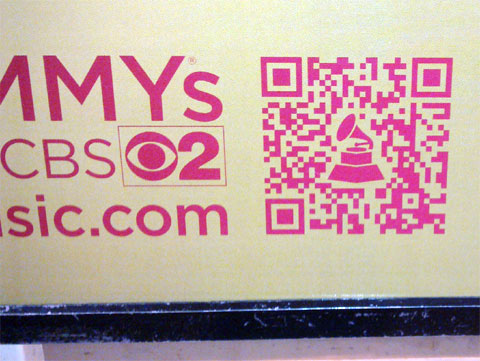
Note I took the second photo before the first one – I first saw the ad panels which featured the second photo at a very narrow point on the platform and was only able to get the detail, where I was able to get a wider shot of 3 panels together, interestingly at the same station and in the 3 panel photo, there is not one of Katy Perry.
There’s a few unique aspects to these ads and how they use QR codes. As each panel has a different QR code, it can be determined which of the 3 was scanned. This can tell one of 2 things – either the person scanning has a preference to the particular artist, or they chose that QR code at random or because it was easier to scan. Also note the Grammy Award trophy in the QR code. As QR codes have built-in redundancy and can have degradation up to 30%, some part of the code can be replaced with another image. There is no magic to this – you have to make the change and test the heck out of it to make it effective.
These particular ads are positioned low to the ground. As a result, you need to bend down to scan, which may cause some not to do so, especially at the narrow part of the train platform where I was. Many times I see QR codes towards the bottom of an ad, which is unfortunate, as QR codes are not afraid of heights!
What do you think of this use of QR codes? Please share your thoughts in the comments of this post.
Did you enjoy reading this? You are welcome to subscribe to The Hot Iron by RSS feed or by email.
QR Code T-Shirt
By Mike Maddaloni on Wednesday, February 02, 2011 at 05:01 AM with 0 comments
For my first example of a QR code in action, I chose a medium displaying one which people may not think about – clothing. We have seen QR codes on signs, posters and flyers, but how about t-shirts? In the photo below, that’s me on the right, sporting a QR code t-shirt, and I am with Dennis Bournique at the Nokia E72 Mode beach Party last summer.

The t-shirt was given to me by QRazystuff.com, a UK-based firm that puts QR codes on apparel. When scanned, this QR code takes you to my Twitter account, @thehotiron.
A QR code on clothing will get people’s attention. On this shirt, it’s a decent size on the front of the t-shirt. Another great place to put one is on the back, as reinforcement for any messaging on the front of the t-shirt. Of course if you are walking around with a QR code on your t-shirt, don’t be surprised if someone stops you to scan it, as that’s how they will be able to scan it.
QR codes on t-shirts and other apparel can be used for promotions or games, where people in a defined area will wear them and scan each other’s as part of the game. They can also be a variation on the traditional brand tag.
Would you wear a QR code on a t-shirt? Are there other reasons for wearing one? Please share your thoughts in the comments.
Did you enjoy reading this? You are welcome to subscribe to The Hot Iron by RSS feed or by email.
QR Codes In Action On The Hot Iron Every Week
By Mike Maddaloni on with 0 comments
 There is no shortage of discussion on QR codes. Whether people are asking what the heck they are to weighing the merits of using them, QR codes are a phenomenon that is not going away any time soon. How far they go is very much part of the discussion.
QR codes tie the offline and online worlds with simplicity. By scanning them with your smartphone (or even Web cam) you will get information – from a URL to a full contact record to a short message. This is my definition, and there are many out there. But rather than focus on the ultimate definition for a QR code, I’d rather show how they are being used.
Starting today and every Wednesday I will show a QR code in action. Each post will feature a picture of a QR code I take over the course of my day. I will describe how it is being used, and of course provide any commentary as appropriate.
Watch for QR Codes in Action here at The Hot Iron as part of the regular RSS feed or by viewing just the QR Codes in Action posts. I welcome your comments and questions, and if you want to learn more how you can use QR codes for your business, please contact us at Dunkirk Systems, LLC.
Did you enjoy reading this? You are welcome to subscribe to The Hot Iron by RSS feed or by email.
Is The NFL Moving To A Unified Web Site?
By Mike Maddaloni on Wednesday, January 12, 2011 at 07:46 AM with 0 comments
Over the holidays I caught up on reading and responding to email, in the process managing both my personal and work email inboxes to zero. One of the messages I processed came from the National Football League, or NFL. As I am a New England Patriots season ticket holder, this is probably why I received it. An image of the short message is below:
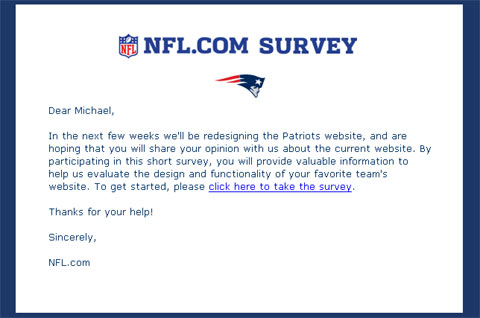
The message text read as follows:
Dear Michael,
In the next few weeks we'll be redesigning the Patriots website, and are hoping that you will share your opinion with us about the current website. By participating in this short survey, you will provide valuable information to help us evaluate the design and functionality of your favorite team's website. To get started, please click here to take the survey.
Thanks for your help!
Sincerely,
NFL.com
After reading it and re-reading it, as well as taking the brief survey, I had one question, are NFL team Web sites moving to a unified platform?
Such a move does not surprise me, as other sports leagues have taken a similar approach. Major League Baseball, or MLB, first comes to mind as they made this move many years ago. Other US pro sports leagues, such as Major League Soccer and the National Hockey League also have. The National Basketball League (NBA) appears to have, but the Boston Celtics Web site appears different from the other NBA team Web sites, though it does not mean it’s not on a common platform.
Having all team Web sites on a common platform provides many gains, which outweigh the negatives. First and foremost is cost and technical management – no need for 32 separate Web sites (there are 32 NFL teams), where you technically have one. Each team Web site (or section of the NFL site) will have a similar navigation structure, making it easy for the Web visitor to navigate from team-to-team. You still have your team-based content writers and coordinators, or whatever their title would be. You can also better leverage content across team sites with relative ease, both the written word and rich media, and the latter may be driving much of this. MLB has been very successful and providing broadcasts and audio and video of games, and charging for it. The NFL, which is known for its high-quality NFL Films, will probably make a similar offer.
If there are any drawbacks from combining Web sites is the complete control of the look and feel and overall content of the Web site. This will be more of an internal team issue than for the fans. Hopefully combining all Web sites will force all teams to offer a consistent level of quality content and design, where currently some team sites offer more content than others, not to mention some have a better design as others.
I performed a few searches and did not see anything specifically mentioning any form of unifying move. I welcome any thoughts and opinions on this, not just from a sports standpoint but from a branding and design view as well. Plus any insight into if the NFL is actually doing this is welcome too.
Did you enjoy reading this? You are welcome to subscribe to The Hot Iron by RSS feed or by email.
Subscribe to The Hot Iron



The Hot Iron strives to present unique content and point-of-view on business, technology and other topics by Mike Maddaloni, a technology strategist based in Appleton, Wisconsin.
Photo credit: Logan Connor/Oomphotography
Value for Value
If you like what you are reading on The Hot Iron, buy me a coffee!
About Links
In posts here at The Hot Iron there are often links and banner ads for products and services. For some of these links and banner ads, I receive compensation if you click and/or eventually buy said products or services. Where most links are marked as such, it is safe to assume any link or banner ad is a compensated one.