
Did Starbucks or McDonald’s Get More PR Mileage This Week?
By Mike Maddaloni on Friday, February 29, 2008 at 01:37 PM with 0 comments
In addition to this week having the leap year day of February 29, it was also a week that featured public relation moves by 2 of the world’s largest restaurateurs – McDonald’s and Starbucks. Each had a cost, got some attention, but who got the most mileage?
On Tuesday, February 26, Starbucks closed all of their US stores for 3 hours to retrain their baristas (the ones who make the coffee drinks) on the art of espresso. For those who don’t know, espresso coffee is not only a standalone drink, but the key component of many of their coffee drinks, such as the latte. This affected all 7,100 of their US stores.
On Thursday and Friday, February 28 & 29, McDonald’s gave away a free McSkillet Burrito breakfast sandwich with the purchase of a drink in all of their US stores. The McSkillet is a relatively new addition to their menu, a large burrito filled with just about every ingredient of a hearty breakfast, including eggs, cheese and sausage.
Both of these events have a cost – lost revenue for Starbucks, but the shutdown was in the early evening when traffic is not as busy as compared to the morning commute, and potential lost revenue for McDonald’s, but you also needed to buy a drink, which have high revenue margins.
Where both companies did these promotions to get free publicity, the reasons behind Starbucks shutdown for training are not purely for marketing. Its founder Howard Schultz has retaken the helm of the company and is trying to get the coffee shop to regain its mojo, or at least that is what I have called it before. Anyone can say they are retraining its staff, but the point gets across much better when you can see it for yourself. The site of an empty Starbucks at the corner of North and Wells in Chicago, a normally bustling, 24/7 location, was something to see.
So who made out better on this? My vote is for Starbucks. First off, most people I asked learned about the free breakfast item from me, where I heard many people talking about Starbucks. And so was the evening news, local and national. Whether you believe the training makes a difference or not, you know Starbucks did so, that they care enough to shut down to do so, and that speaks volumes over something for free.
Business • (0) Comments • PermalinkTurn Off The Lights For Earth Hour On March 29
By Mike Maddaloni on Thursday, February 28, 2008 at 05:00 AM with 0 comments
 On March 29, 2008, people around the world are invited to turn off their lights for one hour for what is called Earth Hour. What started in Sydney, Australia last year is now spreading around the world. I heard about this for Chicago is one of the cities participating in this program at 8 pm local time. And this is not just a grassroots effort, as there are corporate sponsors for the event, including the local electric company.
Why not? For someone whose condo lights could be seen from a distance a skyline shot, I am in. I just hope too much money and effort (and electricity) is not being spent to promote it – wouldn’t that defeat the purpose?
I know from personal experience keeping the lights off can make a difference in your electric bill. Last year when having some work done on our condo, we had the main light fixture taken down in the bathroom and the replacement didn’t go up for another month. Looking at our bills, we noticed a significant decrease. The new fixture also had compact fluorescent bulbs, and we have continued the savings.
Will you be turning off your lights for an hour?
Business • Diversions • (0) Comments • PermalinkMy Take-Aways From The Book Meatball Sundae
By Mike Maddaloni on Tuesday, February 26, 2008 at 05:00 AM with 0 comments
What the heck is meatball sundae? As it sounds, it is a dish with balls of meat and whipped cream and a cherry on top. Not necessarily something you would want, would you? Replace the meatballs with ice cream and you have something you’d like – something that works well together and is a tasty treat.
This harmony, and the converse lack of harmony, is the crux of the book Meatball Sundae by marketing consultant and author Seth Godin. He uses this graphic example to state how you take your business products and services (the meatballs) and market it with today’s marketing tools, namely online (the whipped cream and cherry). Godin’s premise is you just can’t slap today’s progressive marketing techniques (blogs, viral videos) on staid products and services just as they are and how you have marketed them in the past, or New vs. Old Marketing as he refers to it. New Marketing is making a personal connection between the consumer and the emotion of the product or service, where Old Marketing is broadcasted, interruptive promotion as it has always been done in the past.
My greatest takeaway from this book is not necessarily a positive one – it is more unlikely to happen in an older organization than a newer one. In a newer company or firm, New Marketing is all they know, or could even have been the prevailing catalyst for the start of the business. Therefore, the firm is more in sync with what needs to be done to practice New Marketing.
In older companies, where marketing has happened “that way” for a long time and has worked, this understanding may not be in place, and unless it is guided throughout the organization, it will never happen. In most older, traditional companies, people are concerned more for their own jobs in a fluctuating economy than anything else, and are less likely to champion the cause of New Marketing. Despite this, many companies have taken a fresh look at what they do and sell and have made personal connections with their audience. It takes a different allocation of money and resources than before, but with such a perspective, they can see their results, measurable more than a billboard on a highway.
Meatball Sundae is a quick, lively read and full of many examples of companies and what they did well – and didn’t do well – in practicing New Marketing. I recommend it to newer or old companies, to help them in their thinking. Depending on the company, making such a leap may not be as wide as crossing an ocean.
When I read Meatball Sundae, it made me think of a book Godin wrote back in 2002, Purple Cow. I think I’ll re-read that one next.
Book Take-Aways • Business • (0) Comments • PermalinkLinkedIn Offers Stripped-Down Mobile Version
By Mike Maddaloni on Monday, February 25, 2008 at 08:03 AM with 1 comments
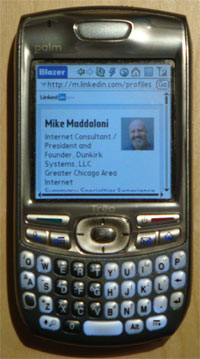 Business networking site LinkedIn has released a version of its service formatted for mobile devices. TechCrunch reported its release though there is no mention of it to be found on LinkedIn itself.
The mobile version is located at m.linkedin.com provides basic but stripped-down functionality of what you can do in a standard browser. Once you log in, you can see your own profile and contacts list. The Updates link appears to be similar to what is on the home page of LinkedIn, but unfortunately does not match the Web page. This is a feature I have identified as one of the key features of LinkedIn. Also, you can view your own Connections, but not your Connection’s Connections. Perhaps this is why there is a “beta” label at the top of the page.
You can of course view the mobile version in a standard browser. This will benefit LinkedIn members who are visually impaired and use a screen reader when surfing the Web. A while back when LinkedIn restructured the Connections list, it made it unreadable for those using screen readers. Using the mobile version will give those users back this vital feature of the service.
Business • Technology • (1) Comments • PermalinkDo You Know Where Your Domain Names Are?
By Mike Maddaloni on Tuesday, February 19, 2008 at 05:00 AM with 5 comments
“It’s 10 o’clock, do you know where your children are?” This was a brief TV spot I recall from childhood every evening just before 10 p.m. (of course my Mom didn’t have to worry about where I was because I was always at home, but I digress). I would like to take a spin on this phrase and apply it to something near and dear to me, domain names:
“It’s right now, do you know where your domain names are?”
In the last couple of weeks, I personally heard of 2 cases where owners of domain names realized they no longer had control of their domain names as they had expired and were in the hands of other entities. As a result, their Web sites and email accounts were disabled.
How do you avoid this? There are 2 ways to do so – take steps to properly manage your domain names yourself, or hire a professional to do so. As a full service Internet consultancy, this is a service I offer through Dunkirk Systems, LLC. However, if you have the time and interest to do so yourself, here are a few basic steps you can do yourself to manage your domains.
Know what you own
This may seem obvious, but it is vital not to overlook. As it is easy to acquire multiple domain names, it is just as easy to lose track of them. Maintain a list of the domain names, and add to it as you acquire others.
Know when they expire
Next to each domain name on your list, note their expiration date. I recommend to my clients to extend their registration to the maximum 10 years in advance, so you don’t have to worry about it every year. You can also put alerts in your calendar software to remind you to renew them, ideally well before they expire.
Know where they are registered
Ideally you should have all of your domain names together in 1 or maybe 2 registration accounts – it’s always good to have a backup account. Add the registrar’s name to your list, and store the login and passwords in a safe location.
Ensure contact information is accurate
Lookup your domain names in your registration account or with a 3rd party service like Domain Tools and see if your contact information is completely accurate. If not, update it. All of your information, especially your email address, should be correct, as to this email address you will receive renewal and other notices from your registrar.
These are basic and vital steps to managing an important asset to your business. Follow them, and then you can go back to worrying about your kids.
Business • Domain Names • (5) Comments • PermalinkSubscribe to The Hot Iron



The Hot Iron strives to present unique content and point-of-view on business, technology and other topics by Mike Maddaloni, a technology strategist based in Appleton, Wisconsin.
Photo credit: Logan Connor/Oomphotography
Value for Value
If you like what you are reading on The Hot Iron, buy me a coffee!
About Links
In posts here at The Hot Iron there are often links and banner ads for products and services. For some of these links and banner ads, I receive compensation if you click and/or eventually buy said products or services. Where most links are marked as such, it is safe to assume any link or banner ad is a compensated one.