
Web Site Accounts and Logins Should Never Be Purged
By Mike Maddaloni on Friday, August 27, 2010 at 06:00 AM with 5 comments
The management of accounts and logins for Web sites can be a task, for both the Web visitor and the Web site owner. For the visitor, they not only need to remember the username and password for many sites, but also secret questions and other identifying information. Then there is the list itself which needs to be protected, as hopefully each login is unique and all passwords are not only different but not easy to remember.
For Web site owners, ideally the Web site has build-in management tools to administering login accounts. These accounts themselves may have additional associated data, like customer detail, order history and frequent customer numbers. Technically, this data can take up space, and many times database administrators will want to archive “inactive” accounts to optimize the database. From a business standpoint, it is often said to also archive or purge similar accounts to not clutter reporting data.
Allow me to 1,000% disagree with both of these stands and say that a Web site accounts and logins should never, ever be purged. Why? Behind these accounts and logins are people or businesses run by people, and where you may not remember them, they remember you! If you remove them, they will remember and it may impact if they do business with you in the future. Or even write about it in a public blog post.
What follows are 3 examples of Web site accounts belonging to me personally and how they were handled. I call them the Good, the Bad and the Ugly.
The Good – Hyatt Gold Passport
Recently my family decided to get away for the weekend and sought out a good hotel rate locally, or what some call a “staycation.” We found an excellent deal at a Hyatt hotel, and I went to their Web site to book it. When I got to the Hyatt Web site, I had to think for a minute if I had an account with their frequent stay program, Hyatt Gold Passport. I checked my list and I did, but for the life of me I couldn’t remember the last time I stayed at a Hyatt.
When I entered the username and password on my list, I was in, and was welcomed by name along with my last stay at a Hyatt, which was a stay at a Hawthorn Suites over 4 years ago. All of my information was correct, as well as the points I earned during that stay. Over 4 years ago! I was extremely pleased, and the online registration was a smooth process as well. After my stay I got this nice email from them – a form email, but still welcome as shown below.
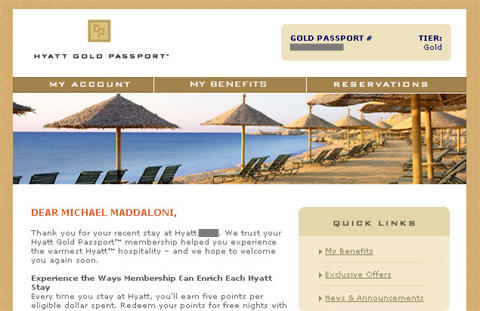
Kudos to Hyatt for not forgetting about me, almost 4 years later.
The Bad – Staples
I have been a customer of Staples since store #6 opened in West Springfield, MA in the late 80’s. As Staples is from Massachusetts, they were the only real choice for discount office supplies, which was not a bad choice by any means. When I moved to Chicago and Staples later opened here, as I was a Staples Rewards member, I got an invite to the grand opening party at their flagship store in the Loop. That store is right around the corner from my office, and I shop there frequently, as well get weekly emails from them and participate in consumer surveys they extend to me. And to keep the FTC at bay, I also own stock in the company.
All of this considered, I was surprised recently when I tried logging into Staples.com to place an online order and my login failed. I was not able to receive a new password either saying my account no longer existed. So I sent a tweet to @staplestweets on Twitter to ask if they purge accounts. I don’t recall the exact time period (nor do I have the links to the tweets) but they said they do purge accounts after a year of inactivity.
The kicker here is that I am not an inactive customer! I shop in the store regularly using my black Staples Rewards Premier card, but hadn’t placed an order on their Web site in over a year. This is a failure on the part of Staples to recognize the true customer experience. If you go beyond purchases alone, I have 5 separate accounts with Staples, one each for Staples.com, Staples Easy Rebates, Staples Feedback Forum, Staples Rewards, and Staples SpeakEasy. When I pointed this out to the people on the Staples twitter account and said they weren’t making it, um, easy for me, they said fair enough. I am sure some of these are run by 3rd-party companies, but still – has anyone ever heard of single sign-on?
I went ahead and recreated my Staples.com account and made the purchase. I hope in the future I never have to do this again, and Staples makes it easier to do business with them.
The Ugly – Hilton HHonors
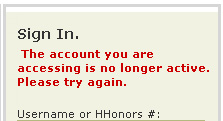 The other day my family was looking into hotels and saw one which was a Hilton property. I knew I had a Hilton HHonors account and went to login. I got the strangest error message, as shown, which says in bold red letters, “The account you are accessing is no longer active. Please try again.” What does that mean? If my account is inactive, why would I try it again?
After staring at the screen for a few seconds, I called Hilton. When the line was answered, I explained the error and gave the rep my account number. She then said matter-of-factly that my account was inactive, period. I asked what that meant, and she said that after a year of not staying at a Hilton or earning any points, my account is marked as inactive and my points are deleted. What? Now sure, there is some brochure I may have received that stated this, but this is the most brutal way to deal with points, even worse than an airline! She then asked if I wanted to reactivate my account, to which I said no – I told her that though it’s their policy I was never reminded of this, and don’t ever want to stay at a Hilton hotel ever again. She didn’t seem to care.
Opportunity Lost
In short, Hyatt gets it, Staples sort of does and Hilton does not.
Staples and Hilton could have easily reached out to me and reminded me that I had not done business with them in a while and given me a special promotion to do so. I get these emails all the time from other vendors, from airlines to restaurants. Staples systems are all separate and thus they do not have an ability to view a dashboard on a customer. Hilton… well, I have no idea what they were thinking, if they were at all.
The cost of acquiring a new customer is much, much greater than keeping a current one. In the retail business, which all 3 of these customers are in, they all have that number – the cost of a new customer. Hyatt made a wise decision to keep a customer’s account active, and thus making a happy customer out of me. I will still shop with Staples and hope they get their act together – literally – and that’s not just because I want my stock value to increase. As for Hilton, I don’t care, as they have lost me as a customer.
Not to mention the cost of acquiring a customer is much greater than any disk storage required to keep that customer’s account on file.
What do you think about Web site accounts being purged? Has this ever happened to you? Please share your thoughts in the comments.
Did you enjoy reading this? You are welcome to subscribe to The Hot Iron by RSS feed or by email.
Someone Has To Write Web Site Content
By Mike Maddaloni on Monday, August 23, 2010 at 06:00 AM with 0 comments
Someone has to write Web site content. Someone has to write Web site content. I could repeat this statement a million times, as it is something of great concern and passion to me. Why? Let me explain in a brief, true story. Names have been masked to protect the, um, innocent.

There’s nothing like a Web site project completed on time and under budget. My colleague and I were proud of the job we did, integrating a design from a designer who wasn’t a Web designer, but we made it work very well. The site architecture was integrated well based on the up-front analysis and the new site looked great, with one exception – there was no content. Literally, pages were blank! When we presented the site to its sponsor, who was also the one who was supposed to have written the content by now according to the project plan, he was irate. After he gave us a short monologue, it came down to the fact he let this slip from his plate altogether, though he was attempting to pass blame onto us. Oh, and this person was also my boss, the president of the company I was working for at the time, and it was for the company’s own Web site.
Completing content for a Web site can be the critical path to the site’s success. Unfortunately this has happened to me more times than I would like. So how do you ensure it is completed on time, as well as being effective and optimized? Here are some tips to follow.
Define the content - Ideally when you sit down to write content for your Web site this should have already have been completed. The information architecture of the Web site will be the top-line for what content is in the site, and its sitemap will define the pages or organization of the content. Within those pages there may be sidebars, call outs, photos, quotes, videos – whatever you feel will effectively communicate what you want to share with the visitor to your Web site.
Envision the content - Once you have gone through everything in the first step, close your eye and envision what the completed Web site will look like. What do you see in your mind’s eye? As much as pages have been laid out with placeholder text and images, seeing the finished Web page will help you in creating what will go on it.
Outline the content - Now that you know what to write and what it will look like, break down the content into manageable pieces, which is in essence outlining what will be the content of your Web site. Will a page of text have several sections with their own headings? Where will the images go?
Don’t forget SEO - Early on in the process of designing your Web site, you should have done work on the target audience of your Web site and their expectations. This information served as the guide post, spaghetti test or whatever metaphor will help you throughout the entire project. From this early analysis, the keywords and who to optimize the content of your Web site to should have bubbled to the surface or shot up like a rocket. Keep this in mind as you put pen to paper or fingers to keyboard.
Just do it or delegate it - Yes, now someone has to write the content. Hopefully the previous steps have energized you to actually write the content, or scared you into hiring a copywriter to do it for you. But no worries, as with all of this preliminary work done, the copywriter should have all they need to create great content for your Web site.
What may be obvious to some – creating content – isn’t always obvious to all. Have you encountered this yourself, and how did you overcome it? Do you have any tips in addition to those presented here? Please leave a comment and help those whose role it is to create content, whether by choice or force.
Did you enjoy reading this? You are welcome to subscribe to The Hot Iron by RSS feed or by email.
Recent Media Mentions for Mike Maddaloni
By Mike Maddaloni on Saturday, August 21, 2010 at 05:59 AM with 1 comments
 Sound the trumpets, as I wish to blow my own horn a little bit and pass along a few mentions I have received in the past few weeks in the Chicago media.
Newcity is a weekly print magazine with a great Web site covering additional aspects of the Windy City. Reporter Ella Christoph interviewed me about likemind Chicago, the monthly coffee meetup I co-host, as well as others who attend. It’s a great article highlighting this unique, morning gathering of tech, creative and agency folks.
Chicago Now is a blog powered by the Chicago Tribune, and reporter Lira Luis wrote about co-working and OfficePort CHI, the office space my Web consulting firm Dunkirk Systems, LLC inhabits most days and a few nights and weekends as well. Where I was not interviewed for the article, a picture of me hard at work is featured.
Thanks for the coverage, and if you are a reporter covering business or technology, I am more than glad to talk to you about an upcoming article!
Did you enjoy reading this? You are welcome to subscribe to The Hot Iron by RSS feed or by email.
My Takeaways From The Book Predictable Success
By Mike Maddaloni on Monday, August 16, 2010 at 06:00 AM with 0 comments
Even if there was such a thing as a silver bullet for the success of a business, it would still need to be properly fired. This would require a silver gun and people who could fire the gun accurately to the exact target, whatever that target is, of course. As ideal as that would be, it doesn’t exist and I takes work to get your business to where you want it.
Thinking about where your business is and where you want it to be is the idea behind the book Predictable Success by Les McKeown. I was given a copy to read by the author. In it, the reader is taken through 7 stages of the lifecycle of a business as identified by McKeown with “predictable success” being at the top of the curve, ideally where your business should be. All of McKeown’s 7 states are: Early Struggle, Fun, Whitewater, Predictable Success, Treadmill, The Big Rut and Death Rattle.
As I read Predictable Success, I had many flashbacks to all of the firms I have worked for, and of course my own Web consulting firm Dunkirk Systems, LLC. In addition to this trip down memory lane, my takeaways from the book are reflective of my experiences, and are:
It’s important to know where your business is - Whether you are joining a business or have been in one, knowing which state the business is in is important to your decision-making there. For management, knowing the state can influence decisions to improve the business. For employees, it can influence your decision to stay or leave a job.
The wrong people can hurt a business - Unfortunately I have seen this one too much personally, where key people in a firm get to a level where many people believe they are irreplaceable and position themselves as such. This can occur to the point where management will work around them to solve problems in the company, even if those people are the real problem.
Some people cannot solve their business’ problems themselves - From small to large, there are some who lead or run a business who don’t have it in to truly do what is needed to correct the problems in their business. Why? There are many reasons, from not realizing there is a problem to being mired in the day-to-day work of the business to pull themselves out to see and do what’s needed to not having the capital they need (whether people and/or money) to make it happen. I’m not trying to be a downer, only realistic. One thing this book does well is outline steps to get to predictable success – so if you have some outline of a plan, it will help you determine if you have what it takes to make things happen, or seek help to do so.
I enjoyed reading Predictable Success. It is written in a no-nonsense, down to business manner and it is, as I said previously, easy to relate to the business stages based on my previous experience, and probably would be the same for you as well. I rate Predictable Success up with The E-Myth Revisited as a guide for businesses who are in a funk, and recommend it to any business owner, even if everthing is going great for them, or so they may think!
Did you enjoy reading this? You are welcome to subscribe to The Hot Iron by RSS feed or by email.
Next likemind Chicago on Friday August 20
By Mike Maddaloni on Wednesday, August 11, 2010 at 01:20 PM with 0 comments
 The next likemind will be Friday, August 20, 2010 in dozens of cities around the world.
In Chicago, it will be at Argo Tea, 140 S Dearborn St. at the corner of Adams and Dearborn Streets in the Loop from 8:00 am to 10:00 am.
I call likemind a gathering of creative-minded people, from various disciplines including Internet, advertising, art, social media, et. al. For more on likemind, read this great article on likemind Chicago from the Newcity and likemind from the New York Times.
No RSVP is required. You are also welcome to join the likemind Chicago Facebook group.
Did you enjoy reading this? You are welcome to subscribe to The Hot Iron by RSS feed or by email.
Subscribe to The Hot Iron



The Hot Iron strives to present unique content and point-of-view on business, technology and other topics by Mike Maddaloni, a technology strategist based in Appleton, Wisconsin.
Photo credit: Logan Connor/Oomphotography
Value for Value
If you like what you are reading on The Hot Iron, buy me a coffee!
About Links
In posts here at The Hot Iron there are often links and banner ads for products and services. For some of these links and banner ads, I receive compensation if you click and/or eventually buy said products or services. Where most links are marked as such, it is safe to assume any link or banner ad is a compensated one.