
Why Consistency Is So Important to Branding
By Mike Maddaloni on Tuesday, September 08, 2009 at 06:00 AM with 0 comments
Editor’s Note - The following is a guest post by Emily Brackett, President of Visible Logic, Inc. a Portland, Maine-based graphic design firm that works with start-ups and growing businesses to help them build compelling and comprehensive brands across media. A longtime reader of The Hot Iron and strategic partner of Dunkirk Systems, LLC, Emily shares some of her wisdom and experience here, which we hope will be the first of many guest posts from her.
 As a business owner, you probably have the usual elements of your corporate identity: business name, logo or wordmark, business cards and a Web site. However, as you grow your business, your identity can either be strengthened by consistent branding, or dilluted by irregular use of these elements.
There are several common reasons why business owners are not consistent in their branding.
The first is that no one is in charge of watching the brand. Many times our brand identity is being added to, molded, and stretched without anyone giving it much thought. Someone should be ensuring that logo usage and graphic elements are consistent from one piece to the next and from one media to another. For a small business, this may be the business owners, or an internal marketing person. If you work with outside designers, Web developers or even a print shop who does some design/typesetting for you, make sure you instruct them on how to use your identity correctly and uniformly.
Another reason why many businesses have so little cohesiveness in their image is that they try new things too often. You may be tired of seeing the same colors and similar layouts, but your customers (or potential customers) may just be starting to grasp your unique identity. Keep with it and the payoff will arrive.
Why is consistency important?
Avoid confusion
The most obvious reason to be consistent with your brand identity is that you don't want to confuse potential clients and customers. Make it easy for someone to remember you. Frequently, people notice certain elements, but not all the details.
For example, you meet a potential client at a networking event and give her your business card which features a large, red, circular logo. A few weeks later, that person is thinking she may need your services so they Google your name and browse to your Web site. If she sees a large, red, circular logo she feels confident that she’s at the right place. If, on the other hand, your Web site shows your logo (even the same graphic) in green, she may feel confused and question whether this is indeed the same person and company she had met previously.
People trust things that they know
The first example highlights the most basic type of confusion that can cost you sales. But often it is more subtle than that. Every time a potential client hears your business name or sees your logo it gets registered, even slightly, in their memory. The stronger the bank of memories - and therefore the connection - someone has to a brand, the more likely they are to buy from that brand. Consumers choose brands that are familiar, because they seem known, established, and therefore trustworthy.
It makes business sense - increase your returns
Unfortunately, many business owners make their brand inconsistent without giving it much thought. One example is an entrepreneur who hires a Web development firm to create their Web site and another design studio for their printed work, without coordinating the two. You’ve paid for two projects but rather than having those two pieces compounding your brand and building them exponentially, you may end up with two unmatched marketing tools. Therefore, the two pieces are not as effective in building brand recognition as one coordinated effort.
How to build consistency:
- Use the same business name, logo, and/or logotype. Typeset the name and other elements, such as a tagline in a fixed fashion. Whether you do this yourself or work with an experienced graphic designer, once the logo or wordmark is done, don't change it.
- If you’ve hired a designer to develop your logo or wordmark, make sure you receive electronic files that you can work with. You and your staff should use these graphics in all letters, memos, proposals, etc. Do not retype or tinker with the logo, and do not allow your staff or agencies to do so either.
- Choose a corporate color, or color palette and use them as the dominant color scheme throughout your materials - printed or online. If you’ve worked with a professional designer for your logo, make sure you’ve received your pantone (PMS) color numbers as well as CMYK and RGB equivalents. Whether you create something yourself in PowerPoint or work with a graphic designer, always use those same colors.
- Think across media. Ensure there are design elements that are similar across all of your materials. From business card to Web site to advertisement to educational brochure, there should be a recognizable look and feel.
- If you worked with a professional designer, have them write up some easy-to-follow guidelines and have them create templates for you. These might include a letterhead template in Word and a PowerPoint template for your presentations.
Did you enjoy reading this? You are welcome to subscribe to The Hot Iron by RSS feed or by email.
True Costs of Joining an Organization
By Mike Maddaloni on Monday, September 07, 2009 at 02:20 PM with 0 comments
As human beings, most of us want to belong to something. Looking around a large city like Chicago or even a small town, there will certainly be options on organizations to join. Where the focus here of The Hot Iron is around business and technology, I will use that angle to talk about joining related organizations. However when you read through this, you will see this applies to most all organizations.

The cost of joining an organization is important to consider because, unless money is no obstacle to you, how much you spend or invest is probably of importance to you. I have broken down cost categories below, and things to consider and ask about when looking to join an organization. Of course, before going into the process of evaluating organizations, you may want to consider a budget or amount you can truly afford to spend. If you’re not sure, then be cautious and accountable along the way. Note this piece is about cost, and not about what you get for the costs, which I will address in the future if there is some interest from you the readers.
Direct Costs
Direct costs of an organization are those that are obvious. If an organization has an annual fee, that is a direct cost. Many times this figure is all that is talked about when joining, though there may be additional direct costs, such as costs per meeting or special events. Some organizations do not charge an annual fee but instead just charge per event or meeting. Which ever way it is done, it is important to find out what the direct cost structure is, as even if you will be paying for this over time, at the end of the year it will all add up.
Indirect Costs
Even after you have asked what it costs to belong to an organization, there may be additional costs of being a member that are not obvious, or official to the group. Some organizations have informal gatherings or just plain happy hours where most of the business or value of being a member can come from. Official meetings or events may be just that – official, structured and may not have the opportunity you would like to network or connect with others. If it means you need to go to the pub afterwards to really get to know people, unless they are running a bar tab, you will have to shell out a few more bucks to get the value of membership. This is also a question to ask – not necessarily from a cost standpoint but to ask if members socialize after official gatherings. You can do the math yourself based on their answer.
Time Costs
If you put any value to your time, then you should consider it when joining an organization. Even if you ask the question about how much time is required to get full-value from an organization, the true answer will come from further investigation and direct experience.
Some organizations are “member organizations” where the members run all aspects of what is done, as well as serve on its Board. As a general member, your time commitment may be lower. But over time, it may increase dramatically, especially if you find interest in being a leader in the organization. Trust me on this – it happened to me, in a good way, when I was involved in the Boston Jaycees, and eventually served as its president.
Some organizations have paid staff who manage the day-to-day of the organization, or there may be a hybrid of staff and members. Whatever the structure, it helps to ask around how much time is required to get the full value from the organization. Keep in mind this value may be on the higher side, as those who are regulars at meetings or events are probably the ones who are more active.
Baptism By Fire
Maybe this section heading is a little on the harsh side, but the only real way to find out the cost commitment to an organization is for yourself. Just be aware going in that you may end up spending a little more than you planned without even realizing it at first. This may not necessarily be a bad thing, as it means you may have found an organization that is a win-win for you.
Did you enjoy reading this? You are welcome to subscribe to The Hot Iron by RSS feed or by email.
All Web Sites Are Always Under Construction
By Mike Maddaloni on Thursday, September 03, 2009 at 06:00 AM with 3 comments
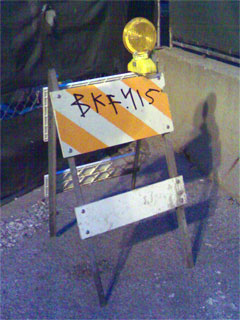 Just say no to sawhorses and construction helmets on Web pages!
It bugs me to no end that in 2009 one can still see the words “under construction” along with some form of icons on Web pages, with the attempt to communicate the message that the Web site is still being built, so come back later once the content and functionality is ready. Imagery of a sawhorse in black and yellow is supposed to symbolize physical labor is involved the creation of what goes on the Web site. What was cute in 1994 is downright unprofessional today, not to mention unnecessary.
This author is guilty of using those 2 words over the course of his 13+ years of working on the Web. At first, it was because everybody else was doing it – it was the standard. Over time, the standards changed. Apparently many people did not get the memo that the standard was no longer, as the thinking of Web sites has changed. Think about – all Web sites are always under construction.
The great thing about a Web site is you don’t need to print 50,000 copies of it to bring to a trade show. It is there, 24/7 (hopefully) and ready for all to see. This means it can change, adapt, be updated whenever without having to go back to square one. Well, that is unless you want to, but I digress. As business or personal needs change, the Web site can grow, contract, be redesigned – whatever is needed. Knowing this going into it helps you realize the building process really never ends.
Original use of “under construction” was to alert Web visitors they hit a dead-end. If the Web site was not live yet, it would be on the only page live of the Web site. If the client testimonial section of the Web site was not ready when the rest of the Web site went live, it would go on that page. The wisdom was you would show in the site navigation all of the things that would eventually be on the Web site, whether they were there or not. There’s nothing like opening a door only to find a wall, right?
Today we know better, or we should know better. Web sites are expected to change. We can add the link to testimonials later, when there are actual kind words from clients for others to read. To begin with, we need to plan for that section (or any other sections) to be there and accommodate for it in the design and layout of the Web site. You add it to navigation when the page or section is ready. We can then use the “what’s new” section of our Web site to alert people to that new content once it is live. We also update our sitemap – both HTML and XML – to let the world know the pages are there. If we offer search, we re-index the Web site to include it for those searching for them. And don’t forget about tweeting the link on Twitter or submitting to social bookmark sites, as well as mentioning in your next newsletter and other communications.
So which is more effective? For the 1-time visitor to your Web site, if something isn’t there, you don’t win either way. For the returning visitor, you have professionally and gracefully informed them.
But wait – there is one exception to my introductory statement. If you’re in the business of selling sawhorses and helmets or are in the construction business, you have my blessings to use them.
Did you enjoy reading this? You are welcome to subscribe to The Hot Iron by RSS feed or by email.
Mike Maddaloni featured in CBS2 Chicago Story on T-Mobile Paper Bill Charges
By Mike Maddaloni on Wednesday, September 02, 2009 at 06:00 AM with 0 comments
 As much as a mobile phone is a high tech device, it doesn’t necessarily mean everybody who uses one is also high tech. In most cases, that is not the case. When I heard T-Mobile, who is my mobile provider, is going to start charging for paper copies of bills to be sent, I was honestly surprised. I heard about it in a tweet from CBS2 Chicago, and responded with my stance.
Shortly after I was asked if I would like to be interviewed about the story, to which your humble and definitely not camera-shy writer quickly obliged. The accompanying photo is a screen shot from the interview today on CBS2 with reporter Vince Gerasole, and by clicking on the picture or this link to the CBS2 Web site you can watch the story.
Maybe I am hyper sensitive to such issues in my capacity as a Web architect and developer, but the ultimate goal of any use of retail technology is to help those using it. As much as online billing is alive and flourishing, not to mention my use and support of it, I also understand that we are “not there yet” as a society when it comes to being completely paperless. Some people prefer a paper bill, especially for those who are not online continuously as others are. T-Mobile is charging $1.50 for a non-detailed bill (not listing all calls) and $3.50 for a bill listing them all. I can see if they wanted to impose a charge on a detailed bill, as they tend to run long (in the news story, the bill I printed was 18 pages), but charging even for a basic bill makes no sense to me.
Rather that starting with the charge, T-Mobile should incentivize people by offering them a credit, say US$5, to go paperless. That may cover most people. For those remaining, this should have already been worked into your pricing structure to send bills in some form. Rather than sending bulky envelopes with all kinds of inserts, perhaps send the statement in a self-sealing sheet, similar to how some checks are sent? There are other options – explore them!
I must admit I am a very satisfied T-Mobile customer, and I have stated that before here on The Hot Iron. However, one issue I do have is with billing. Where I get my bill online, I never get an email or even SMS alert that my bill is available. I have to rely on my credit card statement to see a new bill has been cut. Also, the T-Mobile site offers an HTML version of the bill and not a PDF version, so someone would need the software to make PDFs in order to save it digitally. Most other vendors send email alerts and offer PDFs.
I’m interested in how this issue plays out, and if other providers capitalize on it, or if all others start charging for bills. In any case, we all need to be aware about what is showing up on our bills. For this issue, I thank CBS2 Chicago for letting me know about it.
Did you enjoy reading this? You are welcome to subscribe to The Hot Iron by RSS feed or by email.
How I Write Blog Posts
By Mike Maddaloni on Tuesday, September 01, 2009 at 11:22 AM with 3 comments
As it comes up in conversation many times as to what my process (or dare I say, methodology?) is for writing blog posts on The Hot Iron, I thought it in itself would make a great post. Whether I am working with clients of Dunkirk Systems, LLC for whom we have developed blogs or having a conversation with colleagues, there is a method to the madness.

First Comes Inspiration
Ah, the true magic of blog posts. Ideas usually come to me when I am not at my desk, so I am usually leaving some paper or digital note for myself. These range from something I am passionate about writing to fleeting thoughts that could become something worth writing. Those that don’t get written up right away get added to my idea list, and on occasion I go to it for inspiration.
Pen to Paper
You read that correctly – pen… paper. Call me old school, call me low tech, but I find the best way to write is literally to write. Well, in my case print in my poor penmanship. I don’t write all of my posts out long hand (for example, likemind announcements). And I make no apologies for this, especially after reading James Whatley does the same, and he is much more “wired” than I, not to mention younger than me too.
Type, Post, Promote
Once written, I type up the post in Word, spell and grammar check it, then manually mark up with HTML tags including images and a footer message (see below). As I have been coding HTML since 1993, it works best for me.
At this point I log into ExpressionEngine, the power behind The Hot Iron, and preview and submit my post. I also tag it to categories and set a date and time, especially when I write blog posts ahead of time.
From there, Feedburner, FriendFeed and Facebook do their thing to promote my post. I will also manually tweet on it depending on the topic, as well as submit to social bookmarking sites.
So Far, So Good
And there you have it. This process has worked well for me over the past 2.5 years plus, and now through 500 blog posts!
Did you enjoy reading this? You are welcome to subscribe to The Hot Iron by RSS feed or by email.
Page 120 of 220 pages ‹ First < 118 119 120 121 122 > Last ›
Subscribe to The Hot Iron



The Hot Iron strives to present unique content and point-of-view on business, technology and other topics by Mike Maddaloni, a technology strategist based in Appleton, Wisconsin.
Photo credit: Logan Connor/Oomphotography
Value for Value
If you like what you are reading on The Hot Iron, buy me a coffee!
About Links
In posts here at The Hot Iron there are often links and banner ads for products and services. For some of these links and banner ads, I receive compensation if you click and/or eventually buy said products or services. Where most links are marked as such, it is safe to assume any link or banner ad is a compensated one.