
Defined Goals For Your Web Site
By Mike Maddaloni on Friday, October 30, 2009 at 09:50 AM with 3 comments
Do you have defined goals for your Web site? When I say goals, do you have someplace written down goals and objectives for your Web site, which may have a project charter, mission and/or vision statement, target primary and secondary audience for your Web site and what they may be looking for?
If you do not, you are certainly not alone. Many Web sites start with the assumption of goals even if they are not written down. Over time, goals certainly change, just as businesses and their customers change. Having these guiding principles in writing – even framed and hanging in your office – help guide you in your decision-making for changes and enhancements to your Web site.
The Infamous Spaghetti Test
Many people test to see if spaghetti is fully cooked by throwing a piece up on a wall to see if it sticks. Personally I have never done this, but that may be due to being 100% Italian American and “just knowing” when it is done! This analogy is used quite often in business – taking an idea and throwing it out there to see if it sticks. The same can be done with ideas for your Web site, and instead of a wall you would throw it up against the goals of the Web site.
Goals for your Web site should not be in place to slow you and your business down and hinder you in any way. Many times people see something on a Web site and want it on theirs. Whether it is a cool new way to present something or a change for whatever reason, having goals in place should not kill those ideas altogether, rather they should help in their prioritization.
Usability of Goals in Key
So what should your goals look like? The simple answer is they should be in a usable format. Where that may be obvious, it always isn’t. Many times when people or the consultants they hire to build their Web sites define goals, they are lofty, multi-page documents that by their sheer design get stuffed in a file cabinet or in a folder on one’s computer, never to be looked at again. That’s not to say goals cannot be comprehensive, and if they are they should be then boiled down into a 1-page summary easily accessible by those involved in decision-making for the Web site.
As there should not be a schedule to creative-thinking, ideas will come about and they need to be addressed. As mentioned previously, these ideas may not be acted upon immediately but recorded for future consideration. This process is called product management, where the product is the Web site. The product manager for your Web site may be the organizational “owner” of the Web site or a key individual who serves as the traffic cop for such decisions. Your Web site should have a product manager in some form, if for any other reason to have a contact person to report issues to on the Web site.
Start Somewhere
If you don’t have goals, start by writing down something. If you do have goals written, dust them off and review them. The goals for your Web site are ideally a living breathing entity, but not quite a chameleon that is in constant change and flux. They should parallel changes in business as well as advances in Web design and technology. The latter doesn’t mean you and your business need to be on the bleeding edge of Web design, though in 2009 it is not a bad idea to use video on your Web site to talk about your products and services. But if a goal is to be on the bleeding edge and you are not there, this is where goals can serve you well.
The days of the “geek in the corner” hacking away at your Web site are over. It takes a team effort to create a thriving Web site. The best way to keep everybody on the same page is to understand the goals, whether it is for your Web site or your entity as a whole.
Did you enjoy reading this? You are welcome to subscribe to The Hot Iron by RSS feed or by email.
Be Careful Forwarding Email Newsletters
By Mike Maddaloni on Wednesday, October 28, 2009 at 06:00 AM with 3 comments
Email Newsletters, or simply newsletters, are an extremely efficient way to communicate your brand, message or whatever you want to say clearly, easily and economically. My Internet consulting firm, Dunkirk Systems, LLC, now offers newsletter services, and we have started a newsletter for our clients. As great as they are, most every one has a fatal flaw that can cause subscribers to be involuntarily unsubscribed without them knowing.
Have I scared anyone yet? It may or may not be that big of an issue, but it needs to be recognized. Just about every newsletter has an unsubscribe link which will almost instantly block the subscriber from ever getting another email from the sender. This is a good thing. Not only does it help people manage their email, but it complies with the CAN-SPAM Act. The link to unsubscribe is usually very prominent in a newsletter, and can even be in multiple places. The link is most always built into the design, and the key words there are “built into” as this means that link will be passed along with the newsletter if the email message that delivered it is forwarded to others within an email program or Web interface.
In other words, if you receive an email from someone containing a forwarded newsletter, if you click on the unsubscribe link in the newsletter, you have unsubscribed that person from it! As my 15-month old daughter would say, “uh-oh.” It is not to say every time a newsletter is forwarded this will happen, rather it is to say there is a reality it can happen and everybody needs to be aware of it.
So how can this be prevented? The person who received the newsletter and wants to forward it to others can simply delete the link from the message before they send it. That is, if they remember to. For the newsletter sender, they can always add a “forward to a friend link” to the newsletter as many email marketing services offer this, including Dunkirk. Some may either ignore this or may choose not to use it, namely as the forwarder may not want their recipients tracked. Plus it’s much easier to hit the forward button in an email program and enter a few auto-completed recipients and press send instead of using a forward function of a newsletter.
Just some friendly advice for readers of The Hot Iron, as well as a call to action to email marketing services to brainstorm ideas to prevent this. In case you were wondering if I have ever unsubscribed anyone from a newsletter inadvertently, I plead the fifth!
Did you enjoy reading this? You are welcome to subscribe to The Hot Iron by RSS feed or by email.
Testing Mippin To Mobilize The Hot Iron
By Mike Maddaloni on Monday, October 26, 2009 at 06:00 AM with 1 comments
 Mobile devices are the next frontier of the Internet. Where companies and even governments are now battling it out over the desktop, it is the device you can fit in your pocket that will be the next place they will be after. Where those reading this who live outside of the US are very in tune with this, folks here are not so much aware of this, namely as mobile devices are now crossing over from being simple phones to smartphones.
Now I will step off my soapbox and talk about practical applications, which is the path to the success of conquering the mobile frontier. When I recently happened upon Mippin, a service that will format your blog to display on a mobile device, I had to try it out. By creating a free account and entering my blog’s URL, it created an optimized version of The Hot Iron for a mobile device. You can see this for yourself by clicking the widget above or click this link. You are sent to a page to display it on your device, whether by entering a URL manually of scanning a QR code. As it is a Web page, you can display it in a standard Web browser as well.
Eventually I plan to build my own mobile-optimized version of The Hot Iron, but for now this is a good stand-in for it. I welcome your input on how this mobile format looks and works for you.
Did you enjoy reading this? You are welcome to subscribe to The Hot Iron by RSS feed or by email.
Retail Receipts By Email
By Mike Maddaloni on Sunday, October 25, 2009 at 06:59 PM with 3 comments
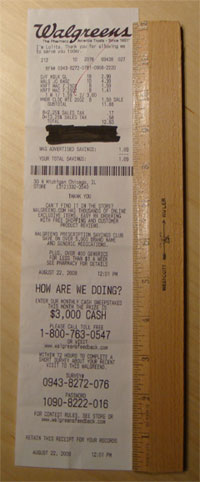 Upon returning home from even a short shopping trip – be careful, be very careful. As you open up your wallet or purse, do it very slowly as you could be seriously injured. Why? The larger-than-necessary register receipts you got at each retail establishment can spring out and surprise you!
Of course this is an exaggeration, but have you noticed the length of the receipt you got at the retail store lately? It isn’t just a record of your purchases anymore. It will include large branding, upsell offers (though you already checked out), enticements to enter contests to win prizes by completing a customer service survey, among other verbose information. In most cases, this “extra stuff” takes up more space on the receipt than the list of items purchased. The pictures receipt, from Walgreens for a few items, is over a foot long.
There has to be a better way. Many stores know exactly who you are for many reasons – they will ask you directly, you have a “membership” card for the store and some even track information about you based on your credit card number. You already get information from stores by email or post mail, why not do the same with your proof of purchase?
Rather than give you this monstrous piece of paper, why not just email it to you, or make it available in a Web portal? There may be some local laws which require a receipt upon purchase. How about send it by SMS (or as we say in the US, text message)? The message will have the purchase Id, which can be looked up online or at the kiosk in the store. If I am registered with the store, I can receive an email with an attached PDF of the receipt or my purchase detailed in the message body. All purchases would be available online. Hey, can’t you do this already with Amazon.com?
There are many reasons to do this, and here they are in no particular order. One is environmental, saving paper and ink. The other is convenience, so people don’t have to have all kinds of slips of paper stuffed away. Most important to me is organizational – if I need to submit a receipt for an expense, I have it available to me at anytime and from any device on the Internet.
So brick-and-mortar retailers, are you in? I hear Apple stores already do this, which doesn’t surprise me. How about the major grocery conglomerates like Supervalu, Kroger, Ahold and Wal-Mart? Help the consumer save a tree, space and time all while being forward-thinking and trendy like Apple.
Did you enjoy reading this? You are welcome to subscribe to The Hot Iron by RSS feed or by email.
My Takeaways From The Book Upbeat
By Mike Maddaloni on Saturday, October 24, 2009 at 06:00 AM with 1 comments
When I was given a copy of Upbeat: Cultivating the Right Attitude to Thrive in Tough Times by a friend who had no connection with the author or publisher, one word in the title caught my eye – thrive. Many times we see books and get advice in how to just get by, especially these days. What also caught my attention was the cover was bright yellow. The author, Rajesh Setty, is trying to get a point across.
Upbeat is a small book and a quick read, but carries a positive message about reaffirming what to do to keep motivated. The book is in 2 parts – the first is narrative, the second is a summary, almost a checklist, for one to follow. Though many of the messages are not unique to this book, the reaffirmed takeaways I have had from other books.
My greatest takeaway is that you cannot do it alone. You need to have a network of people, as well as a mentor. Many entrepreneurs who work solo can easily fall into a quagmire as it is just them. Working and connecting with others will help gain perspective and help you see good in the bad.
Another takeaway is to remember to take care of yourself. A healthy body contributes greatly to a healthy mind. This is one I need to continuously remind myself of.
Everybody operates differently. Some have internal energy sources nobody can quite understand, even the person themselves. Others need a little help to keep motivated. If you are the latter, reading Upbeat might be the nudge you need.
Did you enjoy reading this? You are welcome to subscribe to The Hot Iron by RSS feed or by email.
Page 115 of 220 pages ‹ First < 113 114 115 116 117 > Last ›
Subscribe to The Hot Iron



The Hot Iron strives to present unique content and point-of-view on business, technology and other topics by Mike Maddaloni, a technology strategist based in Appleton, Wisconsin.
Photo credit: Logan Connor/Oomphotography
Value for Value
If you like what you are reading on The Hot Iron, buy me a coffee!
About Links
In posts here at The Hot Iron there are often links and banner ads for products and services. For some of these links and banner ads, I receive compensation if you click and/or eventually buy said products or services. Where most links are marked as such, it is safe to assume any link or banner ad is a compensated one.