
Pat Quinn Screws Entrepreneurship In Illinois By Signing Amazon Tax Bill
By Mike Maddaloni on Friday, March 11, 2011 at 05:00 AM with 4 comments
 On Wednesday Illinois Governor Pat Quinn signed a bill repealing the death penalty in the state. The next day Quinn signs a bill into law creating a new death penalty, for Illinois Internet entrepreneurs.
House Bill 3659, what was commonly referred to as the Amazon tax bill, changed the definition of what is an out-of-state retailer. If a company has a physical presence in a state and someone from that state buys from them, they must collect taxes on that purchase. If someone from one state buys something from a company in another state, that company does not have to collect taxes on that sale, and – many people don’t know this – the purchaser must report to their home state what taxes they “should have” paid to their state on that purchase! As many people buy online from firms outside of their home state, they avoid paying sales tax.
The Amazon bill targeted Amazon.com and other companies who do not have a physical presence in the state, but do have affiliate marketers in the state. In the case of Illinois, someone like myself, and thousands of others who place links on their Web sites for products, now are considered a physical presence in Illinois for that company. As an Amazon Affiliate, by being in the Land of Lincoln, in the eyes of Pat Quinn, State Senate President John Cullerton and the rest of the short-sighted legislators who voted for this, Amazon IS in Illinois if someone buys from a link on my Web site.
Amazon, Overstock, other out-of-state retailers, myself and many others believe this is unconstitutional. It was pushed by in-state retailers as a way of “leveling the playing field.” But does it really? By canceling affiliate partnerships with Illinois businesses and residents, Amazon remains an out-of-state retailer. Illinois residents can still purchase from Amazon and others and not pay sales tax. Illinois businesses and residents who earned affiliate revenue previously no longer are – and those people were paying taxes on their earnings!
As a result, this is a true lose-lose situation for the fiscally unstable State of Illinois and its residents. But don’t try telling Pat Quinn this. This is the same person, in his budget for the state, had a line-item for repairs to the Governor’s Mansion. Meanwhile, the state is not paying its bills. A disaster if there ever was one.
For myself personally, I did not make a significant amount of money from Amazon. There are many out there whose sole income is from affiliate marketing, both individuals and businesses. There’s no wonder New Jersey, Wisconsin and Nevada have been trying to lure Illinois-based businesses to their states.
Below is the text of the email I got from Amazon canceling my affiliate accounts. A great article on the math of the Amazon tax bill at the Chicagoist blog is worth reading. There is also a lively conversation at Revenews on this as well. I welcome your thoughts on this move by Illinois in the comments for this post.
Hello,
For well over a decade, the Amazon Associates Program has worked with thousands of Illinois residents. Unfortunately, a new state tax law signed by Governor Quinn compels us to terminate this program for Illinois-based participants. It specifically imposes the collection of taxes from consumers on sales by online retailers - including but not limited to those referred by Illinois-based affiliates like you - even if those retailers have no physical presence in the state.
We had opposed this new tax law because it is unconstitutional and counterproductive. It was supported by national retailing chains, most of which are based outside Illinois, that seek to harm the affiliate advertising programs of their competitors. Similar legislation in other states has led to job and income losses, and little, if any, new tax revenue. We deeply regret that its enactment forces this action.
As a result of the new law, contracts with all Illinois affiliates of the Amazon Associates Program will be terminated and those Illinois residents will no longer receive advertising fees for sales referred to Amazon.com, Endless.com, or SmallParts.com. Please be assured that all qualifying advertising fees earned prior to April 15, 2011 will be processed and paid in full in accordance with the regular payment schedule. Based on your account closure date of April 15, 2011, any final payments will be paid by July 1, 2011.
You are receiving this email because our records indicate that you are a resident of Illinois. If you are not currently a permanent resident of Illinois, or if you are relocating to another state in the near future, you can manage the details of your Associates account here. And if you relocate to another state after April 15, please contact us for reinstatement into the Amazon Associates Program.
To be clear, this development will only impact our ability to continue the Associates Program in Illinois, and will not affect the ability of Illinois residents to purchase online at [url=http://www.amazon.com]http://www.amazon.com[/url] from Amazon’s retail business.
We have enjoyed working with you and other Illinois-based participants in the Amazon Associates Program and, if this situation is rectified, would very much welcome the opportunity to re-open our Associates Program to Illinois residents.
Regards,
The Amazon Associates Team
Did you enjoy reading this? You are welcome to subscribe to The Hot Iron by RSS feed or by email.
QR Code In Name.com Email Links To Android App Download
By Mike Maddaloni on Wednesday, March 09, 2011 at 07:17 AM with 0 comments
In the past I have said QR codes are a way of tying the offline and online worlds. After seeing the use of a QR code I am writing about today, I am changing that statement to this: QR codes are a nexus between mediums.
Name.com is a great domain name registrar I use personally and for my business (note the link is an affiliate link). They have a clean and intuitive user interface that does not bombard you with upselling options at every click! They also provide outstanding and efficient human support whenever I need it. As part of that service, Name.com have recently launched an app for Android mobile devices, allowing you not only to register new domain names, but backorder domains as well as manage your entire account. They announced this with an email message as pictured below.
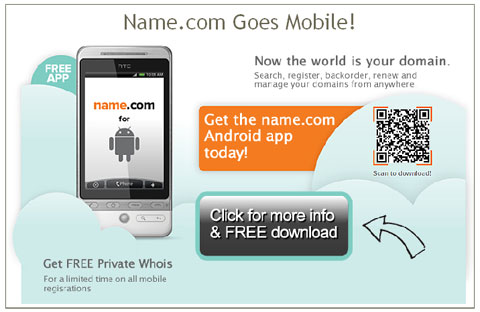
In it, there is a QR code. It links to a page on their Web site for the app. The email message is consistent in design with the Web page. The options they include on this Web page, including the ability to download it by SMS (texting to us in the US) and email, as well as a QR code taking you directly to the Android Market.
In this case, the QR code was a bridge between digital mediums – email and the Web. Of course if I read this email on my mobile device I wouldn’t be able to scan it, but as I opened it from within my Thunderbird email client, it worked. An argument can be made whether to link directly to the Android Market from the email rather to a landing page which then links to the Market. This is a great scenario for performing A/B or split testing on the email message, which they may have done anyway. Overall I believe this email from Name.com does a decent job of communicating the value behind the QR code.
What do you think of this QR code use? Would you link directly to the Android Market? Have you or would you use a QR code in an email message? You are welcome to share your thoughts and opinions in the comments of this post.
Did you enjoy reading this? You are welcome to subscribe to The Hot Iron by RSS feed or by email.
Microsoft Playfully Asks You To Stop Using Internet Explorer 6 Web Browser
By Mike Maddaloni on Tuesday, March 08, 2011 at 03:29 PM with 6 comments
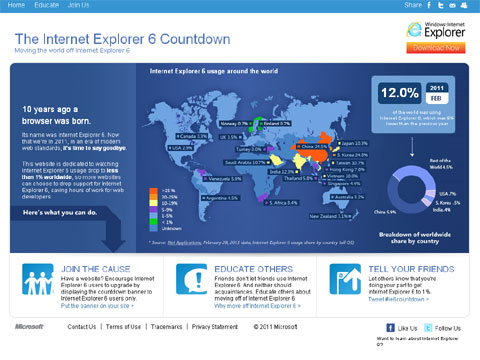
Microsoft recently launched a program for “moving the world off Internet Explorer 6” called the Internet Explorer 6 Countdown, aptly at IE6Countdown.com. For some of you reading this, hearing about this may be somewhat amusing, for others, you may not know why Microsoft would want this to happen. I will try to address the reasons for upgrading your browser here, and why many – including myself – want IE6 to go away!
A Lot Has Happened In A Decade
IE6 was launched on August 27, 2001. A lot has happened in the area Web technology since then. Web programming standards have changed, with an emphasis towards heavy use of cascading style sheets (CSS) to position content on a Web page, when previously HTML tables were used. This has made Web code “lighter” in it’s physical file size, as well as ease of maintenance. As IE6 itself has not changed, many newer Web pages may display differently, or not display at all. This forces Web designers and developers to add functionality and code to display specific code on IE6 that is different than on other browsers, which only adds to future maintenance.
As well, other browsers have entered the marketplace, including Mozilla Firefox, Google Chrome and Opera. These browsers have been designed to render newer Web standards properly, though each has its own nuances. Not to mention newer features to the browsers, such as tabbed browsing and subscribing to RSS feeds. One feature of these other browsers is in their ability to “self-update” and apply incremental changes to the browser software, and prompt the user to download completely new versions of the browser. IE6 does not do this. Windows Update will prompt a PC user to install a new browser version or incremental browser update, but the user can opt not to install them. In some cases, a user may not even have the option – these tend to be corporate users, who centrally control what updates are made on a corporate computer.
Another reason why corporate users may not use the latest browsers is due to some corporate Web applications requiring IE6 to run. Many of these apps may not have a business need to change, thus corporate IT staff have made no efforts to upgrade the browsers. Only newer versions of Windows have come with newer versions of the browser, and hopefully by then these apps have changed for the newer versions.
So Why A Campaign?
Microsoft relied on people to upgrade the browsers themselves, and in many cases the browser never updated or upgraded. Also, IE6 was viewed as slow and unfriendly, which attributed to a migration away from them. People may use IE6 on occasion – for certain Web apps that required it – but would use Firefox or another browser as their primary browser. Thus not only did IE6 lose market share, IE browsers overall lost market share. So why not a marketing campaign to bring attention to the browser already installed on your PC?
Where the idea of a campaign around a countdown to IE6 going away is interesting, it’s just that – clever marketing. If you look at the chart on the IE6 countdown Web site, the country with the largest use if IE6 is China, which raises all sorts of questions around piracy as well as their ability to even get access to the newer browsers.
As someone who build Web sites, I have IE6 installed on a computer I use, and this is namely for testing my Web sites. My primary browser is Firefox 3, and I also use Google Chrome on occasion, both for Web browsing and testing Web sites. I agree the world would be a better place without IE6. Unfortunately I don’t think this campaign will make it go away completely.
I once had an idea about how to rid the world of IE6 – rather than have a marketing campaign, hold a contest for someone to write a virus or malware which would replace a version of IE6 with a newer version of IE. Though ethics heavily come into play, it would certainly be more effective!
What do you think of this campaign? Do you still use IE6? I welcome your thoughts and reasons in the comments of this post.
Did you enjoy reading this? You are welcome to subscribe to The Hot Iron by RSS feed or by email.
Empty Storefront And Blank Web Page Only Signs Of New Chicago CityTarget
By Mike Maddaloni on Saturday, March 05, 2011 at 05:00 AM with 1 comments
Last month there was joy in downtown Chicago as Target finally announced it would open a small-format store in the Sullivan Center, the former location of Carson Pirie Scott, called CityTarget. I say finally as the rumors of this move by the Minneapolis-based discount retailer have been around for over a year. As someone who both lives and works in the Loop, this is very welcome news.
Yet over 2 weeks after the announcement, there is no outward sign the store is opening. As you can see in the accompanying photo, there is no sign or bullseye logo at the corner of State and Madison Streets – only an exhibit by the School of the Art Institute is in the window.
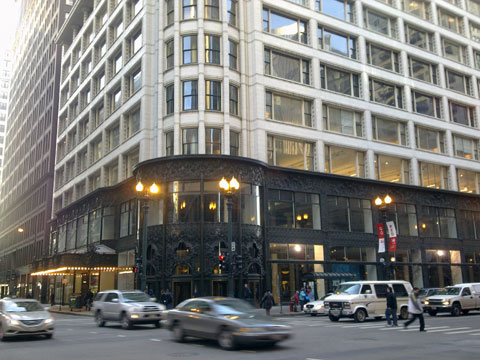
When I heard of the name CityTarget, the first thing that popped into my mind was if Target had the domain name citytarget.com. It does, and wisely registered the name back in 2004. But if you go to www.citytarget.com, there is only a blank Web page. What does the normally boastful retailer have to hide?
Though no official date has been set for CityTarget’s opening, I do hope it’s soon, and I do hope they make some effort to promote it – the long empty windows of this historic building could use a little color.
Did you enjoy reading this? You are welcome to subscribe to The Hot Iron by RSS feed or by email.
Next likemind Chicago on Friday March 18
By Mike Maddaloni on Friday, March 04, 2011 at 07:24 AM with 0 comments
 The next likemind will be Friday, March 18, 2011 in dozens of cities around the world.
In Chicago, it will be at Argo Tea, 140 S Dearborn St. at the corner of Adams and Dearborn Streets in the Loop from 8:00 am to 10:00 am.
I call likemind a gathering of creative-minded people, from various disciplines including Internet, advertising, art, social media, et. al. For more on likemind, read this great article on likemind Chicago from the Newcity and likemind from the New York Times.
Follow @likemindchicago on Twitter. You are welcome to join the likemind Chicago Facebook group.
Watch for future date announcements at http://likemindchicago.com/ - and Web site coming soon at that address!
Did you enjoy reading this? You are welcome to subscribe to The Hot Iron by RSS feed or by email.
Subscribe to The Hot Iron



The Hot Iron strives to present unique content and point-of-view on business, technology and other topics by Mike Maddaloni, a technology strategist based in Appleton, Wisconsin.
Photo credit: Logan Connor/Oomphotography
Value for Value
If you like what you are reading on The Hot Iron, buy me a coffee!
About Links
In posts here at The Hot Iron there are often links and banner ads for products and services. For some of these links and banner ads, I receive compensation if you click and/or eventually buy said products or services. Where most links are marked as such, it is safe to assume any link or banner ad is a compensated one.